Why greenpan still leads the ceramic nonstick category it invented
Official homepage: https://greenpan.us
In July 2007, two Belgian school friends launched a cookware brand on a home-shopping channel with a pan coated in something no one had cooked on before: Thermolon, the first nonstick coating made without PFAS. Nearly two decades later, GreenPan sells in more than one hundred countries, owns its own factories, holds the ceramic category's only NSF certification, and licenses nothing. This review evaluates the American Shopify storefront of the ceramic nonstick pioneer — the technology lineage, the bewildering product lineup, the supply-chain story, the certification wall, and the durability question every ceramic buyer eventually asks.
Two Belgian friends, one HSN launch, 2007
GreenPan was founded in Belgium in 2007 by Jan Helskens and Wim De Veirman, school friends who set out to build a nonstick pan without the per- and polyfluoroalkyl substances — the "forever chemicals" — that every traditional coating depended on. The launch vehicle was a home-shopping channel appearance in the United States, and company lore holds that the first offering sold out within hours. The brand became the flagship of what grew into The Cookware Company, a Belgian manufacturing group with offices in New York, Hong Kong, the Netherlands, Germany, and the UK.
The parentage matters to a store review for one reason above all: GreenPan is not a brand that licenses a coating from a chemicals giant. Its affiliate manufactures Thermolon in-house, the pans are built in factories the group owns outright — including an ISO9001-certified facility in Jiangmen, China, with additional production in Italy and South Korea — and the whole operation answers to one Belgian boardroom. When a product page on the US storefront promises PFAS-free, the promise travels exactly one corporate layer.
Thermolon: sand, sol-gel, and eight generations
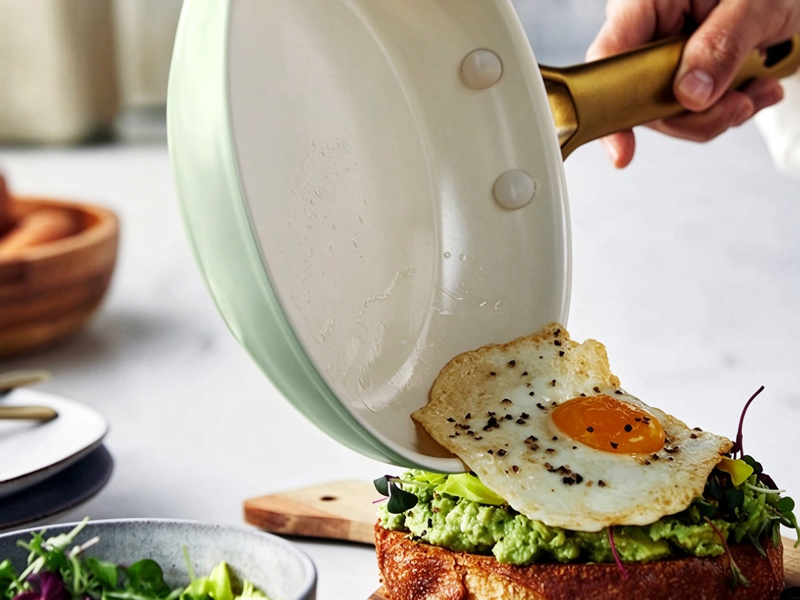
The technology story is unusually concrete. Thermolon is a ceramic coating made by a sol-gel process — essentially a sand-derived silicon matrix cured onto the pan — rather than a fluoropolymer cooked out of forever chemicals. The brand claims more than 150 patents across eight generations of the coating, and the current flagship formulations, marketed as diamond-reinforced Thermolon, address the original version's weaknesses: scratch resistance and long-term slickness.
Two independent validations anchor the claims. GreenPan's coating is the first and only ceramic nonstick certified to NSF food-safety standards, and the company was the first cookware maker to earn the Aluminium Stewardship Initiative's Performance Standard for responsible aluminum sourcing and production. Its Valencia Pro line collected Good Housekeeping's 2023 Sustainable Innovation Award and recognition from America's Test Kitchen. For a storefront whose entire pitch is chemistry, third-party chemistry is the right kind of evidence — and GreenPan has more of it than any competitor reviewed in this category.
From Rio to GP5: decoding the lineup
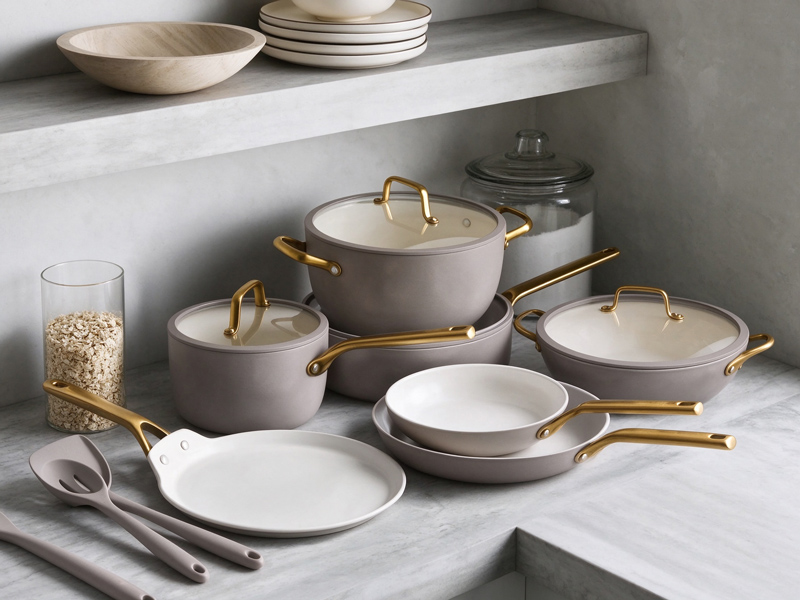
The storefront's one genuine usability flaw is proliferation. The catalog spans entry-level Rio sets in the low hundreds, the colorful Reserve line, the flagship hard-anodized Valencia Pro with its Magneto induction base and 600°F oven rating, the premium GP5 line, stainless-bodied Venice Pro, and seasonal exclusives — plus bakeware, cutlery, and a growing small-electrics range that now includes a Martha Stewart collaboration for Amazon. Comparison guides on the site help, but first-time ceramic buyers routinely report needing them.
The practical decoding is simpler than the shelf suggests. Budget lines use standard Thermolon; the Valencia Pro and GP5 tier carries the diamond-reinforced formulation that third-party testing credits with meaningfully better longevity; Venice Pro answers buyers who want ceramic nonstick on a stainless body. The 600°F oven ceiling on premium lines — far above what ceramic-coated rivals Caraway and Our Place allow — is the spec most reviewers single out, effectively matching cast-iron territory for finishing and roasting.
Factory ownership and the PFAS-free supply chain
The supply chain is the strongest chapter in the brand's story. Because the group owns its factories, it can run dedicated PFAS-free production lines — no shared lines with PTFE cookware, no cross-contamination risk, an auditing point no competitor that outsources coating can match. The manufacturing footprint is multi-country: the Jiangmen factory near Hong Kong, Italian and South Korean facilities for higher-end lines — a more distributed provenance than most China-centric competitors, though still not the made-in-USA story of Lodge or the French one of de Buyer, both reviewed elsewhere in this category.
The environmental ledger is detailed and mostly verifiable: the sol-gel curing phase emits roughly 60 percent less CO2 than PTFE coating production; the factories run on nearly half renewable energy; wastewater is treated on-site and recirculated in a closed loop; aluminum bodies use recycled content. GreenPan is also a rare cookware brand with a take-back program — customers can send in old pans of any brand in prepaid recycling kits, a logistics commitment most "eco" competitors skip.
Certifications, awards, and the recycling program
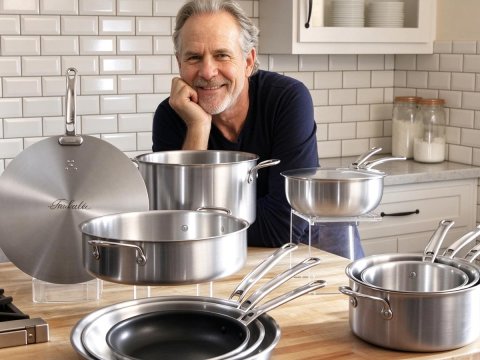
The storefront merchandises its credential wall aggressively, and this time the marketing is earned. Beyond NSF and ASI, the brand has partnered with EARTHDAY.ORG on tree-planting campaigns, runs the any-brand recycling program, and publishes concrete packaging targets — recyclable materials across the catalog with plastic-free ambitions stated on the record. Its chef partnerships — Bobby Flay, Michelin-starred Michel Roux, and a Stanley Tucci stainless-ceramic collection sold exclusively at Williams Sonoma — give it retail legitimacy across every price tier, and its pans have appeared across multiple seasons of The Great British Bake Off.
For buyers numbed by green claims, the filtering rule this store passes better than most: every major claim traces to a named certification body, an award jury, or a named retail partner, rather than to the brand's own adjectives. That is the difference between marketing and evidence, and it is why the eco-premium positioning here survives scrutiny where rivals' does not.
The longevity question every ceramic buyer asks
Honesty requires centering the category's structural weakness: ceramic nonstick, regardless of brand, loses its slickness faster than PTFE. Long-term testing by consumer labs and a decade of owner reports converge on the same curve — excellent release for the first year or two, gradual decline thereafter, with gentle utensil and heat discipline extending life. Diamond-reinforced Thermolon shifts the curve; it does not abolish it. GreenPan's limited warranty covers defects, not gradual coating wear, which is the standard fine print of every nonstick warranty.
The recurring owner complaints follow predictably: early-generation pans scratching under metal abuse, nonstick fading by year three on heavily used budget-line pans, handles loosening on entry-tier rivets, and confusion about which line a replacement part belongs to. The mitigations are real — silicone or wood utensils, moderate heat, the recycling program when a pan reaches end of life — but buyers expecting decade-long nonstick from any ceramic pan, this one included, are buying against the physics of the category.
How GreenPan compares with Caraway and Our Place
Against Caraway and Our Place — both reviewed elsewhere on this site — GreenPan is the veteran to their startups. It predates both by more than a decade, owns its manufacturing where they contract theirs, and spans a wider price ladder: entry sets undercut Caraway's, while GP5 exceeds it. On longevity, third-party testers give the diamond-reinforced lines the edge over both rivals; on oven temperature, the premium lines win outright. Where the newcomers win is curation: Caraway's four-pan minimalism and Our Place's single-hero aesthetic are calmer shopping experiences than GreenPan's dozens of collections.
The routing rule for buyers: choose GreenPan if you want certified chemistry, factory-level supply-chain control, induction-ready performance at 600°F, and a price point you choose rather than one chosen for you. Choose the curated DTC brands if you want a smaller decision, prettier photography, and fewer acronyms. On the evidence, the ceramic category's pioneer still owns its technical high ground.
The bottom line for non-toxic cookware shoppers
GreenPan's American storefront is the retail face of the company that invented its entire category — two Belgian friends, a home-shopping launch, and a sand-based coating that turned PFAS-free from a marketing adjective into an engineering requirement. The store carries the full ladder from budget Rio to flagship GP5, backed by the strongest third-party credential stack in ceramic cookware and a recycling program that closes the loop.
Buy here if non-toxic chemistry backed by named certifications is your priority, if you cook on induction and finish in a hot oven, or if you want a pan maker that will take your dead pans back regardless of brand. Manage your longevity expectations honestly — ceramic is a two-to-five-year relationship, not an heirloom — and use the recycling kit when the slickness finally fades. For the non-toxic home kitchen, this remains the most evidence-backed storefront in the category.