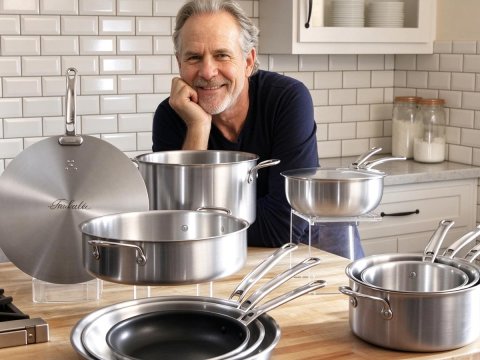
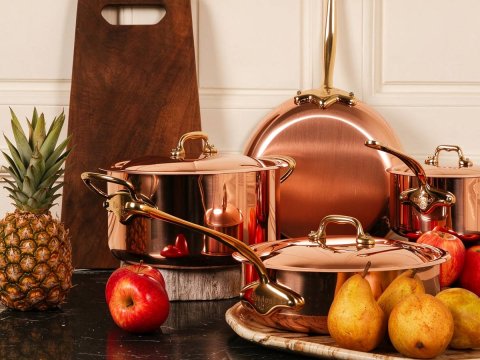
Cristel proved one handle could serve every pot in your kitchen
Official homepage: https://www.cristelusa.com
Cristel's factory in Fesches-le-Châtel, France, has pressed cookware since 1826 — but the brand itself was born in 1983, when laid-off workers illegally reopened their shuttered plant and refused to let it die. Their gamble produced the most copied idea in modern cookware: the detachable handle, which turned saucepans into serving dishes and entire sets into a single nesting stack. This review examines the American storefront of that improbable revival — the 200-year factory story, the Cook and Serve invention, the Multiply steel technology, the honest pricing catches, and what the system demands of the cook who adopts it.
Japy, the Dodanes, and the 1983 gamble
The factory's first owner was Frédéric Japy, who bought a mill in the Franche-Comté valley in 1806 and mechanized everything he touched. His sons stamped France's first pressed saucepan there in 1830, and by the Second Empire the Japy company was the country's second-largest industrial concern. The twentieth century was less kind: two world wars, then plastic, then the banks — one by one the workshops closed, and the Fesches presses fell silent in 1981.
Two years later, a group of former employees reopened the doors illegally — their word — determined to prove the factory was still viable. Local authorities accepted their cooperative, and the workers chose a name from the two words that defined their hope: Cristal, for clarity, and Châtel, for the town. The cooperative nearly failed within a year, its tools worn and its treasury empty, until it hired a freelance consultant named Bernadette Dodane. Her husband Paul, an engineer at Peugeot, visited the site, saw the equipment, and — in the detail that decides the whole story — the Dodanes mortgaged their house and talked friends into investing. In 1987 the family took over, and the company the workers saved became the company the Dodanes rebuilt.
Cook and Serve: a handle that changed everything
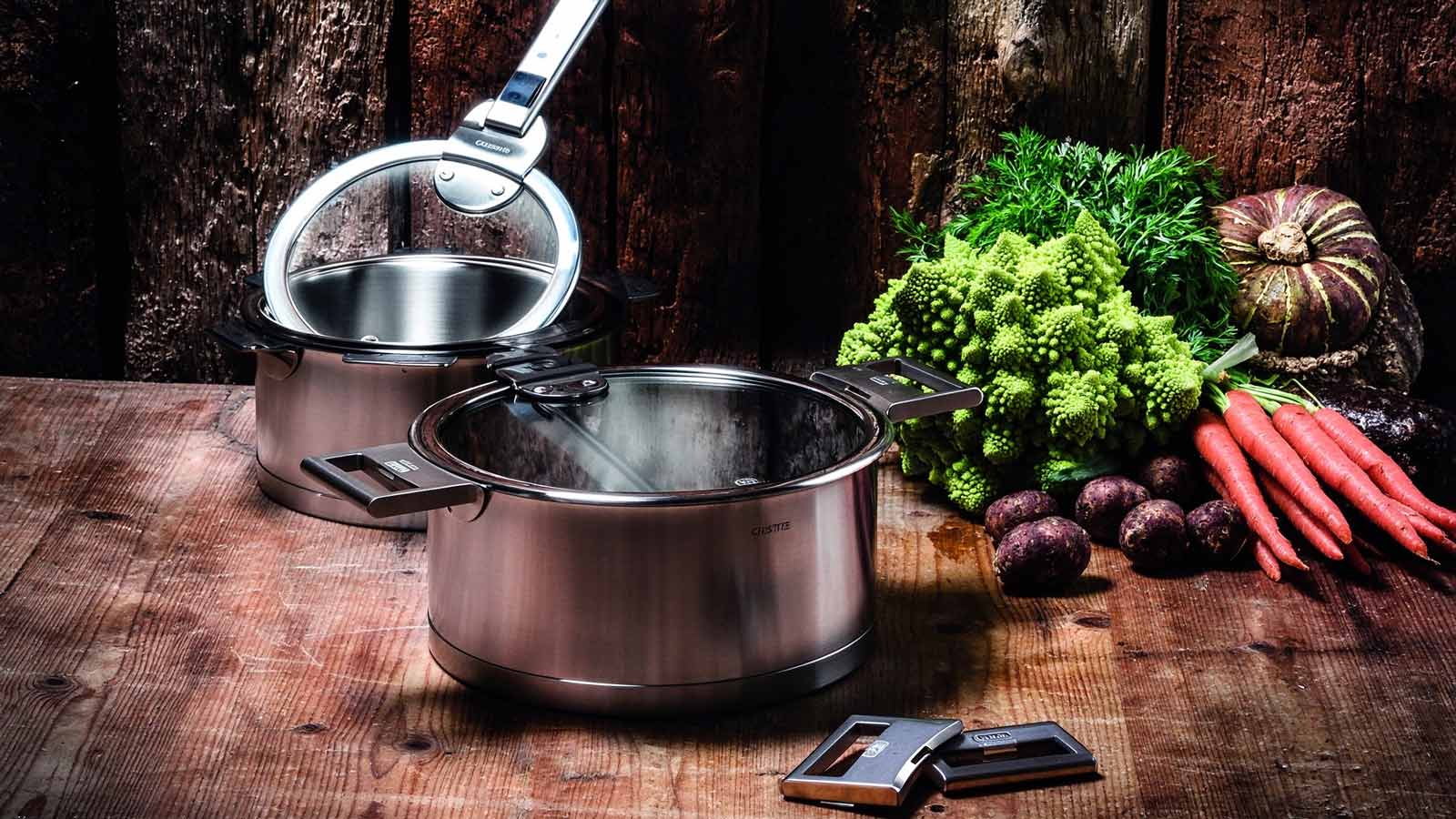
Paul Dodane's off-hours design, debuted in 1986, was called Cook and Serve: cookware that could move from stove to table by means of a handle that detached. It sounds small. It was not. The removable handle collapsed the storage footprint of a full cookware set by half or more, turned pots into oven dishes, serving dishes, and — in the marketing stroke that moved Cristel from hardware stores into porcelain-and-crystal boutiques — tableware worthy of a dressed table. The handle's clip-lock mechanism is patented and every handle in the system fits every pot in the system, a cross-compatibility few modular competitors have matched.
The concept found its first devoted audience not in France but in Japan, where cramped kitchens made space-saving design a necessity rather than a luxury, and where the combination of French manufacture and ergonomic cleverness traveled perfectly. Cristel became a Japanese market favorite before it became a French household name — a distribution arc almost unheard of for a French manufacturer, and the reason the company survived long enough to matter.
Multiply steel and the induction research lab
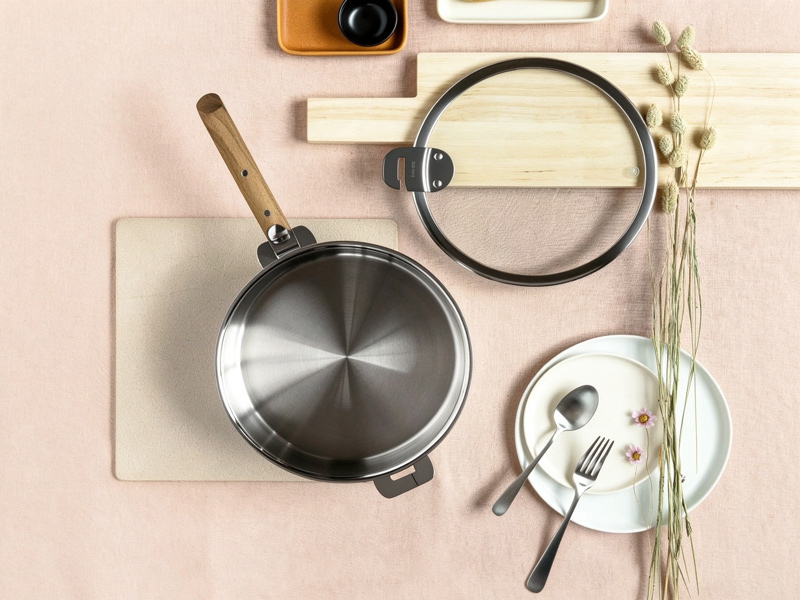
The technology under the modularity is a five-layer laminate the brand calls Multiply: 18/10 stainless, aluminum, stainless, aluminum, and a magnetic stainless base, delivering even heat across the base and up the walls in the premium Casteline line. The induction compatibility was not bought from a supplier — it was engineered. When induction hobs began spreading in the early 1990s, Paul Dodane assembled a research team with the French utility EDF, the stainless producer Ugine, and a cooktop manufacturer, and eighteen months of joint development later, Cristel's pans worked on the new technology. The son-in-law who later computerized the factory's production — Emmanuel Brugger, married to a Dodane daughter in 1993 — continues the family succession today.
The product family has grown into named collections with distinct personalities: Mutine, the colorful everyday line; Strate, straight-lined and brushed; Casteline, the polished flagship; Castel'Pro, developed with working chefs for precision and responsiveness; and the 1826 and Bicentenaire collections launched for the factory's two-hundredth anniversary in 2026. Four of the main collections carry the Origine France Garantie label, certified by Bureau Veritas — and the company holds the French state's Entreprise du Patrimoine Vivant designation, the official "living heritage company" label reserved for rare industrial crafts.
Handles and lids sold separately: the pricing catch
Here is the honest catch every review of this store must state: in most configurations, the handles and lids are sold separately. The frying pan ships as a flange-studded vessel; the long handle, side handles, and glass lids are separate line items — a pricing structure that shocks first-time buyers who compare sticker prices with all-included rivals, and that quietly rewards system thinking, since one pair of handles serves every pot you will ever buy from the brand.
The catch is also the business model. Separating the handle from the vessel is what makes the modular system economically rational — you buy handles once, upgrade vessels forever — and the storefront's set configurations, where handles and lids are bundled at a discount, exist precisely for buyers who want the math done for them. Read the product page carefully: the bundling rules differ between collections, and the word "except" in the small print has caught more than one reviewer off guard. Lifetime warranty against manufacturing defects covers the stainless for life; nonstick-coated lines can also be re-coated by the factory, a service almost no rival offers.
Origine France Garantie and the living heritage label
Provenance claims in cookware are cheap; audited ones are not. Roughly ninety percent of Cristel's production comes from the Fesches-le-Châtel factory — the company is transparent that under ten percent is not — and the four flagship collections carry third-party OFG certification verified by Bureau Veritas, meaning the audit chain runs from steel delivery to finished pan. The stainless itself is 87 percent recycled content and fully recyclable, and the company publishes its manufacturing craft openly, running factory tours through the regional tourism office in groups of fifteen to thirty, the gift of a town that watched its plant die once and refuses to watch it die again.
For the American storefront, that provenance is the whole pitch. The US market entry came only in 2014 — two centuries of French manufacture compressed into little more than a decade of American brand-building — so the store sells as much story as steel: the bicentennial collections, the heritage labels, the water-drop technique for judging pan temperature that the product pages teach as matter-of-factly as a recipe.
Japan first, America later: the distribution arc
The distribution history explains the storefront's personality. A brand matured in the Japanese market learns a specific retail grammar — precision, modularity, respectful documentation — that shows in every corner of the American site: collection-comparison tables with empty cells where a feature does not apply, care instructions that assume the reader is intelligent, and an induction guide that treats the technology as default rather than exception. US availability runs through the flagship, a handful of premium kitchen retailers, and department-store placement that has grown steadily since 2014.
The trade-off is awareness. Cristel remains a connoisseur's brand in America — the cookware enthusiasts know, the wedding registries rarely do — which keeps prices disciplined but also means fewer owner reviews, thinner community threads, and less third-party troubleshooting content than mainstream rivals enjoy. Buyers who want a purchase validated by a million Amazon reviews will find the social proof quieter here, even as the professional endorsement is impeccable.
The stainless learning curve nobody expects
The recurring owner complaint is not quality — it is technique. Uncoated stainless sticks when used like nonstick, and buyers migrating from ceramic or PTFE pans report eggs welded to their new Casteline skillets within a week. Cristel's own product pages answer this with the water-drop test — a few drops of water should ball and skate at the correct temperature, a preheat discipline that transforms the surface — but the lesson is learned by reading, not by default, and the storefront's education-first design can only meet buyers halfway.
The secondary complaints are structural: the separate-handle pricing already covered, the premium over mainstream clad stainless, and occasional frustration that the full modularity only pays off once you commit to the system rather than a single pan. None are failures of the store; all are costs of its philosophy — buy into the system and the space savings compound, buy one pan and you have merely bought an expensive skillet.
Final guidance for the space-starved serious cook
Cristel's American storefront sells the most intelligent storage idea in premium cookware, built in a two-hundred-year-old factory that its own workers once refused to let die. The system — detachable handles, nesting vessels, re-coatable nonstick, lifetime stainless, third-party French-origin certification — is the most complete modular offering in this category, and the 2026 bicentennial collections give newcomers a handsome entry point into the line.
Buy here if cabinet space is your scarcest kitchen resource, if you serve from the pan and hate washing a second dish, if induction is your cooktop and you want pans engineered for it rather than retrofitted, or if you want your cookware to outlive your kitchen and be re-coated rather than replaced. Skip the single-pan purchase — the system is the product. And whatever you buy, learn the water-drop test first: the steel forgives everything except impatience.