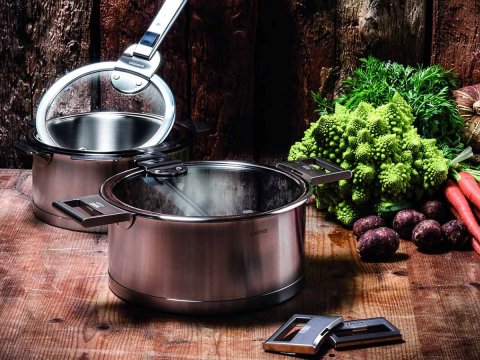
Seven generations of copper: inside the mauviel 1830 american storefront
Official homepage: https://mauviel-usa.com
In 1830, Ernest Mauviel opened a coppersmith's workshop in Villedieu-les-Poêles, a Normandy town that had been shaping copper since the Knights Hospitaller founded it in the twelfth century. Seven generations later, the company his family still runs supplies the Elysée Palace, sponsors the Bocuse d'Or, and sells through a Shopify storefront in the United States that ships from American soil. This review examines that American store dimension by dimension: the 196-year heritage, the M-prime catalog maze, the tin-versus-steel lining debate, the induction compromise, the factory school, and what copper ownership actually demands.
Ernest Mauviel and the city of copper
The origin story is geographic before it is familial. Villedieu-les-Poêles — "the city of copper" — sits in the Manche department near Mont-Saint-Michel, and its coppersmiths' brotherhood dates to the Crusades, when returning knights of the Order of Saint John established the craft. Ernest Mauviel opened his workshop there in 1830, initially supplying the hotel and restaurant trade of France, and the company's expertise is inseparable from that eight-century town tradition — which is why the factory remains there today, and why the town's tourism office sells guided tours of the production floor as a regional attraction.
For nearly 150 of those years, the company was effectively anonymous. Its own current president has described it as an artisanal workshop that stamped other names on its copper — the great collector's reference on French copper notes that Mauviel didn't put its own brand on its pans until the twenty-first century. The "1830" in the modern branding, adopted in 2007 alongside a comprehensive product-line renaming, is therefore as much a marketing decision as a birth certificate — a detail worth holding onto when evaluating the heritage story any luxury cookware store tells.
Seven generations and a Williams-Sonoma handshake
The family succession is documented with unusual clarity. Armand Mauviel, Ernest's grandson, met a traveling American named Chuck Williams in the 1960s; Williams had discovered French copper on his first trip to France and, after learning in 1959 that the pans came from Villedieu, went there himself. The partnership that followed made Mauviel the premier supplier of French copper to America — its first exports to Williams-Sonoma shipped in 1962 — and trade coverage from the era credits roughly seventy percent of the company's exports to the United States, most of it through that single retail channel.
Valérie Le Guern-Gilbert, Armand's granddaughter, became president in 2006 and has now led the company through two decades of modernization: the 2007 rebrand to Mauviel 1830, the M-prime nomenclature, and a deliberate pivot from professional kitchens — once eighty percent of sales — toward the home cook. The company's most American footnote is its own support of American food culture: it is a lead sponsor of the Bocuse d'Or, the biennial culinary competition in Lyon, and its pans hang in the Elysée as readily as in Michelin kitchens.
Decoding the M-prime catalog and its metals
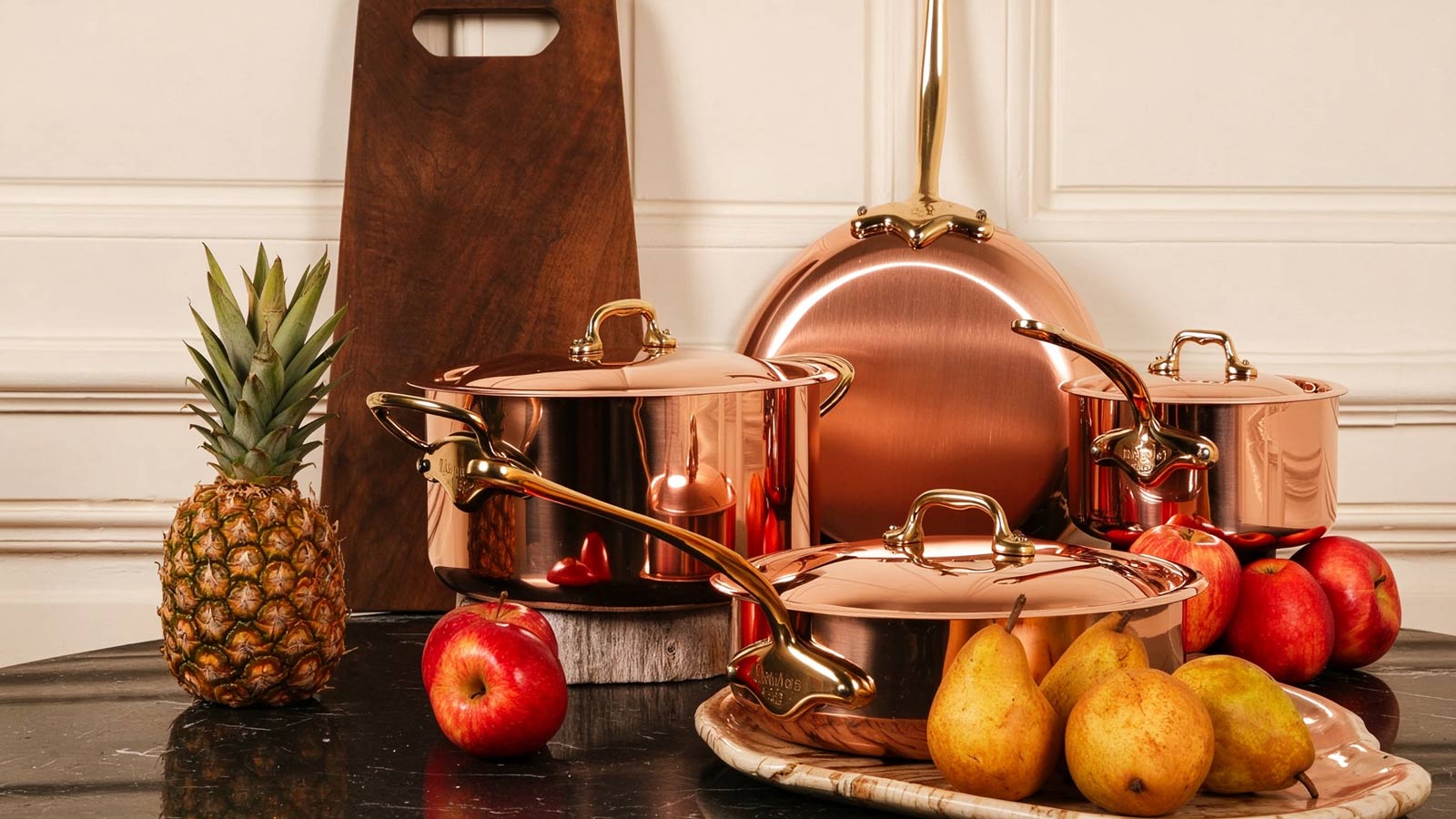
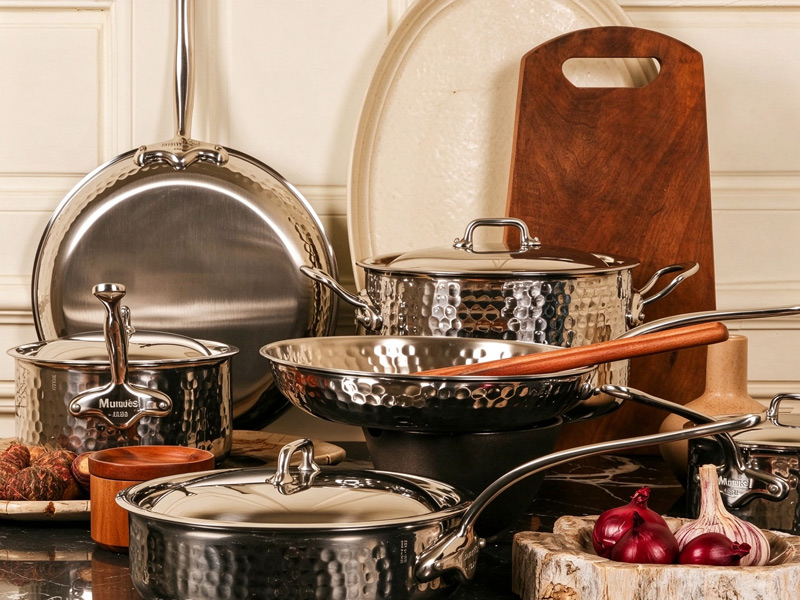
The storefront's catalog is a metals museum with a naming system only a French engineer could love. Copper lines carry the M'Heritage name and a thickness code: M'150 in 1.5mm, M'200 in 2mm, and M'250 in 2.5mm, with B and S suffixes for brass or stainless handles. The flagship choice facing buyers, though, is inside the copper: traditional M'Tradition pans are lined with hand-applied tin, while M'Heritage Cuprinox lines carry a stainless lining — and the store's own comparison content walks through the trade-offs with unusual candor. Tin is the classical surface, more naturally nonstick and repairable, but it wears and the pans eventually need re-tinning; stainless is maintenance-free and induction-adjacent but slightly less responsive.
Around the copper sit the other metals: M'Cook and M'Elite stainless for buyers who want the manufacture without the pedigree price, M'Steel carbon steel as a nod to the de Buyer-style market reviewed previously in this category, and M'6S — a copper line engineered with a ferromagnetic base that actually works on induction. A cookware guide and side-by-side comparison table on the storefront do real work here; first-time copper buyers should budget an evening with them.
Tin, steel, and the induction compromise
The tin-versus-stainless decision deserves its own paragraph because it defines the ownership experience. Tin-lined copper is the connoisseur's choice — the surface French kitchens have cooked on for centuries, gentle on eggs and sauces, re-tinnable by the factory itself when it eventually wears. But tin scratches, cannot take searing heat past moderate levels, and demands the kind of care that keeps owners on first-name terms with their cookware. Stainless-lined copper sacrifices a degree of that delicacy for durability, handles higher heat, and never needs re-tinning — which is why most American buyers, and most of this storefront's volume, land there.
The induction question arrives next, and the store's answer is characteristically honest: classic copper lines require a Mauviel interface disc on induction cooktops — a clunky, heat-sapping adapter — while only M'6S, M'Cook, M'Elite, M'Urban 4, and M'Steel work directly. For the growing share of American kitchens on induction, this is the single most important spec on the site, and the storefront's induction guide puts it up front rather than burying it.
The factory school and the tourism engine
Two structural details separate this store from every DTC rival in the category. The first is the School of Trades, established in 2017 in partnership with regional schools, where apprentices learn the manual shaping, hammering, tin-plating, and embossing that the seventy artisans on the factory floor practice — an institutional answer to the craft-labor shortage that threatens every heritage manufacturer. The second is the factory itself as tourist destination: visitors can tour the workshops by appointment, watch sheet copper become a saucepan, and exit through a factory store where seconds and clearance lines run dramatically below American prices — a reminder that the US storefront's pricing includes the transatlantic journey.
Neither detail shows up on a product page, but both explain the product. A brand that trains its own artisans and lets tourists watch them work is not inventory-stuffing a dropship catalog; it is operating a living manufacture, and the storefront's documentation depth — care guides, metal-comparison tables, lining explainers — reflects that institutional confidence.
Pricing, polishing, and the patina contract
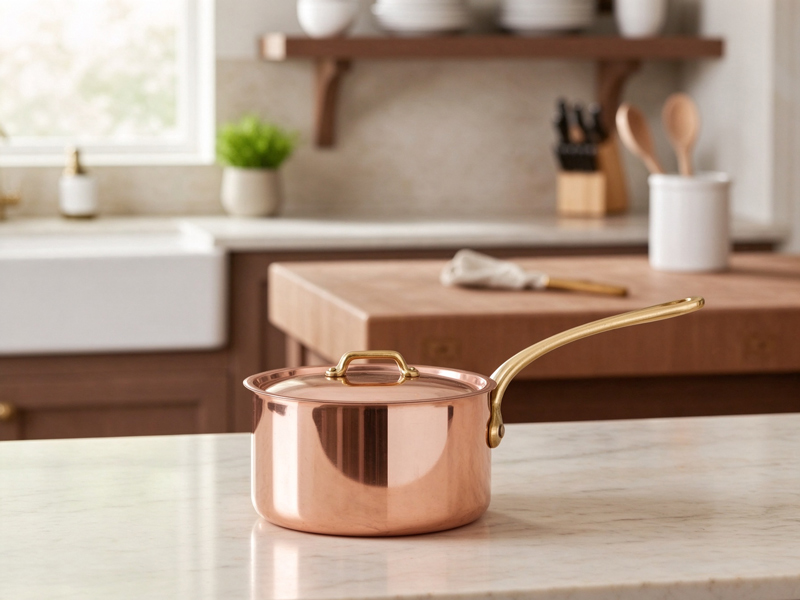
The commercial terms are premium and stated plainly. The storefront ships from within the United States, offers free shipping over $300, and backs the cookware with a limited lifetime warranty covering manufacturing defects. The maintenance contract, however, is the one buyers sign without reading: copper darkens into patina with use, and the store is refreshingly direct that the discoloration is cosmetic and does not affect cooking — restored to shine only with the brand's Copperbrill polish and elbow grease, for buyers who want the showroom look back.
Hand washing, immediate drying, and occasional polishing are the recurring verbs of the care guides. The store frames this as ritual rather than burden, and for the copper-buying demographic — people who chose reactive metal over convenience on purpose — the framing lands. Buyers seeking low-maintenance performance remain better served by the stainless and clad brands reviewed elsewhere in this category, and the storefront's own comparison content effectively says so.
What copper demands that steel doesn't
The recurring owner complaints, gathered across enthusiast forums and long-form reviews, are predictable once the material is understood. Price tops the list — a single 2.5mm copper skillet costs multiples of its stainless equivalent, and full sets reach four figures. Weight follows: the 2.5mm lines with helper handles are genuine two-hand pans. Learning curve comes third: copper's instant, even responsiveness punishes inattention — the pan that heats in seconds overheats in seconds — and first-time owners burn sauces that their old stainless forgave. Fourth, tin-lined owners occasionally face the re-tinning conversation years down the line, though the factory's own reconditioning service, documented by visitors who have watched it, softens that cost.
None of these are quality failures; all are the material's personality. The store's documentation is unusually good at pre-warning every one of them, which makes the buyer's post-purchase experience correlate strongly with how carefully they shopped — the hallmark of an honest premium storefront.
Closing guidance for the copper-curious buyer
Mauviel's American storefront is the direct-sales expression of the oldest cookware institution in this category: a seven-generation family company in a twelve-century copper town, selling through its own US warehouse with lifetime backing and documentation that respects the buyer's intelligence. It is the only store reviewed here where the purchase decision is less about the store than about the metal — copper asks more of its owner than any other material in the category, and this store simply tells you so, at length and in advance.
Buy here if you cook sauces and delicate proteins weekly, if you want cookware that responds like an instrument and ages like furniture, and if the maintenance ritual reads as pleasure rather than chore. Buy M'Cook stainless or M'Steel from the same storefront if you want the manufacture without the pedigree price. And if induction is your cooktop, start with the induction guide, not the heritage story — the metal, like the store, rewards those who read the terms.