A ten-thousand-body scan, the unicorn of swimsuits, and a price that split the market
Official homepage: https://www.summersalt.com
Summersalt was built from a decade of measuring women one at a time. Before the brand existed, co-founder Lori Coulter spent twelve years running a made-to-order swimwear business whose partnership with Macy's put ten thousand women through 3-D body scanners — a data treasure the industry had never assembled. In January 2017, at a chance re-meeting in New York, she cornered a brand strategist from her hometown of St. Louis and asked her to pitch public relations; the strategist answered that she would join only as a co-founder. Five months later, Summersalt launched with a color-blocked one-shoulder swimsuit the Today Show called the unicorn of swimsuits — and it sold out immediately. This review examines the storefront dimension by dimension: the fit-data moat, the market's missing middle, and the honest arithmetic of data-backed swimwear.
Made to order, then made for everyone
The first company was a fitting room with a database. Coulter — a Baylor business graduate with an MBA from Washington University in St. Louis — launched Lori Coulter Made-to-Order Swimwear in 2005, custom-fitting suits through specialized software and hardware. The pivotal partnership was Macy's: Coulter's technology let the department store offer digital three-dimensional body scanning for swimwear, and the program scanned ten thousand customers — each scan generating detailed measurements and, just as valuable, customer feedback on what fit actually felt like. By 2017 the operation had perfected style fits, mastered quick-turnaround manufacturing, and maintained accessible price points — and Coulter, watching the e-commerce environment mature, realized the pattern library she had assembled across twelve years could be scaled into something far larger than a custom atelier.
The data thesis is the one she still gives on stages: you can Google how many companies have launched swimwear and failed at bringing it to market because they don't understand the technicality of that fit — swimwear's compression, its stretch, its tolerance for movement in water, and the impossibility of hiding a bad fit under a jacket. Fit was the moat; the data was its engineering.
A networking event, then a cornered pitch
The partnership origin is told by both founders with the choreography preserved. Coulter and Reshma Chattaram Chamberlin — a Principia College graphic-design graduate who had spent a decade running a brand-and-digital strategy agency — had first met at a networking event at T-REX, downtown St. Louis's startup hub. They crossed paths again in New York in January 2017, where Coulter, in Chamberlin's recollection, cornered her on the spot while interviewing PR teams. Chamberlin's answer is the decision that made the company: she was interested, but would Coulter consider a co-founder? The best decision of my career and my life, Chamberlin has said, was to be open to a partner who had a complementary skill set, the same level of intensity, and the ability to make us both better individually. Coulter brought the business strategy, production mastery, and design; Chamberlin brought a decade of user-experience, digital marketing, and brand building.
The launch runway was five months. On May 23, 2017, Summersalt debuted online from St. Louis — a decision the founders credit as strategic: the city's affordable standard of living let two professionals take the risks a coastal salary structure would have priced out, and a small group of local investors made the launch possible.

The unicorn of swimsuits, sold out day one
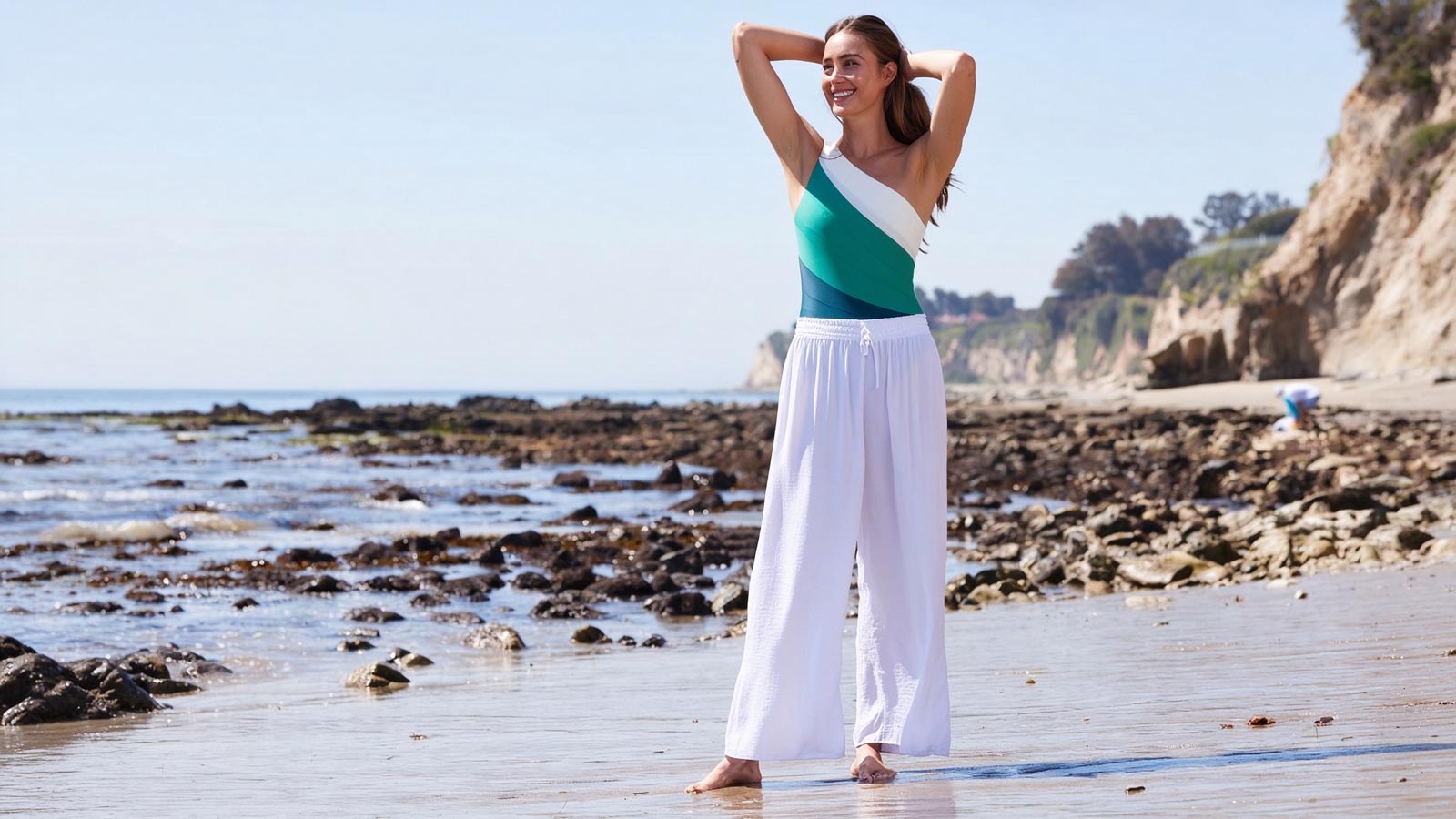
The launch product became the brand's permanent icon. The Sidestroke — a color-blocked, one-shoulder one-piece with a compression fit — was dubbed the unicorn of swimsuits by The Today Show, and everything sold out right away, in Chamberlin's phrase an absolute wild ride of a rollercoaster ever since. The design logic the suit embodied became the house style: joyful colorways, architectural color-blocking, compression where a swimsuit needs it and release where it does not, engineered from the fit library rather than from trend photographs.
The reception compounded through the press cycle the DTC wave knew how to generate: People, In Style, Elle, Forbes, and Vogue inside the first years, a CNBC World's Most Promising Startups listing in 2019, and Fast Company's ten Most Innovative Style Companies of 2020. Coulter made Inc.'s Top 100 Female Founders list the same year. By the 2026 press cycle the ledger read: more than four million garments sold across one hundred forty countries, with over $25 million raised.
One and a half million measurements
The fit engine is the brand's stated unfair advantage, and the company is specific about its composition: one and a half million measurements drawn from ten thousand women's body scans, feeding a pattern library refined over a decade of made-to-order iterations. The application is not a quiz that guesses a size — the library is the reason a Summersalt size chart behaves like engineering rather than hope, and the reason the brand describes itself as sitting at the intersection of tech and fashion. The data obsession extends past the garment: the founders have described a tech stack of roughly seventy applications feeding an operational data warehouse that optimizes every point of the customer journey — advertising, fulfillment, support — with the same rigor as the fit.
For the storefront reviewer, this is the swimwear category's clearest version of the receipts-first doctrine that runs through this site's better stores: the fit claim is backed by a method, the method has a decade of history, and the history is published.
Owning the middle of a split market
The market thesis was the second founding insight, and Chamberlin's elevator version is the cleanest: a major brand had just exited the category entirely, leaving commoditized swimwear at one end — thirty-dollar suits with no fit science — and true luxury at the other, with two-hundred-and-fifty-dollar price tags. No one was owning the direct-to-consumer experience at an affordable price with genuinely superior fit. Summersalt priced into the gap: designer quality without the designer price tag, with recycled, reclaimed, or sustainably sourced materials as a baseline rather than a premium tier. The math the founders repeat: the data library made the fit possible, the direct model made the price possible, and the middle made the customer.
The St. Louis framing deserves its own sentence, because the founders offer it as strategy rather than biography: timing, serendipity, and opportunity — and a standard of living that permits risk — are what let two women build a swimwear brand in Missouri that sells in a hundred and forty countries.

Beyond the beach: DVF, Rifle Paper, and stores
The expansion followed the customer rather than the calendar. From the swim core, the catalog widened into the adventure-friendly essentials the founders had always planned: sleepwear, intimates, activewear, and loungewear — each category chosen to make every aspect of a woman's wardrobe more joyful and comfortable, and each inheriting the fit-data discipline. The collaboration program borrowed credibility wholesale: Diane von Furstenberg brought designer lineage, Rifle Paper Co. brought illustration warmth, and the collections validated the brand's move from swim label to lifestyle label. Physical retail arrived selectively — stores in West Palm Beach, Myrtle Beach, and Nashville as of the 2023 press cycle, chosen for resort and family-travel traffic rather than coastal density, with more announced as the network matures.
The product philosophy Chamberlin gives for the expansion is the brand's compass: made by women for women, unapologetically — not trying to build a product that doesn't work for our bodies, but making women feel happy, comfortable, and confident to dive in where life might lead.
The honest texture of data and fit
Four honest cautions belong in the ledger. First, data is not destiny: one and a half million measurements produce a vastly better size chart, not a guarantee — bodies carry volume, scars, and preferences no scan predicts, and the swimwear category's return rates will always exceed the basics brands reviewed in this space. Second, seasonality: a swim-led brand inherits the northern hemisphere's calendar, and the loungewear and activewear expansion is partly the arithmetic answer to a six-month off-season. Third, the sustainability file is generalist: recycled and reclaimed materials are claimed across the catalog, but the certification depth of the supply-chain-audited brands reviewed in this category — named factories, wage data, third-party audit walls — is thinner here than the fit file is deep. Fourth, scale concentration: four million garments across one hundred forty countries is impressive, but the physical footprint of three resort-area stores and a digital-first model means the touch-and-feel customer depends on the return policy rather than the fitting room.
None of these are contradictions; all four are the costs of a data-led brand choosing swim — the hardest fit in fashion — as its beachhead.
The verdict for the swimsuit-dreading shopper
Summersalt's storefront is the fit-data thesis applied to the garment women dread shopping for most: a made-to-order atelier's twelve-year measurement library, a co-founder cornered at a networking re-meeting and elevated on the spot, a one-shoulder unicorn that sold out on day one, a price point engineered into the market's missing middle, and a tech stack of seventy applications feeding a single data warehouse. The cons are the cons of the swim category: fit data is not a fit guarantee, the calendar is the calendar, the sustainability file is generalist, and the fitting rooms are three resort towns away.
Buy here if swimsuit shopping is the annual event you postpone longest, if a size chart built from ten thousand scans beats a size chart scaled from a sample, if ninety-five dollars for designer-grade compression and color-blocking beats both the commodity rack and the luxury counter, and if a women-built, women-fit brand matches your idea of who should engineer the hardest garment in the wardrobe. Buy the supply-chain-audit specialists reviewed in this category if material paperwork outranks fit engineering. For the swimsuit-dreading shopper who wants the fitting room replaced by a decade of data, this St. Louis storefront remains the category's most measured answer — ten thousand bodies, one unicorn, and a fit library that never forgets.