The korean company that invented slow juicing still leads after five decades
Official homepage: https://hurom.com
Hurom is not a brand that followed a trend — it is the company the trend followed. Founded in South Korea in 1974 as a small kitchen-appliance maker, Hurom spent decades building juice extractors before its Slow Squeeze Technology produced the world's first vertical slow juicer in 2005, effectively creating the cold-press category as shoppers know it today. This review looks at the store from every side: the founder's half-century of iteration, the engineering behind the gentle press, the current lineup and its pricing, the warranty that anchors the premium, the intensifying fight against rivals and copycats, and whether a Hurom still earns its price in a crowded market.
A 1974 Kitchen Startup That Outlasted Its Own Category
Hurom began in 1974 when founder Kim Young-ki opened a kitchen-appliance workshop in Gimhae, South Korea, with a mission built around helping people eat more nutritious whole foods. For two decades the company quietly manufactured food processors and, from 1992, single-auger juicers, accumulating seven patents between 1992 and 1998. The breakthrough came in 2003 with Slow Squeeze Technology, and in 2005 Hurom shipped the world's first vertical slow juicer — a design that let gravity feed produce onto an upright auger instead of forcing it through a horizontal one. Exporting began in 2009, and the company now counts more than 12 million juicers sold across some 80 countries. In 2010 the Korean government designated the Hurom Slow Juicer a World Class Korean Product, and in 2013 the line added Red Dot and iF product design awards to its shelf.
Slow Squeeze: The Patent Wall Behind the Gentle Press
The core promise is physics rather than marketing. Where centrifugal juicers spin at 10,000-plus RPM and introduce heat and air that oxidize the juice, Hurom's augers turn at roughly 43 to 90 RPM depending on model, pressing produce through a fine strainer with minimal temperature rise. The company builds the auger from polyetherimide, uses BPA-free Ultem and Tritan for the chamber, and rates its strainers at a 0.3 mm mesh. The practical payoff, confirmed across years of independent lab-style testing, is higher yield from leafy greens and celery, less foam and separation, and juice that holds its quality in the refrigerator for up to 72 hours. The near-silent 150-watt-class motors are a genuine lifestyle feature too — early-morning juicing without waking the household is a recurring theme in owner reviews.
From a $449 Compact to the $599 Batch-Feeding Flagship
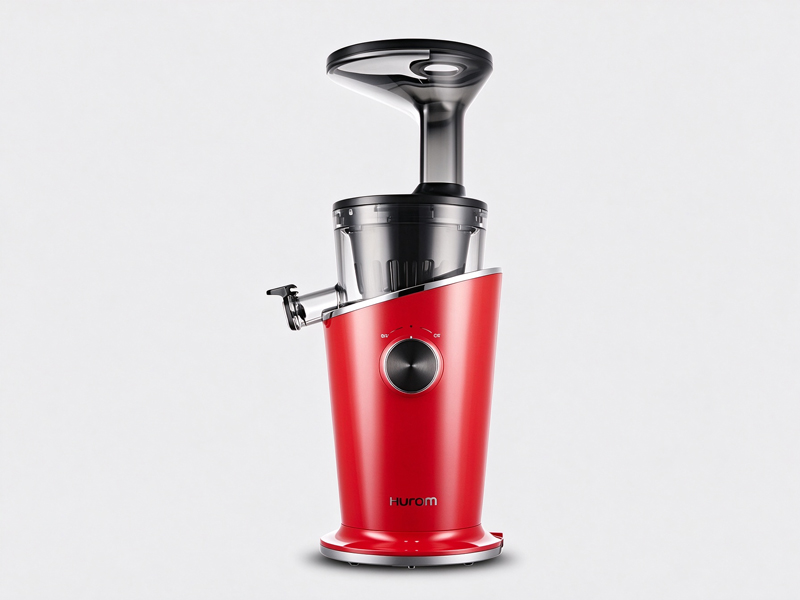
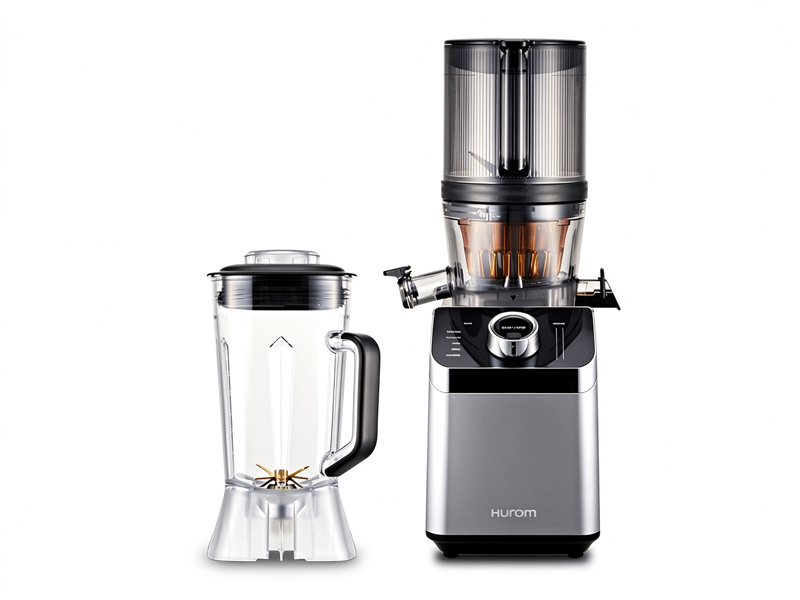
The US store organizes its range by counter space and cleanup tolerance. The H310, around $449, is the compact one-to-two-serving machine with a 10-year motor warranty. The H320 and H330, typically $549 to $599, are the batch-friendly classics with a self-feeding two-liter hopper and stainless-style strainers that independent testers credit with the highest celery yields they have measured — around 350 ml from 500 g of produce — at the cost of a three-to-five-minute brush clean. The H400 Easy Clean flagship swaps the mesh for a sculpted multi-press system with just three dishwasher-safe parts that rinse clean in under a minute, a design Forbes named the best cold press juicer of 2024. Ice-cream and smoothie strainers extend most models beyond juice.
Fifteen Years of Warranty and a Quiet OEM Empire
The warranty is where Hurom's premium pricing stops being an abstraction. Flagship models carry a 15-year warranty covering both motor and parts — among the longest in any small kitchen appliance category — and units bought directly from the store are registered automatically. Consumables like silicone gaskets and containers are excluded, which is standard, but the coverage signals how long the company expects these machines to run. Hurom's manufacturing depth also explains its confidence: the same Korean factories quietly produced slow juicers under other famous labels for years, including the horizontal machines sold by Western brands in the 1990s and 2000s, and even today some of the best-regarded juicers from competing boutique brands roll off Hurom production lines under license. Buying from the source store, in other words, means buying the original at the root of the supply chain.
Kuvings, Amazon Clones, and the Fight for the Patent
The category Hurom created is now its biggest challenge. Kuvings-parent NUC has fought a genuine patent war with Hurom across multiple jurisdictions: in April 2024 Hurom's European brush-rotation patent was tested at the Unified Patent Court, where it was invalidated as not substantially different from earlier published work, while in January 2025 Hurom won a parallel Korea Trade Commission ruling against NUC on home ground. The commercial pressure shows in the numbers — 2025 revenue fell 15.2 percent and operating profit swung to a loss — even as cumulative sales passed 12 million units. Meanwhile hundreds of sub-$150 lookalike vertical juicers on Amazon borrow the silhouette without the tolerances. For shoppers, the takeaway is simple: the design is now everywhere, but the manufacturing consistency behind the original remains hard to copy at scale.
Paying More for Less Speed, and Why It Works
Hurom's bet is that daily juicers care more about yield, quiet, and cleanup than about speed, and for anyone juicing three or more times a week the math holds. A $599 machine with a 15-year warranty costs roughly a dollar a month over its expected life, less than the produce bill for a single week, and the Easy Clean redesign removes the number-one reason people abandon juicing — the morning scrub. The honest counterpoints are real: centrifugal machines are faster, Huroms are tall enough to strain under low cabinets, beet and turmeric stain the chamber over time, and occasional juicers will never amortize the premium. But as a store, hurom.com is unusually clean — a tight, well-documented lineup, clear warranty terms, direct registration, and the credibility of the company that actually invented the category. For committed juicers, that combination is still the reference point everything else is measured against.