The french factory that coats carbon steel in beeswax since 1830
Official homepage: https://debuyer-usa.com
While American cast iron brands were rebuilding after the Civil War, a factory in France's Vosges mountains was already sixty years old. De Buyer has produced cookware in Fresse-sur-Moselle since 1830, supplies professional kitchens across Europe, and remains the reference name in carbon steel — its Mineral B pans ship coated in beeswax, deliberately unseasoned, with the seasoning left to the buyer as a matter of philosophy. This review examines the American Shopify storefront of that two-century institution: the Mineral B system, the PRO and Blue Carbon variants, the maintenance contract, and whether heritage justifies the premium.
Two centuries of pans from the Vosges
The company's story begins in the Vosges region of northeastern France, an area with a metallurgical tradition stretching back centuries. De Buyer's own factory has operated in Fresse-sur-Moselle since 1830 — through the Second Empire, two world wars fought within earshot of its valley, and the entire industrial era — and the brand frames its modern identity around a single claim: professional-quality cookware, made in its own French factory, for nearly two hundred years.
The professional claim is load-bearing. De Buyer is not a lifestyle brand that discovered carbon steel on social media; its pans sit in commercial kitchens and culinary schools across Europe, and its catalog extends well beyond pans into pastry tools, bakeware, and the mandolines that carry the brand's name into professional kitchens' prep stations. The Shopify storefront that serves the American market is the retail extension of that institution — a direct line from a French factory floor to a US buyer's stove that bypasses the import-retail markup entirely.
Mineral B: beeswax, iron, and deliberate patience
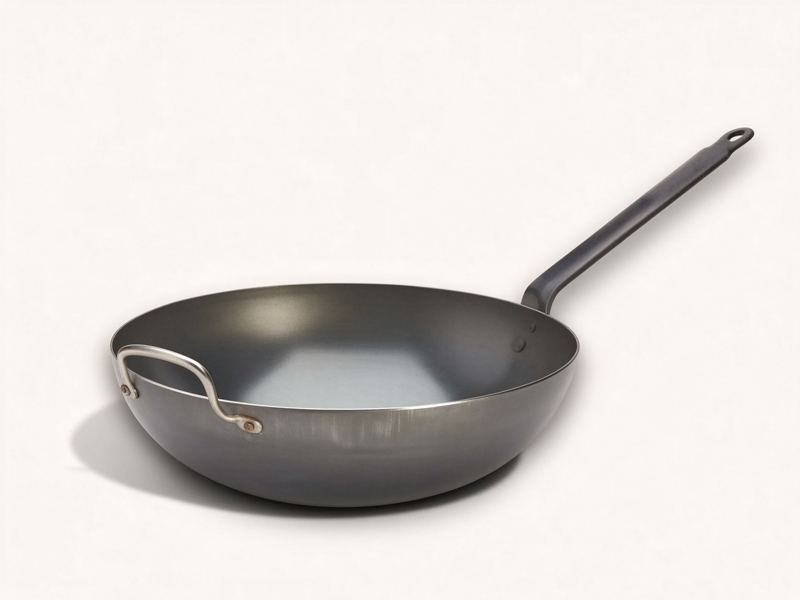
The Mineral B line is the store's center of gravity. Pans are pressed from steel of 99 percent iron and 1 percent carbon, in 2.5mm and 3mm thicknesses, and finished with a coating of natural beeswax — not as seasoning, but as protection against oxidation between the factory and your kitchen. The FAQ is unusually direct about what happens next: the beeswax must be scrubbed off with hot water, the bare pan seasoned with a high-smoke-point oil, and the dark patina built over weeks of cooking. The store refuses to pre-season because, in its words, "seasoning is part of the carbon steel experience, and we let you enjoy it."
That stance is either charming or infuriating depending on the buyer, and it defines the entire product. Sizes run from an 8-inch, 2.2-pound pan to a 14-inch, 7.8-pound pan with a helper handle, with the 3mm versions intended for the largest diameters. The French handle is engineered to stay cool on the stovetop, the riveted construction is industrial-grade, and the base is intentionally slightly convex — a detail the FAQ explains prevents spinning on flat glass surfaces.
PRO, Blue Carbon, and the oven question
Around the flagship Mineral B Classic, the storefront organizes two important variants. The Mineral B PRO swaps the epoxy-coated steel handle for a cast stainless one, which converts the pan from "oven flash use only — maximum 400°F for under ten minutes" into genuinely oven-safe cookware; for buyers who finish steaks in the oven, the PRO is the correct purchase and the Classic is a false economy. The Blue Carbon Steel line uses a thinner 2mm, force-blue-finished steel for buyers who want carbon steel responsiveness at lower weight and price, accepting slightly less forgiving thermal mass.
The catalog fans out further — country pans with higher sidewalls, paella pans, griddles, crêpe pans, and oval roasting dishes — and the store is refreshingly honest about the edges: lids are not recommended for Mineral B because trapped steam can give food a metallic taste, and induction users are warned to match pan size to burner size and raise heat gradually to avoid warping. This is documentation written by people who cook, and it shows.
The seasoning contract nobody reads first
Every honest review of this store must center the maintenance contract, because the store itself does. The FAQ reads like a prenuptial agreement with your pan: avoid soap and the dishwasher entirely, deglaze while hot, dry completely, wipe with oil before storing, limit acidic foods until the patina matures, and accept that rust is "the laws of nature" — manageable with the brand's rust cleaner and a non-abrasive brush, but inevitable if the pan is neglected. Harsh detergent strips seasoning; acidic tomato sauce in a young pan strips it faster.
The reward for compliance is a cooking surface that behaves like nothing else in the category: seasoned carbon steel sears with cast-iron intensity at roughly half the weight, responds to burner changes almost as quickly as copper, and develops a natural nonstick patina that no coating can replicate. The buyers who love these pans use the word "relationship" unironically; the buyers who return them skipped the contract. The storefront mitigates the risk with detailed how-to content, but it cannot season the pan for you — it has explicitly declined to.
Copper, stainless, and the mandoline sidebar
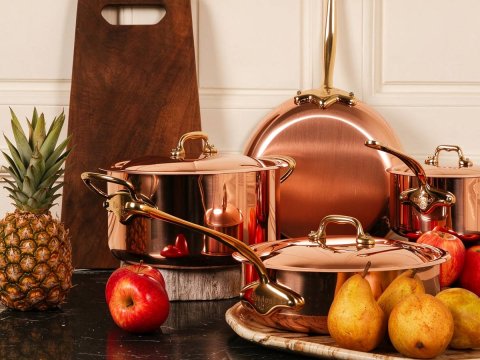
The store's breadth is easy to underestimate. Beyond carbon steel, de Buyer sells Prima Matera copper — the professional-grade reactive metal that French kitchens have sworn by for two centuries — alongside stainless lines and the pastry equipment (tart rings, sheet pans) that gives the brand its second life in serious home baking. And then there is the mandoline: de Buyer's slicers are a professional kitchen standard with a devoted following, a product most cookware storefronts don't stock at all.
This breadth matters to store reviewers because it changes who the customer is. A buyer who arrives for a Mineral B skillet and stays for a tart ring and a mandoline is shopping a professional restaurant supplier with a consumer interface — a different retail animal from the single-hero-product DTC brands that dominate this category elsewhere on the site. The storefront's recipe content leans into this, publishing professional French technique in home-kitchen portions.
Made in France, priced like it, worth it?
The pricing lands where heritage manufacturing lands. An entry Mineral B costs meaningfully more than Lodge's carbon steel and sits in the same band as mid-market American clad stainless — a consideration American buyers feel acutely, since Lodge offers the same raw material at a lower price with the factory pre-seasoning Lodge pioneered. De Buyer's counterarguments are thickness discipline (2.5mm and 3mm throughout, where cheaper pans thin out), handle engineering, two centuries of metallurgical consistency, and the absence of any coating to eventually fail.
The value verdict depends on the buyer's relationship with the category. For a cook who will season, maintain, and use the pan hard for decades, the premium buys verifiable French manufacture and professional pedigree. For a cook who wants a low-maintenance weeknight tool, the same money at Lodge or Misen — reviewed previously in this category — buys more convenience per dollar, pre-seasoned and oven-safe out of the box.
What longtime owners complain about online
Community complaint patterns are consistent and structural. First, the learning curve: buyers who expected nonstick behavior from day one report sticking, rust spots, and seasoning flaking — nearly always traceable to skipped steps the FAQ warns about, but real nonetheless. Second, the oven limitation on Classic pans catches gift buyers who never read the handle specification. Third, weight: the larger 3mm pans are genuinely heavy, and the 14-inch demands two hands and forearm commitment.
Fourth, a minority of owners report warping on induction cooktops, which the FAQ attributes to burner-size mismatch and thermal shock — a carbon steel behavior rather than a defect, but one that surprises buyers migrating from clad stainless. None of these complaints suggest quality failures; all of them suggest buyers who didn't know what carbon steel demands. The store's extensive documentation reduces but cannot eliminate that mismatch.
The final word for serious home sears
De Buyer's American storefront is the direct-sales arm of the oldest cookware factory covered in this category: two centuries of continuous production in the Vosges, a carbon steel line that professional kitchens actually use, and documentation honest enough to talk you out of a purchase you can't maintain. In a category crowded with DTC brands discovering cast iron and carbon steel for the first time, this store sells the original article.
Buy here if you sear seriously, enjoy the ritual of seasoning, want French-made provenance without import-retail markup, or are outfitting a kitchen that aspires to professional technique. Buy elsewhere if you want low maintenance, oven-safe handles at the base price, or a pan that forgives a week in the dish rack. Carbon steel is a contract, and this storefront — alone among its peers — prints the terms in full before you sign.