The environmental engineer grandfather who built america's most certified mattress factory

Official homepage: https://www.naturepedic.com
In 2003, a board-certified environmental engineer went shopping for his first grandchild's crib mattress and refused every option on the market. Barry Cik had spent thirty years tracking industrial chemicals; he knew what polyurethane foam, vinyl waterproofing, and flame retardants were, and, in his words, there was no way he was putting his grandchild to sleep within a few inches of them. Six months later he had built his first mattress in his garage. Today Naturepedic handcrafts organic mattresses in a factory in Chagrin Falls, Ohio that is itself GOTS-certified — not just the products — and holds a certification wall deeper than any competitor in the industry, including the first-ever EWG Verified mattress. This review examines the storefront dimension by dimension.
A crib mattress, a grandchild, and a refusal
The origin is the rare founder story where the credential comes before the emotion. Cik was not a sleep entrepreneur who discovered toxins; he was a veteran environmental engineer who had spent decades chasing chemicals through industrial supply chains, and the crib mattress was personal. The options he found were unacceptable for two separate reasons: the conventional mattresses were chemical cocktails he knew too much about, and even the organic options were not waterproof — meaning a single accident would grow mold and fungus with no effective way to clean it. His two sons, Jeff and Jason, joined him, and the family's engineering response to both problems — a patented food-grade waterproof surface made from non-GMO sugarcane — became the company's founding intellectual property.
Twenty-three years later the family still runs the company, still independent, with no outside owner who could reset the standards — a governance fact the organic-certification community cites as much as any certificate, because the entire value proposition rests on the founder's technical authority remaining in the building.
Guilty until proven innocent: the chemical doctrine
The company's materials policy, stated on its own pages, inverts the regulatory default: chemicals are guilty until proven innocent. The exclusions list is comprehensive rather than curated — no polyurethane foam in any layer of any product, no chemical flame retardants, no fiberglass flame barriers, no vinyl or PVC, no phthalates, no formaldehyde-based adhesives, no PFAS. The company's framing statistic does the persuading: more than eighty-five thousand synthetic chemicals are used in consumer-product manufacturing, and only a small fraction have been tested for human health.
The engineering solutions are the interesting part. Rather than chemical flame barriers, Naturepedic uses organic wool batting and plant-based PLA fiber from non-GMO sugarcane. Rather than glued coil units — the industry standard — it manufactures its own encased coils in-house from recycled American steel, without glues or adhesives, an arrangement the company describes as exclusive. And the waterproofing that conventional brands achieve with vinyl or PFAS coatings, Naturepedic achieves with polyethylene derived from sugarcane — the same food-grade material used in food packaging.
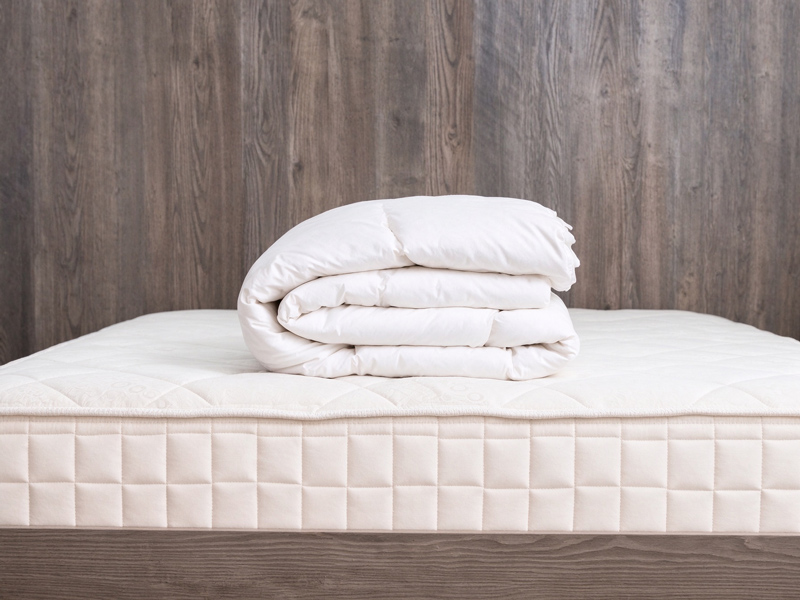
The factory itself carries the certificate
The certification distinction that matters most in the organic mattress category is not the material certificate — GOTS-certified cotton is common — but the factory certificate. Naturepedic's manufacturing facility in Chagrin Falls has been GOTS-certified since 2009: every finished mattress, not merely its components, meets the standard, and the certificate is publicly checkable with its issuing body. The company completed the Organic Trade Association's fraud-prevention audit — the only mattress manufacturer to do so — and staffs an in-house chemist to police its own supply chain.
The manufacturing ledger runs local and specific: Texas-grown organic cotton from farmers the company knows personally, cotton gins it can name, recycled steel coils built on-site, and — per the GOTS case study documenting the operation — a predominantly Amish workforce whose craftsmanship reviewers describe as immediately apparent when handling the finished mattress. Even the packaging was engineered: a kraft-paper roll-packing system that the case study credits with averting fifty-five thousand pounds of plastic waste annually.
EWG first, MADE SAFE first, twelve certifications deep
The certification wall is industry-leading and dated like Coyuchi's bedding timeline. GOTS since 2009; MADE SAFE in 2016, the first mattress brand so certified; 1% for the Planet the same year; GREENGUARD Gold for emissions; UL Formaldehyde-Free validation; UL Non-Detectable PFAS validation in 2025; FSC-certified wood; and in 2024, EWG Verified — the Environmental Working Group's strictest consumer-health standard, earned by the first and still the only mattress brand. Twelve independent third-party certifications in total, each checkable.
The founder's public line on the subject has not changed in two decades: if a mattress is not GOTS certified, it is not organic, and no self-declared alternative is trustworthy. In a category where greenwashed "natural" claims are the norm, the wall functions as the entire product — the mattress is what the certificates say it is.
The Ohio and California fork in organic
The serious buyer's comparison in this category runs between the two certification-heavy American paths. Naturepedic's Ohio model — crib-first, family-owned, factory-GOTS, engineered for adjustability and medical-grade caution, with latex-free configurations for sensitive families — stands opposite the California model built by Avocado, which launched in 2016 with a vertically integrated wool-and-latex supply chain, a B Corp certification, Climate Neutral status, and a single celebrated hybrid at aggressive pricing. Both certify to the same GOTS and GOLS benchmarks; the difference is philosophy. Naturepedic optimizes for caution and configurability — split firmnesses, vegan and latex-free builds — where Avocado optimizes for one very good mattress at the best possible price.
The trade-offs cut both ways: Avocado's twenty-five-year warranty outlasts Naturepedic's twenty, but Avocado's crib mattress ships without waterproofing — a separate certified cover is essential — where waterproofing is the patent at the heart of the Naturepedic origin story.
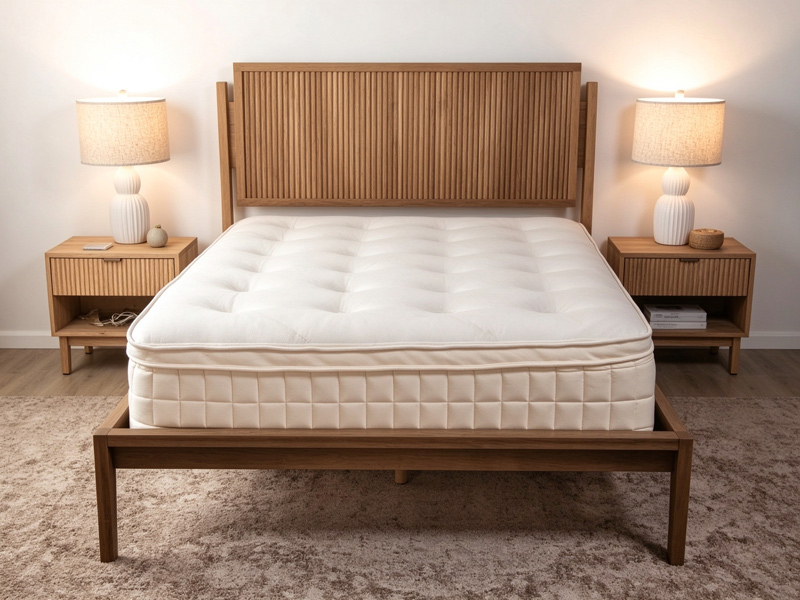
Ninety nights and a free comfort swap
The commercial terms sit at the premium category's standard: a ninety-night trial, a twenty-year limited warranty, free shipping within the continental United States, and — the differentiator — a free comfort-layer swap within the first ninety days, so a mattress that arrives slightly wrong for a sleeper's body can be corrected without a return. The modular construction philosophy extends further: components are designed to be replaceable rather than landfilled, which the circular-economy reviewers count as quietly radical in an industry built on eight-year replacement cycles.
Distribution runs omnichannel but restrained: the flagship, a network of company stores across the United States and Canada, and select retail partners — a slower, showroom-assisted model than the bed-in-a-box wave it predates by a decade.
The premium price, honestly accounted
Naturepedic's queen mattresses sit in the premium band, above Avocado's celebrated hybrid and several multiples above the conventional mattress-club tier. The honest accounting, as every long-form review converges on, is that the premium buys the certification depth, the factory certificate, the waterproofing patent, the Amish-adjacent Ohio manufacturing, and the family-owned governance — not necessarily a better night's sleep than a cheaper certified competitor for a sleeper without chemical sensitivities. The company's own public mission frames the stakes higher than comfort: its annual fundraiser for childhood-cancer research, with a guaranteed minimum donation, ties the business to the epidemiological concern — chemical exposure in early childhood — that launched it.
The buyer's calculus is therefore unusually philosophical for a purchase this practical: you are paying for documented absence — of chemicals, of doubt, of outsourced responsibility — and for the small fraction of families for whom that documentation is non-negotiable, the price reads as the point.
The verdict from the nursery to the master bedroom
Naturepedic's storefront is the mattress category's most complete answer to the question the founder asked in a baby store twenty-three years ago: prove it. The proof is the deepest certification wall in the industry — the only EWG Verified mattress, the first MADE SAFE mattress, a GOTS-certified factory, UL-validated absence of PFAS and formaldehyde — built on a family-owned, Amish-crafted Ohio factory and a patented sugarcane waterproofing that solved the problem the organic aisle ignored. The cons are the cons of that seriousness: premium pricing, a shorter warranty than the California rival, a configurator's complexity where one-mattress simplicity sells.
Buy here if someone in your home is chemically sensitive, pregnant, or newborn; if waterproofing without vinyl or PFAS is the non-negotiable; if you want split firmness or latex-free builds that most organic rivals do not bother engineering; and if factory-level certification is the only language of trust your household speaks. Buy the California rival if value-per-night rules and climate-neutral corporate certification is your preferred vocabulary. For the family that starts shopping at the crib and ends at the master bedroom, this grandfather-engineered Ohio factory remains the industry's most certified answer — and its most stubborn.