The cloud couch dupe that canadians built and americans are adopting
Official homepage: https://www.sundays-company.com
Sundays launched in Vancouver in November 2019, the week the world was about to stop shopping for sofas. Four friends and family members — an ex-UN worker, her husband, his sister, and a high-school friend — built the brand on a self-funded budget, a borrowed storefront, and a single design instinct: deep, washable, family-proof comfort. Six years later, its Movie Night sofa is the internet's most persuasive answer to the ten-thousand-dollar Restoration Hardware Cloud Couch, its showrooms dot four North American cities, and the United States already drives roughly a third of its sales. This review examines the storefront dimension by dimension.
Four friends, one borrowed storefront, and 2019
The founding quartet is a family photo with a business plan. Barbora Samieian, a former UN worker with a drive for brand-building, leads marketing and creative; her husband Moe co-founds; his sister Sara brought the furniture-industry experience that handled sourcing; and Noah Morse, Barbora's high-school friend with a design background, led product development. Because all four kept full-time jobs at first, they met on Sundays to talk business — the name stuck, and the founders still describe it as the day you feel most at home. The company launched online in November 2019 with living-room pieces and no outside capital.
That self-funded constraint became the brand's operating philosophy. In the founders' own words, the company is conservative and slow in growth because furniture inventory is expensive — the anti-venture playbook in a category that burned through billions of VC dollars between 2015 and 2022. The grit is on the record too: early promotion meant, in Barbora's phrase, having no shame in messaging everybody on LinkedIn.
The UN, LinkedIn DMs, and self-funded grit
The pandemic arrived four months after launch and forced the first real strategic decision. Sundays' original model — in-stock items shipping from its own warehouse, a genuine speed advantage — collapsed under freight costs and closed factories, and the company pivoted to short-timeline pre-orders. Then came the accident that shaped everything after: a Vancouver salad restaurant called Field & Social had leased a Yaletown space whose construction was pandemic-delayed, and Sundays staged a pop-up in the empty storefront. The lesson the founders took was blunt — when customers are buying a five-thousand-dollar sofa, they want to sit on it — and the pop-up permanently rewired the company from pure e-commerce to showroom-led.
The triple-threat playbook that followed — pop-ups, targeted digital advertising, and local influencer partnerships in Vancouver and Toronto — produced consistent month-over-month growth by September 2020 and a breakout Black Friday. By 2023 the company was growing roughly threefold year-over-year, with Forbes covering the expansion while American home retailers were contracting.
Movie Night anatomy: feathers, LiveLife, and footprint
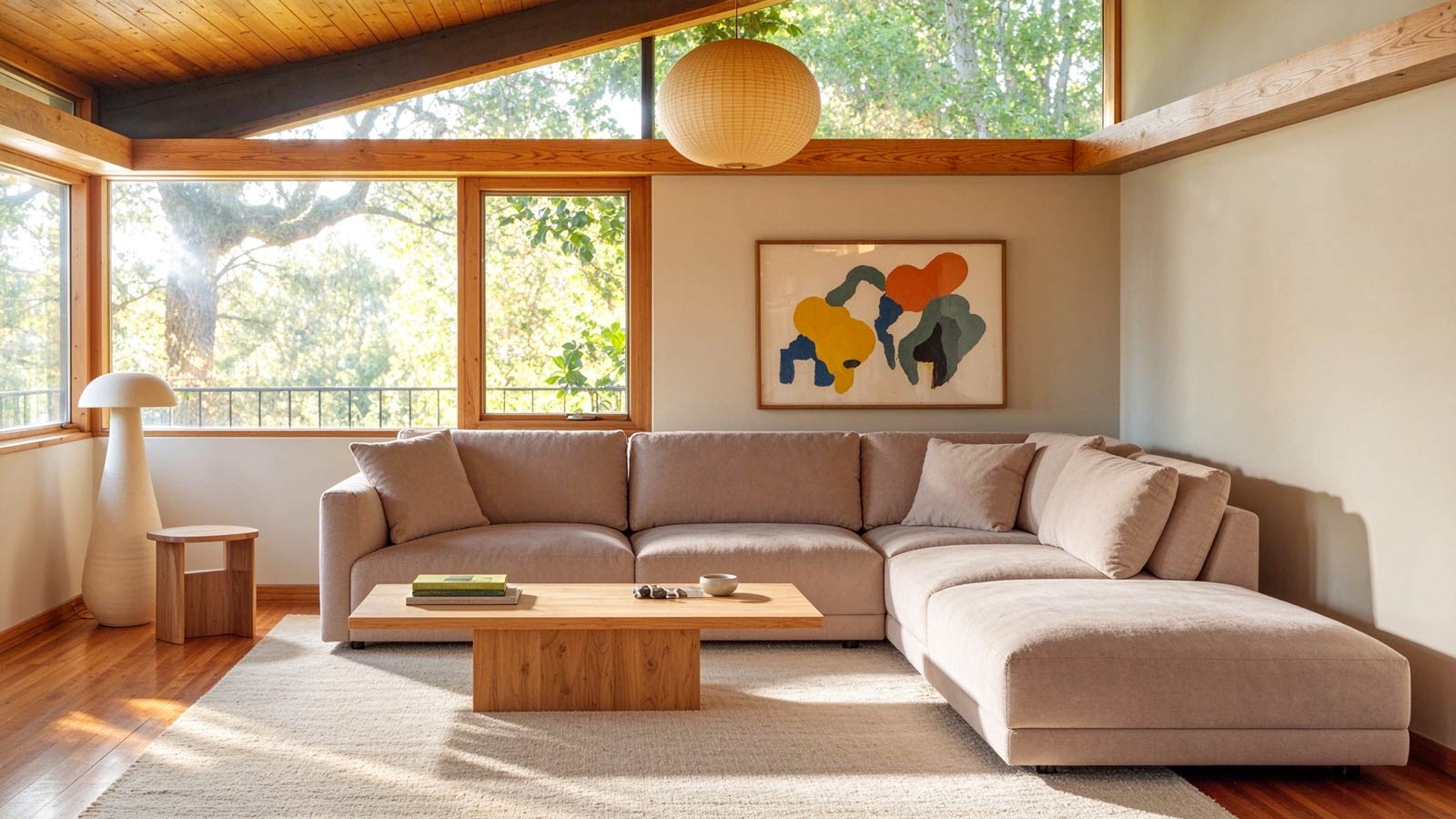
The hero product is an unabashed homage: the Movie Night is the internet's most-discussed Cloud Couch alternative — a three-seater around $2,750 against the Restoration Hardware original's five figures — built from feather-fibre blend cushions over premium foam cores, wrapped in the brand's LiveLife performance fabric. That fabric is the engineering argument: stain-resistant, moisture-repellent, PFAS-free, rated to fifty thousand double rubs, and cut into fully removable, washable slipcovers — the feature that lets buyers choose cream upholstery in a house with children and dogs, a promise the brand's own marketing videos demonstrate with red wine.
The anatomy has honest edges the independent testers all find. The footprint is genuinely enormous — ninety-six inches wide and forty deep — rewarding for loungers, punishing in small rooms. The sink-in seat runs warm in long sessions, and the cushions demand a regular fluffing routine or the sofa visibly slumps. None of this is hidden: it is the physics of deep-seat feather comfort, and the store sells the Movie Night precisely to the household that wants that physics.
Showrooms: the Yaletown lesson that changed strategy
The showroom network is the strategic bet. After the borrowed-storefront experiment, Sundays opened permanent spaces in Vancouver and Toronto, then Calgary and — in March 2023 — Seattle, its first American location, chosen because the city already held a customer base and a local warehouse. Pop-ups in Los Angeles and New York preceded the push; New York's Manhattan showroom opened to the kind of editorial attention — New York Magazine's Strategist visited three times — that advertising cannot buy. The United States accounted for about thirty percent of sales within a year of the Seattle opening, and the founders framed the physical presence as legitimacy: American customers, they said, get a sense of stability from the brand's storefront even when they live a thousand miles from it.
The stores remain curated rather than stocked — warehouses ship, showrooms demonstrate — with the Get Together sofa, the Cloud bed, and the Field and Plane dining tables as the recurring cast. In a category where most DTC rivals treat retail as failure, Sundays treats it as the trust engine the five-figure basket requires.
Get Together: the firmer sibling with hand-tied springs
For buyers the Movie Night's sprawl scares off, the catalog's second pillar is the Get Together — a modular sofa from around $2,650 with a different construction philosophy: solid wood and top-grade plywood on eight-way hand-tied springs, the traditional upholstery craft most DTC brands abandoned as too labor-intensive. The performance spec sheet is the same LiveLife fabric logic — PFAS-free stain repellency, fifty thousand double rubs — but the sit is firmer and more upright.
The independent testing pattern on the Get Together deserves quoting because it is so consistent: firm to the point of disappointment on day one, noticeably broken in at four weeks, and still holding its shape months later. Living Cozy's tester recorded the dumbbell test — a weight left on one spot dipped locally while the rest of the seat stayed flat, which is a sprung deck doing its job. The texture complaints are equally specific: a slight rustle, and the seams between modules felt when lying down flat — modular honesty rather than a seamless slab.
Free assembly, $150 returns, and the warranty clock
The service terms split the difference between boutique and big-box. Delivery is free on all items, and oversized pieces carry free white-glove delivery and in-home assembly — reviewers consistently describe two-person crews assembling a sectional in under twenty minutes and removing the packaging. Lead times run two to three weeks on stocked pieces; backordered configurations have historically stretched to about two months, though the company has largely caught up. Swatches ship free, and ShopPay installments spread the cost.
The return terms are the store's shortest paragraph and its sharpest edge: a thirty-day window with a $150 return shipping fee. Against the category's newer hundred-day offers — Poly & Bark, reviewed previously in this category, allows triple that — thirty days is the legacy retail default, and the fee makes a wrong-sized sectional an expensive lesson. The warranty ran a limited five-year term for purchases on or after August 2025, an improvement that also quietly grandfathered earlier buyers into shorter coverage.
The footprint tax and the warmth problem
Two physical realities define who should not buy here. The first is geometry: the Movie Night's deep, low sprawl swallows small living rooms, and its single-frame sizes can complicate stairwells and doorways — one tester flagged access complications that modular rivals avoid. The second is thermodynamic: sink-in feather seats run warm, and hot sleepers and warm-climate loungers report long-session discomfort that the fabric cannot fix. Add the neutral-only palette — every colorway earns its keep but none of them is a statement — and the store's ideal customer resolves clearly: family households with real square footage, in temperate rooms, who want furniture that absorbs chaos.
The Strategist's verdict deserves airtime in any honest review: for pure specification-per-dollar, established retailers like Crate & Barrel or Room & Board can beat the Get Together on price at similar specs. What those rivals do not offer is the washable-slipcover deep-seat formula at this price, the showrooms with the curated cast, or the brand warmth — which is, in the end, the actual product Sundays sells.
Final call for the deep-seat loyalist
Sundays' storefront is the most family-logical in this category: four founders who built slowly on their own money, a sofa engineered for washable chaos, showrooms that treat sitting as due diligence, and a Canadian directness about what deep-seat comfort costs in footprint, warmth, and fluffing. The Movie Night is not a luxury sofa at a discount; it is a well-executed answer to a specific modern problem — the white-sofa household — and its thirty-day, hundred-and-fifty-dollar return terms are the price of that specificity.
Buy here if you have the square footage, the household chaos, and the lounging priorities to match; visit a showroom first if one is within a day's drive, because the founders are right that five-figure baskets deserve a sit test. Buy from Poly & Bark for the leather traditionalist's sofa, from Floyd or Burrow for the modular movers. And keep an eye on Hetta, the sister brand the founders launched for the same households as their children grow — the Sunday-morning philosophy, it turns out, scales.