Reliefband: a quarter-century of zapping nausea, now riding the ozempic wave

Official homepage: https://reliefband.com
Reliefband is the nausea-relief store that prescription medicine left behind. Born in hospital wards at the turn of the millennium as a device for morning sickness, it became a cruise-ship essential, earned FDA clearances across an unusually broad list of indications, and — with more than a million units sold — has lately found an unexpected second act: quieting the nausea that GLP-1 weight-loss drugs leave in their wake. This review examines the neuromodulation science, the hardware lineup, and the honest catches.
Hospital wards first, cruise ship boutiques second
The company's own materials describe a device developed for hospital use, where post-operative and chemotherapy nausea demanded something faster than a pill and safer than a sedative. The first-generation ReliefBand appeared around 1999 as a prescription device, with morning sickness among its earliest indications — a history the brand still leans on, describing nearly a quarter-century of clinical use. The pivot to consumer channels was led by the travel industry: cruise lines discovered that a drug-free, non-drowsy wristband solved the seasickness that ruined vacations and onboard bar tabs alike. The device is fully FAA-legal for pilots, stocked by pilot shops, and has become the default answer in boating and aviation communities for the simple reason that it works without sedation — and pilots cannot afford drowsiness.
Eighty-five percent, according to its own trials
The mechanism is transdermal neuromodulation, and the company's core claim is an eighty-five percent success rate from its clinical trials. The device sits on the underside of the wrist, where its contacts deliver a specific pulse pattern to the median nerve; the signal travels the nervous system to the dorsal vagal complex — the brain's nausea command center — and quiets the errant vagus-nerve messages between brain and stomach. Users feel tingling in the palm and middle finger, which confirms correct placement, and relief typically arrives within five to fifteen minutes. The FDA clearances are unusually broad: motion sickness, morning sickness, nausea as an adjunct to chemotherapy, post-operative nausea, physician-diagnosed migraine nausea, and anxiety-related queasiness. The honest caveat belongs here too: independent reviewers note the evidence for neuromodulation is promising but that, as with every anti-nausea remedy, it works for most users and not all.

The gel, the tingle, and the two-hour reapplication
Ownership comes with a ritual. A pea-sized drop of hypoallergenic conductivity gel must be spread on the skin at the target point — between the two tendons, two finger-widths up from the wrist crease — and the band's steel or copper contacts press onto it. The gel needs reapplication every two to three hours, or after washing, and sensitive-skinned users are advised to wipe both wrist and band before refreshing. Skip the gel and the pulses simply do not conduct. The upside of the ritual is immediacy: the device works after nausea has already started, unlike pressure bands and most medication, and its five-to-ten intensity levels let users find the precise tingle that means the nerve is properly engaged. It rewards being worn before symptoms crest — reviewers consistently advise strapping it on at the dock, not after the boat clears the harbor.
Sport, Flex, Premier, and the smartwatch marriage
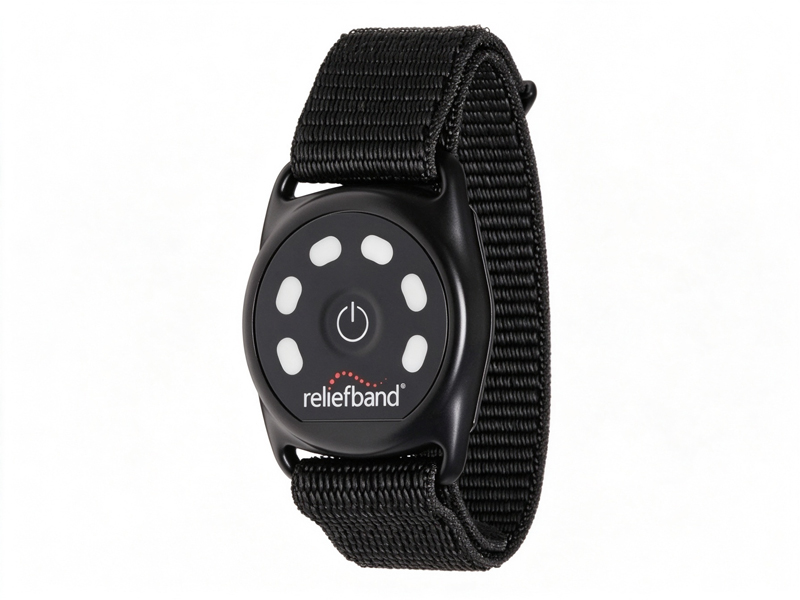
The current lineup is a tidy ladder. The Flex, at $179.99, runs 350-plus hours on a replaceable battery and accepts a smartwatch-attachable strap, letting it share real estate with an Apple or Samsung watch. The Sport, at $249.99, is the boat-and-beach model: IPX7 waterproof, thirty hours per charge, stainless contacts, six intensity levels, and the same watch-pairing option. The Premier+, at $299.99, is the jewelry-grade flagship with hypoallergenic 316L surgical-steel contacts, ten levels, and an eighteen-hour battery — the choice for daily-wear users who want discretion. Around the bands the store sells conductivity gel, replacement straps, watch adapters, bundles, and gift cards, and it now markets by use case rather than product: motion sickness, general nausea, morning sickness, and a dedicated GLP-1 page for the medication-induced nausea that weight-loss drugs leave behind.
A charging cable too short with magnets too weak
The honest engineering complaints cluster on the recharge experience. A widely read long-term review praised the therapy itself while cataloging the accessories: a charging cable only a few inches long, terminated not in USB but in magnetic contacts too weak to hold their own weight — the band must be laid flat beside the outlet or the connection separates and the device charges nothing. The same reviewer found the Premier difficult to fasten snugly one-handed on smaller wrists, recommending the Velcro-style Sport and Flex straps instead. Amazon reviews echo the charging complaint at the $249 price point. None of it undermines the core therapy; all of it is the kind of friction a premium price should have engineered away years ago.
Sea-Band does less for fifteen dollars
The value debate is real and worth having. Sea-Band's acupressure wristbands cost under fifteen dollars, carry tens of thousands of positive reviews, and use no batteries, gel, or charging cables — though clinical evidence for motion sickness specifically is mixed and they prevent rather than reverse. EmeTerm competes in electric stimulation without gel. The consensus across independent reviews is sensible: try the cheap band first if nausea is occasional; step up to Reliefband when the pressure band fails, when nausea is recurring, or when drowsiness-free immediacy matters — pilots, boaters, pregnant users avoiding medication, and now GLP-1 patients protecting their progress. The store's own framing — fast-acting, drug-free, works after symptoms start — is the honest summary of why the premium exists.
The last wave before the shore
Reliefband's store sells the most clinically decorated band on this tag: nearly a quarter-century of use, a shelf of FDA clearances most wearables never approach, a million units sold, and a marketing machine that just found its biggest new audience in a weight-loss prescription. Its catches are the prosaic ones — the gel ritual, the weak magnetic charger, the premium price beside a fifteen-dollar pressure band, and the honest reality that no anti-nausea remedy works for everyone. For the seasick, the airsick, the medication-nauseated, and the morning-sick who refuse sedation, it remains the reference answer — strap it on at the dock, feel the tingle, and enjoy the ride.