Nix biosensors: the sweat patch telling athletes when, what, and how much
Official homepage: https://nixbiosensors.com
Nix Biosensors is the Boston store that turned sweat into a data feed. Founded by a nine-time marathoner who was hospitalized with hyponatremia — too much water, not too little — it sells a reusable sensor pod that clips onto a disposable arm patch and reads fluid and electrolyte loss in real time, telling endurance athletes exactly when, what, and how much to drink. Approved for UCI competition and backed by a ten-million-dollar Series A, it is quietly becoming the hydration layer of professional sport. This review examines the science, the adoption, and the six-dollar-per-session economics.
Boston Marathon hyponatremia and an eleven-pitch streak
Meridith Cass's founding problem was the opposite of the obvious one. A collegiate basketball player, former venture capitalist, and nine-time marathoner, she suffered hyponatremia — over-hydration — during the Boston Marathon and discovered that real-time hydration monitoring simply did not exist for everyday athletes. At Harvard Business School she won the Blavatnik Fellowship, which gave her a twelve-month salary, office space, and funding to explore healthcare opportunities full-time, and she founded Nix in 2015 after winning eleven pitch competitions in a row. The advisory bench reads like a sport-science hall of fame: Tom Fowler, former president of Polar; Dr. Bob Murray, founder of the Gatorade Sports Science Institute; Olympians Shalane Flanagan and Tatyana McFadden; Magdalena Boulet, president of GU Energy Labs; and Dave McGillivray, the Boston Marathon's race director.
A reusable pod, a disposable patch, twenty-five minutes
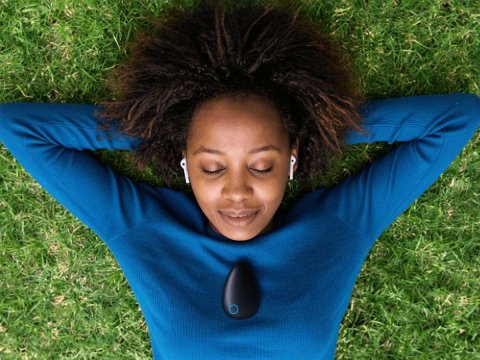
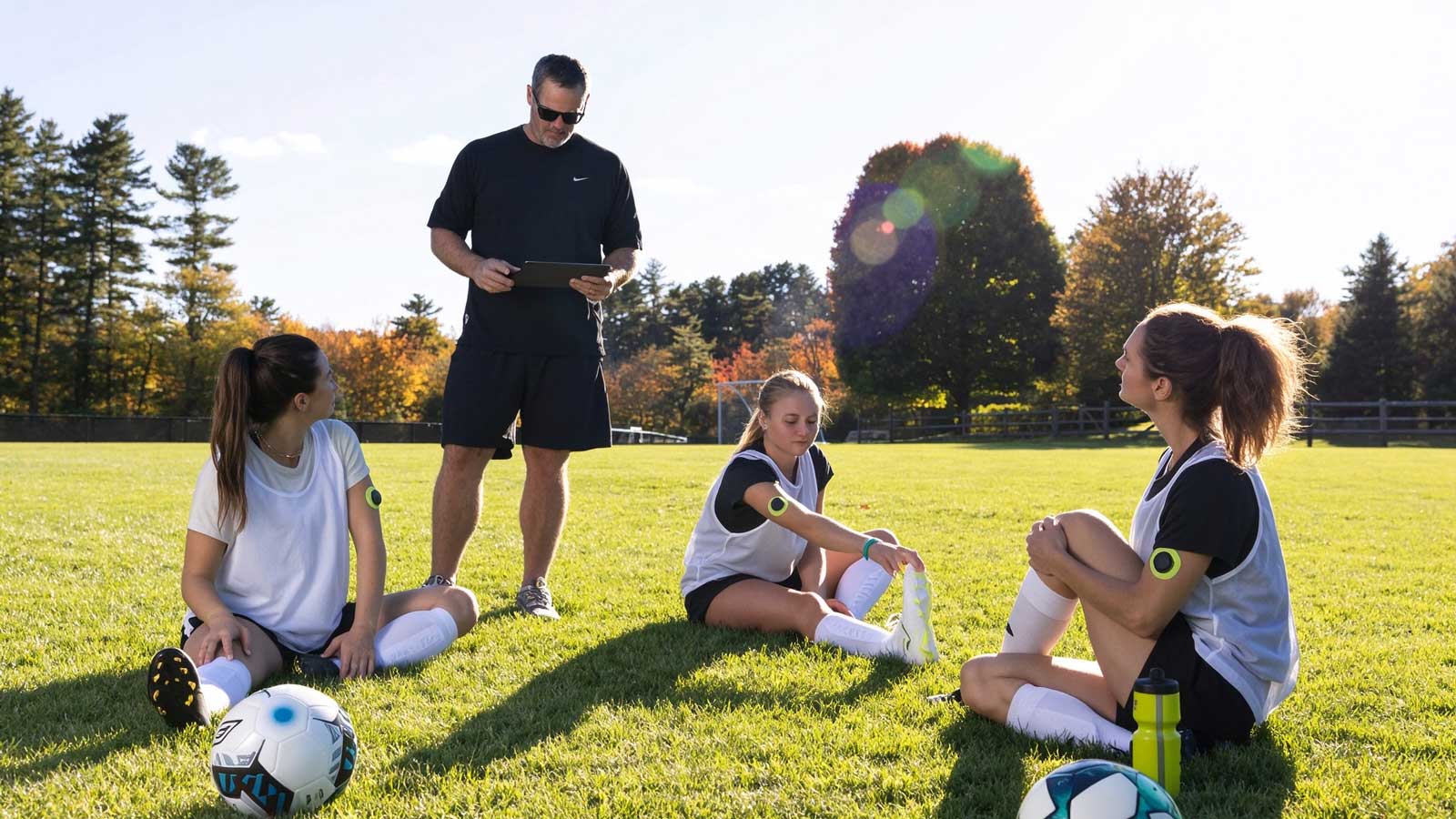
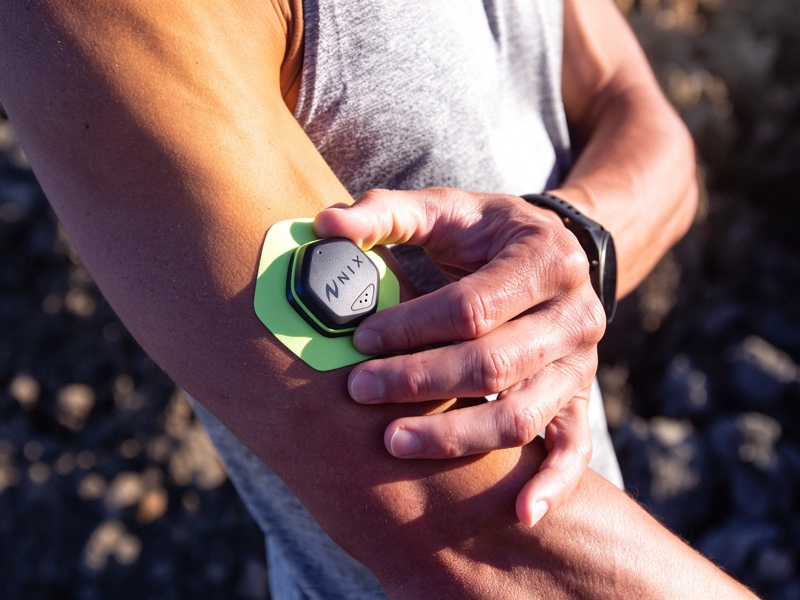
The hardware splits into two parts. A lightweight, reusable pod — under half an ounce — clips with three metal pins onto a single-use adhesive patch worn on the outer bicep, where sweat flow is reliable and the patch, built on KT-tape principles, survives hard exercise. The starter kit bundles the pod, a USB-C charging case, and four patches, with refills sold in four-packs. One honest operational detail: the sensor needs roughly 4.5 microliters of sweat and can take up to twenty-five minutes to begin reporting, so cold mornings and low-intensity warmups delay your first data. Once flowing, the pod transmits continuously over Bluetooth to the Nix Solo app on iOS or Android, and onward to an Apple Watch or Garmin head unit.
Ionic impedance, one reading per second
The patch is the laboratory. Two microfluidic channels route sweat past two pairs of electrodes that measure the sweat's ionic potential — its electrical impedance — once per second, while a small reservoir meters flow. From impedance variation across a known distance the system derives sweat rate, and from ionic concentration it derives electrolyte and sodium loss per hour. Proprietary machine-learning models, trained and validated on thousands of workouts by the company's claim, then turn local bicep data into whole-body numbers. The app layers in environmental intelligence — temperature, humidity, dew point, solar load, wind, altitude — producing a zero-to-hundred Nix Index that ranks the day's thermoregulatory stress against your personal range. Post-workout, a personalized Sweat Profile averages your sessions, and a beverage chart ranks a dozen sports drinks against your electrolyte fingerprint so you can match replacement to loss.
An estimate of your whole body, from your bicep
The honest scientific framing matters. Independent analysts at Precision Hydration describe exactly what the device does: it estimates rather than directly measures whole-body fluid loss, extrapolating from a single site using proprietary equations, and the current app stops short of post-exercise recovery recommendations. The company's validation claims are strong — scientifically validated, accuracy exceeding industry standards — but the buyer should understand the architecture: one bicep, two channels, and a model standing in for your entire skin surface. For endurance athletes whose race outcomes hinge on hydration, the estimate is far better than the generic tables it replaces; for casual gym-goers, it may be more laboratory than they need.
UCI approval and the Nix Health pivot
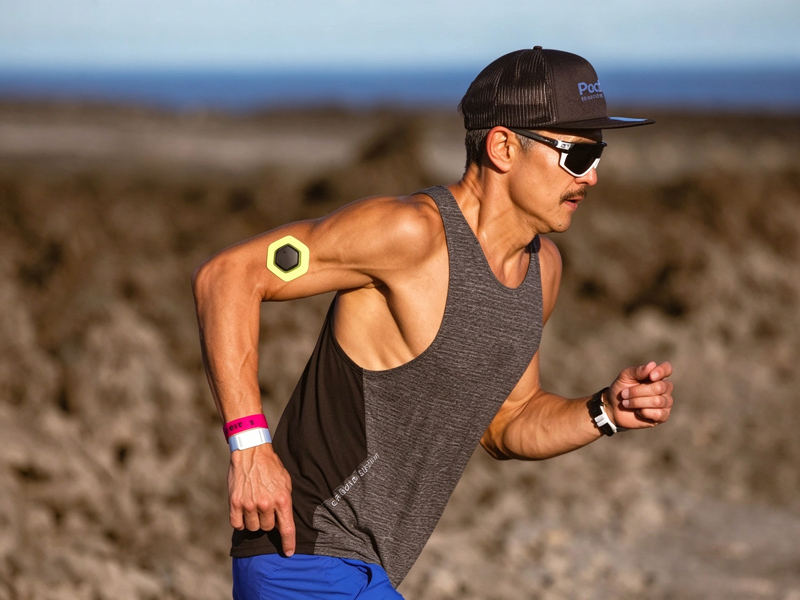
Adoption is where Nix stops looking like a gadget. EF Pro Cycling expanded its use into custom race strategies; Chicago Fire FC, Louisiana State University, and Legacy Motor Club signed on; US Speedskating named Nix an official supplier in 2024; motorsport programs studied it for drivers racing at over two hundred miles per hour; and in early 2025 the UCI approved the technology for use in competition — a landmark for hydration wearables in cycling. Baylor Athletics signed a department-wide partnership in 2026, and a Nix Pro dashboard serves coaches, military units, and labor crews monitoring groups at once. The bigger story arrived in September 2026: a $10 million Series A — $17 million total, backed by Anne Wojcicki, Len Blavatnik, the Clif Bar founders' family office, and owners of the Celtics, Orioles, Blues, Rangers, and Boston Legacy FC — funding Nix Health, a licensable, sensor-free hydration algorithm for consumer platforms, in beta for a Q1 2027 launch. The stated roadmap runs through lactate, cortisol, glucose, and hormone biomarkers toward a broader Self Health platform spanning blood, saliva, and tears.
Six dollars a session, and the pairing glitches
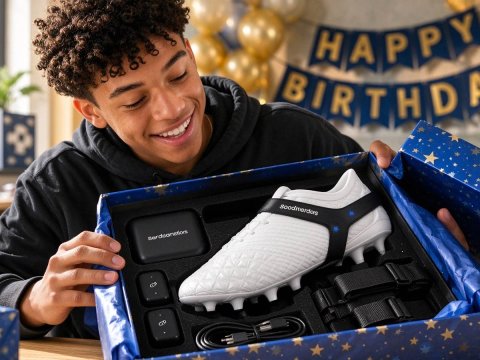
The ownership economics are the honest counterweight. At roughly $130 for the kit, Nix undercuts several rivals — but the patches are consumables at about $25 per four, roughly six dollars a session, which adds up fast for athletes testing weekly, as Wired's review noted in calling the refill pricing hefty. The same review, while calling the concept genius, flagged glitchy device registration and Bluetooth pairing at setup. The twenty-five-minute onset delay and the absence of recovery guidance round out the current limitations. None of these have slowed adoption, and the company now sells training bundles and gift cards alongside refills — but budget-conscious buyers should price the per-session tax before committing.
The last drop of sweat on the patch
Nix's store sells the most actionable fluid ounce in endurance sport: a bicep laboratory that converts perspiration into a drinking plan, validated by Gatorade's founding scientist and trusted by WorldTour cyclists, Big Twelve programs, and Olympic speed skaters. Its trade-offs are specific — a per-session patch tax, occasional pairing friction, and data that estimates rather than measures — but for marathoners, triathletes, and cyclists whose performances dissolve in heat, nothing else on this tag turns biology into a bottle plan mid-workout. And with the Nix Health pivot, the company is betting its sweat dataset matters even more than its sensors. For the data-obsessed athlete, this is the rare wearable whose advice you can taste.