He blended an iphone on camera and accidentally built a blender empire

Official homepage: https://blendtec.com
Blendtec is the rare kitchen brand most people know from a video rather than a product. In 2006, founder Tom Dickson pointed a camera at his blender, dropped in a garden rake and later an iPhone, and asked the question that made the company famous — will it blend? This review goes beyond the viral moment to examine the actual store: a Utah engineering company with commercial blending roots, a lineup of countertop machines with unusual blunt blades and five-sided jars, a famous patent victory over Vitamix, and the honest trade-offs of owning a blender built like lab equipment.
From Wheat Mills to 2x4 Destruction Testing in Utah
Tom Dickson founded Blendtec in 1975 in Orem, Utah, after his curiosity about a vacuum cleaner and spilled wheat kernels led him to invent a stainless-steel home mill that took flour grinding off the stone age. The company added mixers and then commercial blenders as the smoothie era began, operating under its parent name K-TEC for years before the Blendtec label took over. Dickson, an engineer by training, tested every machine the way competitors would not dare: by feeding it two-by-fours, marbles, and rakes to see whether the blender or the object would lose. The sawdust left on the factory floor from those destruction tests is what gave his marketing team the idea that changed the company.
Blunt Blades, a Five-Sided Jar, and No Tamper
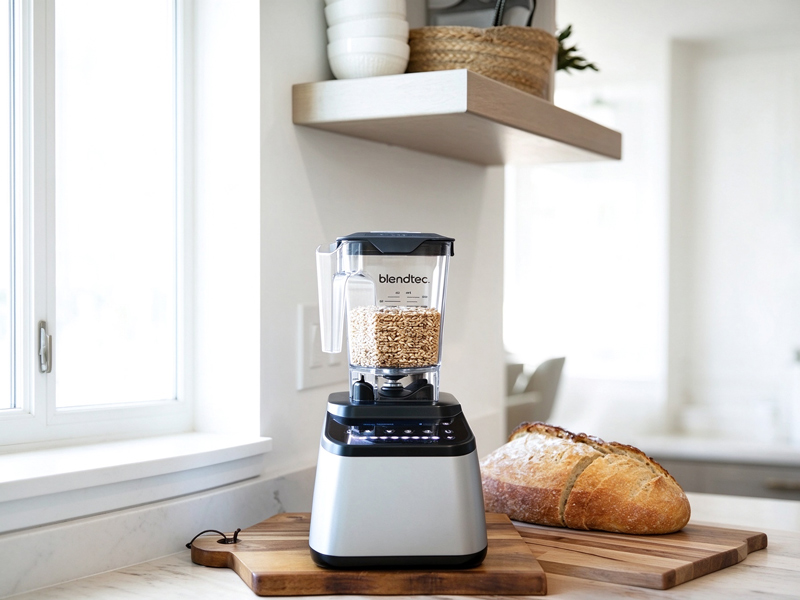
The engineering philosophy is genuinely different from rivals like Vitamix. Blendtec blades are cold-forged stainless steel, deliberately blunt — the company claims they are 80 percent thicker and ten times stronger than typical blades — and they pulverize rather than slice, which is why the jars are safe to clean by hand without sliced fingertips. The patented WildSide jar adds a fifth side that interrupts the vortex and folds ingredients back down into the blades, eliminating the need for a tamper. Jars are molded from BPA-free Tritan copolyester. Independent testers consistently confirm the payoff: snow-like crushed ice and exceptionally smooth fibrous blends, though the same design that avoids a tamper means very small batches sometimes splash and need a scrape-down.

Six Presets, Ten Speeds, and a Famously Loud Motor
The Total Blender Classic that anchors the store runs a 1,560-watt direct-drive motor with ten speeds, pulse, and six timed programs — smoothie, batters, hot soup, whole juice, ice cream, and ice crush — with a backlit countdown display. Tom's Guide measured it at 108 decibels, among the loudest blenders they tested, so morning smoothie households should know what they are signing up for. Around it sits a full ladder: the Classic 575 as the entry point, the Designer 625 through 725 with touch interfaces, the Pro 800 with a sound enclosure for quieter operation, and the commercial Stealth line built for juice bars. Prices typically run from the low $300s to about $1,000 for the quiet flagship, with warranty coverage ranging from two years on the Classic to eight on newer models — shorter than the decade-plus coverage now common among premium slow-juicer rivals.
The Viral Video That Invented YouTube Marketing
In October 2006, marketing director George Wright convinced Dickson to film one of his destruction tests. The first Will It Blend? episode — a handful of marbles — drew six million views in five days and reportedly lifted retail sales around 700 percent within a year; the 2007 iPhone episode became one of the defining clips of early YouTube and even turned the blended remains into charity auctions on eBay. The series earned Dickson a Tonight Show appearance and a permanent nickname, and it is still studied as the template for product-as-content marketing. What matters for a store review is subtler: the videos were product tests first and advertising second, and that engineering-first tone still runs through blendtec.com, from the spec-sheet honesty to the recipe library built around the preset cycles.
Winning $24 Million From Vitamix Over One Jar Wall
Blendtec's most famous courtroom fight was not with a lookalike startup but with Vitamix, its century-old rival. After Vitamix released a jar with a truncated fifth wall that Blendtec believed copied its WildSide design, Dickson spent six and a half years and millions in legal fees pressing the case — and in 2012 a federal jury awarded Blendtec $24.1 million in one of the largest patent verdicts in small-appliance history. The episode says a lot about the store's posture: Blendtec patents aggressively, defends those patents expensively, and treats jar geometry as core intellectual property rather than styling. Shoppers benefit indirectly — the five-sided design remains exclusive, and the legal record is public proof the company considers its engineering worth protecting.
A Workhorse for Daily Blenders, Overkill for Occasional Ones
The honest verdict mirrors every long-term test of the Total Classic: this is a machine built for people who blend most days, and a blunt-object overreaction for people who make a smoothie twice a month. Daily users get commercial-grade motors that long-term testers report surviving a thousand-plus blends, jars that rinse clean in seconds, and enough power to heat soup by friction. Occasional users get noise, counter footprint, and a price that premium personal-blender rivals undercut. As a store, blendtec.com earns its keep with transparent spec sheets, the full commercial-to-home ladder, and a brand that — unlike most of the category — can credibly claim it invented modern high-speed blending and then proved it in front of a jury. For the right kitchen, it remains the reference standard.