From the gridiron to your living room: the NFL linebacker's furniture second act

Official homepage: https://www.edloefinch.com
Edloe Finch has the most unusual founder biography in this category: an NFL linebacker who began selling furniture between practices at the University of Miami, played five professional seasons through multiple surgeries, then retired to build an online furniture company with his wife. Founded in 2017 and acquired in 2022 by an office-seating manufacturer, the Houston-based brand now sells mid-century sofas from around $1,200 through its own Shopify storefront and a sister label designed to kill decision fatigue. This review examines the store dimension by dimension: the gridiron origin, the acquisition, the two-brand architecture, the construction at its price point, and the uncomfortable review data buyers must weigh.
A linebacker sells furniture, 2008 to 2015
The company's own About page tells the story with unusual candor. Darryl Sharpton began selling furniture in 2008, while pursuing a finance degree and playing linebacker at the University of Miami — initially for extra money, and quickly, in his words, as an obsession. The Houston Texans selected him in the fourth round of the 2010 NFL Draft, and his plan to return to furniture after one professional season kept getting postponed because, as he puts it, he loved the game too much. Five seasons and several knee and shoulder surgeries later, he retired and pursued the obsession full-time.
The detail that matters for a store review is not the celebrity of the origin but its commercial texture: Sharpton spent seven years learning the furniture trade as a working seller before founding a brand. Edloe Finch is not an athlete's licensing venture but a merchant's second career — the difference shows in the merchandising, which is disciplined, assortment-led, and notably free of sports marketing.
Rice, oil and gas, and a home-building detour
The co-founder completes the unconventional résumé. Jessica Sharpton is a Rice University graduate and former oil and gas consultant who changed careers after their first child was born, pursuing a long-standing passion for construction through a custom home-building business. Designing homes, the company history notes, only sharpened the pull toward furniture, and she joined her husband in launching the brand in 2017. The couple's stated division of labor — his commerce and supply experience, her design and building background — reads on the storefront as a merchandising organization with genuine product literacy.
The brand's self-description completes the picture: it operates exclusively online with no retail stores, showrooms, or salespeople, passing the savings to the customer — a positioning statement that is also, quietly, a warning, because a sofa bought sight-unseen is a bet the rest of this review must price.
The Exemplis acquisition and the Albany Park sibling
In April 2022, Exemplis — a California-based manufacturer best known for office seating — acquired Edloe Finch's parent company. The press framing was consolidation logic: a contract-furniture manufacturer buying e-commerce distribution and consumer-brand know-how. For buyers, the deal matters in two ways. It gives the brand manufacturing depth and procurement scale most similarly priced DTC rivals lack, and it means the company you are buying from is no longer founder-owned — the second acquisition in this category after Floyd's sale, and worth the same watchful skepticism.
The second structural detail is the sibling brand. Edloe Finch's parent launched Albany Park in 2019 — a deliberately anti-choice label offering three collections engineered to end what its founders called decision fatigue. Two brands, one supply chain: the curated, browseable Edloe Finch catalog and the triage-fast Albany Park experience, each aimed at a different psychological profile of sofa buyer. The Shopify flagship's merchandising borrows from both instincts.
What $1,300 buys: frames, coils, and vegan leather
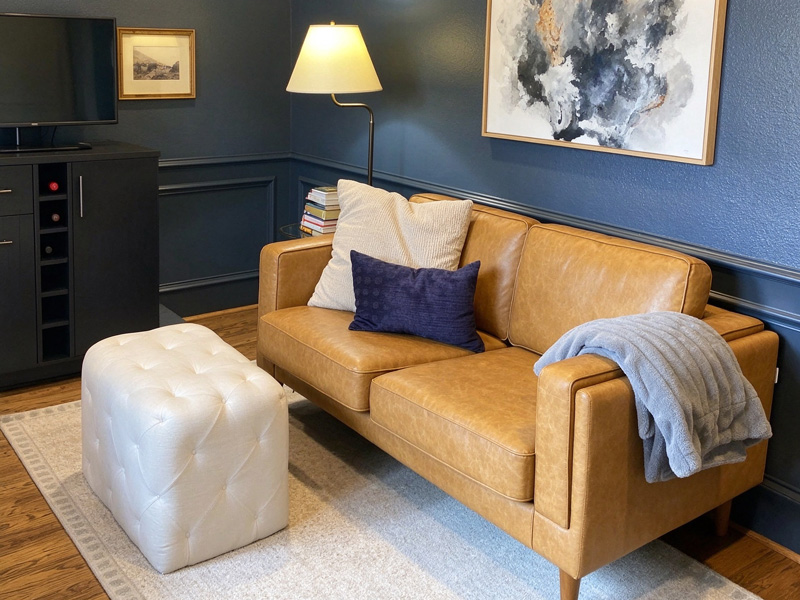
The value case rests on construction that punches above the price band. Sofas across the catalog use kiln-dried hardwood frames — the warp-resistant foundation independent testers treat as the first checkbox of durability — with cushion architecture offered in two recipes: supportive pocket coils wrapped in high-density foam, or mattress-quality foam topped with feathers for the sink-in buyer. Upholstery runs from vegan leather in standard, distressed, and bouclé-adjacent finishes to velvet and linen blends, with the Albany sleeper starting under a thousand dollars and three-seaters clustering between $1,200 and $1,500.
Assembly is leg-attachment minimal, boxes are sized for apartment logistics, and the aesthetic — mid-century bones with contemporary proportions — photographs well enough that the brand's own customer-review wall doubles as a design portfolio. At this price, the construction is genuinely competitive; the question the next sections raise is what the spec sheets do not say.
The transparency gaps the spec sheets skip over
Honesty requires listing what the storefront declines to publish. Fabric specifications — rub counts, fiber origins, stain treatments — are absent, leaving buyers who need pet-grade performance numbers to guess. Manufacturing geography is described only as designing and manufacturing collections through worldwide travel, which is a lovely sentence and not a provenance disclosure. And while the brand states its products are free of harsh chemicals and flame retardants, it holds no third-party certifications — no OEKO-TEX, no GREENGUARD, no FSC — at a moment when, as the Medley review in this category detailed, certified competitors make the paperwork part of the product.
None of these gaps is disqualifying at the price point; all of them are information. Edloe Finch sells construction and style at a fair number, not audited chemistry or factory tours.
No showrooms, free swatches, and thirty-day returns
The commercial terms are the lean-online standard, executed competently. Shipping is free and contactless; fabric swatches — up to four — ship free on request; financing is available at checkout. The return window is thirty days with a return shipping fee of ten percent of the item price capped at $200 — better than the category's worst terms, well short of the hundred-day offers reviewed elsewhere. The absence of showrooms is the structural trade: every purchase is a sight-unseen bet softened only by swatches, photography, and the review archives.
Support runs through chat and email, and the brand advertises A-plus service on its own homepage — a claim the next section must test against the independent record.
How to read the 1.7-star warning correctly
The independent review record is genuinely mixed, and a serious review must put the numbers on the table. On Trustpilot, the brand carries roughly 1.7 stars across only about forty reviews — a small sample, but the complaints within it rhyme: damaged items on arrival, shipping delays, and service that went quiet after the sale. Against that, the brand's own site carries hundreds of positive verified reviews praising value and assembly, and independent comparison reviewers score the construction highly. The reconciliation is not that one record lies; it is that freight furniture is a logistics business wearing a design costume, and this brand's logistics are its most exposed flank.
The practical buyer's protocol follows: inspect thoroughly at delivery and document everything before the freight driver leaves, order swatches first, and treat the thirty-day window as the real deadline it is. Buyers who need white-glove certainty should weigh the hundred-day, fee-structured rivals reviewed in this category instead.
Closing guidance for the budget MCM loyalist
Edloe Finch's storefront is the budget tier's best-argued case for mid-century style: a founder who sold furniture for seven years before founding a brand, kiln-dried frames and pocket coils at four-figure-adjacent prices, a no-showroom cost structure passed through as price, and a two-brand architecture that respects both the browser and the decider. The acquisition by an office-seating manufacturer and the thin independent review base are the two threads to watch.
Buy here if the aesthetic is the goal and the budget is real, if you can accept a thirty-day window and a $200-capped return fee, if you will order swatches and inspect at the curb, and if uncertified-but-stated material safety is sufficient for your household. Buy from Medley for certified chemistry, from Sundays for washable chaos, from Floyd or Burrow for modularity. For the first-apartment mid-century loyalist, this linebacker-built storefront remains one of the internet's most efficient paths from search to sofa.