Floyd at twelve: the table leg that grew into a whole-home brand
Official homepage: https://floydhome.com
Floyd began with a product that was deliberately incomplete: four bent-steel legs, sold in a canvas bag, that clamped onto any flat surface — a door, a slab of plywood, a piece of stone — to become a table. The Kickstarter that launched it in 2014 sought $18,000 and closed at $256,000. Twelve years later, the Detroit brand's beds, sofas, and shelves live in more than fifty thousand homes — and, as of early 2025, the company belongs to an Ohio bed manufacturer. This review examines the Shopify storefront through every chapter: the leg, the design doctrine, the modular engineering, the venture money, and the acquisition buyers should know about.
A $500 prototype and a locker-blue powder coat
Kyle Hoff sketched the first Floyd Leg in a Chicago coffee shop in early 2013, living with three Craigslist roommates and one move away from abandoning another particleboard desk. He called manufacturers across the Midwest and was rejected by close to twenty before a small fabricator in Columbus, Ohio agreed to build a single set from his drawings for about $500. The shop had exactly one powder-coat color available — the industrial blue used on school lockers — and Hoff said yes. That accidental color became the prototype, and the clamp-on leg that emerged from it embodied the insight the entire company still runs on: the bulky, expensive, irreplaceable part of furniture is rarely the part that defines it.
The legs solved the serial mover's real problem — furniture that either dies on the curb or costs more to move than to replace — by making the tabletop a found object and the leg the product. Within months of the Kickstarter, Floyd was shipping legs to more than thirty countries, and the canvas bag with four bent legs inside became one of the most recognizable unboxings in direct-to-consumer retail.
Youngstown steel, and why the leg is shaped like an F
The name is a family archive. Hoff is from Youngstown, Ohio — a city defined by its steel mills — and his father, grandfather, and great-grandfather were all named Floyd, all steelworkers. The bent leg, turned sideways, resembles an F. The brand that emerged in a Detroit business incubator in 2013, when Hoff met co-founder Alex O'Dell, was assembled from a family name, a material, and a shape rather than a naming workshop. O'Dell brought a different résumé — a University of Michigan public-policy degree, a telehealth startup in Mumbai, film work in Georgia and Armenia — and the operational temperament that later earned him a Forbes 30 Under 30 nod and carried the company to eight-figure revenue.
That biographical texture matters to a store review because the storefront wears it openly. Product pages credit the Youngstown steel lineage, the garage prototypes, the oral history of the leg; the design principles are published on the site as a named doctrine, which is rarer than it should be in a category built on borrowed Scandinavian adjectives.
Kickstarter math: $18,000 goal, $256,000 reality
The campaign economics deserve a close look, because they explain the company's first five years. The $18,000 goal represented one hundred sets of legs — the break-even point for time and money already spent. The founders shot their own video over a couple of weeks, launched, and watched the first day go okay. Then Kickstarter featured the Leg in its weekly email, and the counter began moving in real time: $60,000, $70,000, and finally $256,273 from 1,395 backers in thirty days, with orders arriving from Tokyo and Moscow.
What the Kickstarter actually bought was not capital but proof — proof that strangers would pre-pay for a weird, incomplete object, which became the template for everything after. Each subsequent product, from the Bed Frame to the Sofa to the Sectional, was developed in the open, tested against the same nomadic-lifestyle brief, and sold with the same expectation that the customer would finish the last mile of assembly. The company still sells the Leg, now refined, more than a decade on — a rarity in DTC, where founding products usually get quietly retired.
Nothing Unnecessary: Floyd's written design doctrine
The storefront publishes three design principles, and they function as a quality-control filter anyone can apply to the catalog. The first, "Nothing Unnecessary," is the famous one: every element must earn its existence, which is why Floyd sofas have exposed, honest structures rather than skirts and cladding. The second — "Constraints make good design" — is the engineering credo: the decision to make every piece ship flat and assemble with minimal tools produced the tension-structured frame systems that reviewers consistently praise for rigidity. The third, "Challenge what already exists," is the least checkable and mostly shows up in products like the expandable bed.
The doctrine gives the store a filter no algorithm can fake: when a Floyd product feels austere, the austerity is traceable to a written rule the founders will defend on the record. Whether you find the result cold or honest is an aesthetic judgment; that it is consistent is a store-quality fact.
The Bed that grows from twin to king
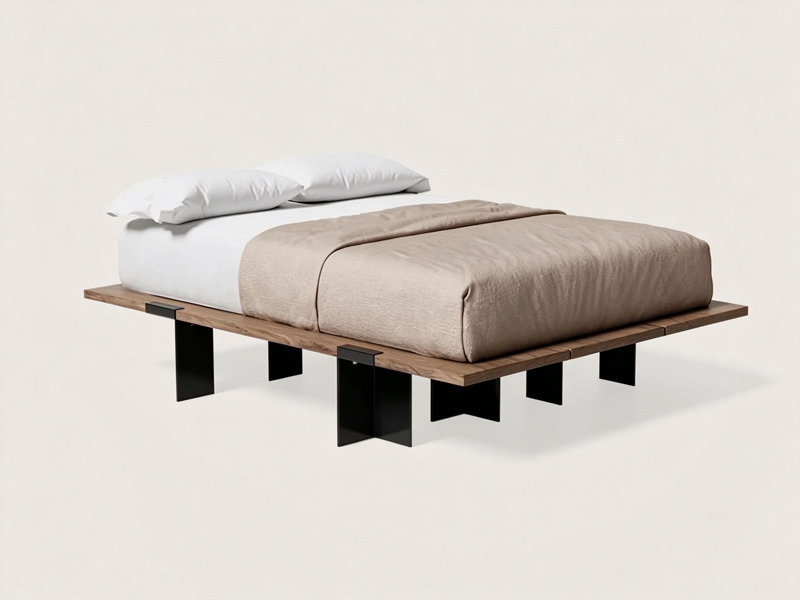
The flagship engineering artifact is the Floyd Bed: a platform frame that converts between sizes — twin, full, queen, king — without new parts, because the design anticipated the customer's next apartment. Expandable slat systems, tension-and-wedge joinery, birch veneer over engineered ply, and stainless hardware mean the bed that survives a move also survives a life-stage change. The first frame was famously hacked together at 250-plus pounds of solid plywood so the founders could get their own mattresses off the floor, and the shipping version retains that overbuilt, tool-light character: two people, under an hour, no specialist vocabulary.
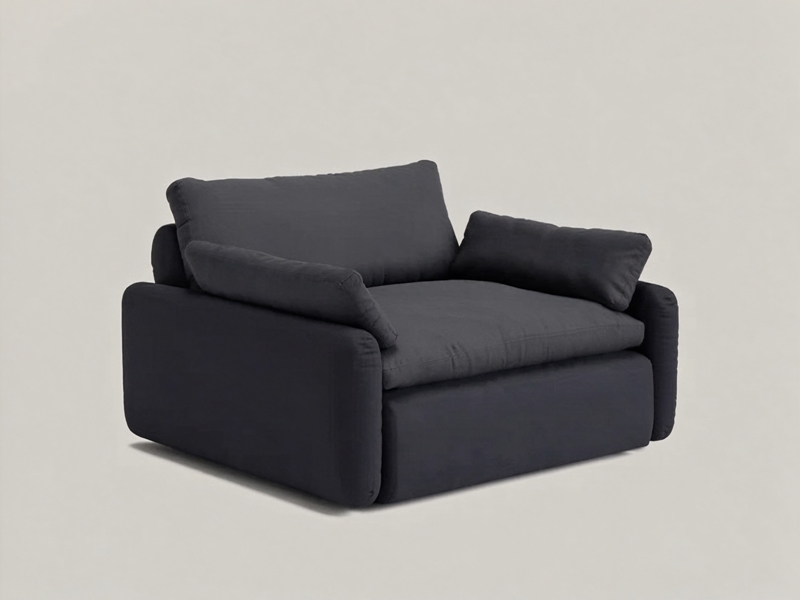
The same logic runs through the sectional — modular units that reconfigure, add seats, and move through doorways that defeat conventional sofas — and the shelving system. For the reviewer's purposes, the pattern is the store's deepest value: furniture engineered around the customer's mobility rather than the manufacturer's logistics. In an industry where "flat-pack" usually means compromise, Floyd's flat-pack is the point.
Fifty thousand homes, twenty-five million dollars
The scale story follows the standard DTC arc with better props: media buzz, social growth, a West Elm partnership, placement in more than fifty thousand homes, and venture capital that reached $25 million by 2021 — including a $15 million Series B led by Walden Ventures with participation from Beringea, La-Z-Boy, and JPMorgan Chase. The company grew from a hundred-square-foot corner of a Detroit coworking space to a twenty-thousand-square-foot headquarters in Eastern Market, employing sixty-two people at its peak — with access to the Great Lakes manufacturing corridor as a strategic advantage the founders cited repeatedly.
The arc then bent. The pandemic's furniture boom pulled demand forward, and the subsequent bust hit sourcing and logistics hard — the company's own trade coverage describes post-COVID operational strain as the reason the founders began looking for a partner. That candor sets up the chapter that matters most to today's buyer.
The Rize Home acquisition, told honestly
In late 2024, Floyd was acquired by Rize Home, a Cleveland-based manufacturer of bed frames and bedding founded in 1952. The buyer's owner — David Jaffe, a Moosejaw cofounder — has said the right things on the record: Floyd keeps its Detroit office, its brand, its design identity, and its founders, who remain involved in setting direction; what Rize adds is manufacturing depth, logistics efficiency, and a path into physical retail the startup had never cracked. The headquarters moved from Eastern Market to Corktown; terms were not disclosed.
For a store review, the acquisition is neither red flag nor footnote. The DTC furniture graveyard is full of brands that sold and dissolved; the honest reading of the available record is that Floyd's design operation survived its first year under Rize with its doctrine, catalog, and founding voices intact, while gaining a parent that actually manufactures beds. Buyers should note the new ownership, watch the retail expansion with ordinary skepticism, and weigh the founders' continued involvement as the strongest available signal of continuity.
Final advice for the serial mover's next sofa
Floyd's storefront is the most coherent articulation of anti-disposability in American furniture: a written design doctrine, modular engineering that survives apartments and life stages, a founding product still in the catalog twelve years on, and a supply story rooted in a Youngstown steel family. The acquisition by Rize Home closes the startup chapter and opens an industrial one — with the usual risks of new ownership and the unusual benefit of a parent that builds beds for a living.
Buy here if you move often and want furniture engineered for that fact, if exposed structure and honest materials are your aesthetic, if you can assemble a bed with one friend and no cursing, and if a twelve-year product lineage matters more to you than a showroom down the street. Compare against the Burrow review elsewhere on this site if modularity is your primary filter — the two Detroit-era rivals solve the same problem with different philosophies. And as with any recently acquired brand, keep one eye on the catalog over the next year: the doctrine is written down, but the new owners now hold the pen.