EQ3: the twenty-five-year-old canadian furniture veteran betting its american future on e-commerce
Official homepage: https://www.eq3.com
While the direct-to-consumer furniture gold rush burned through venture capital between 2015 and 2022, a vertically integrated manufacturer in Winnipeg quietly did the same job for a quarter century without a single funding round. EQ3 — founded in 2001 inside the Palliser Furniture family empire, named for "emotional quotient in the third dimension" — designs, builds, and sells its own modern furniture, operates a designer line carrying Herman Miller and Marimekko, and in late 2024 closed its last American stores to bet everything on the web. This review examines the storefront of the category's oldest direct model: the family origins, the bench-made thesis, the hybrid manufacturing map, and the e-commerce pivot American buyers now shop.
A German son-in-law and a DeFehr basement
EQ3 is the design-forward offspring of one of Canada's great furniture dynasties. Palliser Furniture was founded in 1944 by Abram Albert DeFehr, a Russian-born immigrant who began making wooden furniture in his home basement in Winnipeg, and grew into one of North America's largest upholstered-furniture manufacturers. In 2001, Peter Tielmann — DeFehr's son-in-law, born and raised in Europe — saw what he has since described as a missing middle in North American furniture: between the small family producers and the big-box manufacturing centers, nobody was offering modern design made in Canada at realistic prices. EQ3 was his answer, launched with Palliser's manufacturing muscle behind it and Tielmann as president and CEO.
The origin explains the store's unusual character: EQ3 is not a startup that discovered manufacturing, but a manufacturer that discovered retail. It designs, engineers, upholsters, and sells under one Winnipeg roof — a vertically integrated posture the 2010s DTC wave would later rediscover and rebrand as a virtue.
What EQ3 actually stands for, and why it matters
The name is a thesis. EQ3 expands to "emotional quotient in the third dimension" — the idea that furniture operates on an emotional register, not merely a functional one. Architectural Digest, profiling the brand's Chelsea flagship, found the executives eager to unpack it, and the company's campaign language has long argued that mental space is more valuable than square footage. President Mark Letain framed the design philosophy as "Canadian by design": comfort-first proportions — larger scale, deeper seats — applied to the functional forms of the northern European tradition, informed by what the company lists as Canadian values of inclusivity, pragmatism, modesty, empathy, and thoughtfulness.
For store reviewers the naming philosophy matters less as poetry than as product constraint: EQ3's catalog consistently chooses livable over sculptural, scaled-for-real-rooms over gallery-piece — a positioning that reads as humility in Winnipeg and as restraint in Manhattan.
The vertical integration thesis, bench-made in Winnipeg
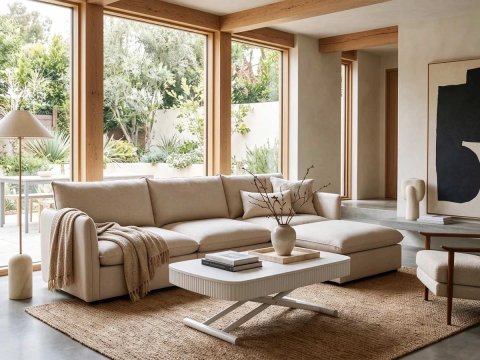
The manufacturing claim is the store's spine: all custom upholstery is bench-made in Winnipeg, at the same headquarters where design, research and development, and merchandising sit under one roof. Buyers ordering a custom sofa are literally commissioning a piece from the same complex that conceived it — the lead time, quoted between roughly four and twelve weeks depending on period and collection, is the price of that proximity. Independent secondary-market dealers who handle used EQ3 describe the construction as physically noticeable: the weight of the frames, the feel of the joinery, a bench-made quality rare at a price point that sits alongside West Elm and Rove Concepts rather than above them.
The flagship retail expression of that integration opened in 2021: a 44,000-square-foot store at Winnipeg's Polo Park mall — the hometown monument to a company that never left its manufacturing zip code.
The hybrid map: Winnipeg, Mexico, and Indonesia
The honest geography is more complicated than the marketing shorthand. Custom upholstery — the category EQ3 is known for — is manufactured in Winnipeg, with some production at a Palliser-owned facility in Mexico. The casegoods and bedroom collections, including the popular Marcel line, are produced at an EQ3-owned plant in Indonesia. The company is transparent about the split, striving to produce as much in Canada as possible while acknowledging that its own factory network spans three countries. Water-based finishes reduce VOC emissions across the lines, FSC-certified wood options exist, and styrofoam has been eliminated from packaging.
The takeaway for the provenance-minded buyer: "made in Canada" applies literally to the upholstery program, not to the entire catalog — a distinction sharper than most national-brand claims and blurrier than a purist would like.
EQ3 Plus: selling Herman Miller and Marimekko
The most unusual shelf in the store belongs to other brands. EQ3 Plus is the company's designer line, an authorized-dealer program carrying Herman Miller, Marimekko, Pablo, and Vitra — with many pieces exclusive to EQ3 in Canada. The arrangement makes the storefront a curated modernist shop rather than a single-brand catalog: a buyer can pair a bench-made EQ3 sofa with an Eames lounge or a Marimekko textile in one cart, one delivery, one warranty relationship. The Marimekko collaboration in particular — bold Finnish prints on EQ3 frames — has produced the kind of limited-run pieces that anchor design-press coverage.
The trade program extends the same logic to professionals: designers and real-estate partners access structured discounts, and the wholesale channel supplies select partner retailers — the infrastructure of a trade brand operating inside a consumer storefront.
The American brick-and-mortar retreat of 2024
The strategic chapter American buyers should know: EQ3 spent the late 2010s expanding stateside — a San Francisco Design District showroom, Chicago locations, a flagship across from the original Barneys in Chelsea — and then, in November 2024, announced the closure of its last U.S. stores, in New York City and Norwalk, Connecticut, by year's end. The company's framing was explicit: the U.S. would be served through e-commerce, trade services, and wholesale partners rather than traditional retail outside Canada. The pandemic's timing had punished the American flagships, which opened just before it, while digital and trade channels grew.
For this review's purposes, the retreat is the story: the Shopify storefront is no longer a companion to American showrooms — it is the American market. That concentrates both the opportunity and the risk: every U.S. customer now experiences the brand exactly as the website performs, with no sofa to sit on first and no local floor for service recovery. The 2026 appointment of Jim Hunt — a company veteran since 2008, elevated to president with a mandate for profitability and intentional growth — signals the era's theme: consolidation, not expansion.
Custom fabrics, memory foam, and the waiting game
The commercial mechanics follow the made-to-order thesis. Customization is extensive — decades of fabric options, multiple leather programs, leg and finish choices — with signature collections like Replay and Cello featuring memory-foam cushions and sculptural curves. Lead times run weeks, not days; the reward is a piece configured to the room rather than the warehouse. The circularity program, ReHome, resells returned and floor-model pieces to keep them out of landfills, giving budget buyers a secondary door into the brand.
The honest texture: the wait punishes the impulsive, the price sits in the band where West Elm discounts compete, and the brand's quiet Canadian modesty means a thinner American review corpus than its twenty-five years deserve. Buyers who validate by volume of Amazon stars will find lesser social proof than newer, louder rivals — a data problem, not a quality verdict.
Closing thoughts for the patient modernist
EQ3's storefront is the category's continuity argument: a manufacturer-retailer that survived the DTC boom and bust without the boom's money or the bust's funeral, built on a family factory, a design philosophy with a name, and a dealer line that borrows Herman Miller's credibility when its own needs amplifying. The 2024 American retail retreat makes the website the whole show for U.S. buyers — a bet that bench-made customization and curated adjacency can win online the sales that showrooms once closed.
Buy here if you want modern design from a real factory rather than a marketing department, if custom upholstery and a four-to-twelve-week wait sound like craftsmanship rather than delay, if the EQ3 Plus shelf — an Eames beside a Marimekko beside a Winnipeg bench-made sofa — matches how you actually shop, and if Canadian-made upholstery with a transparent three-country map is provenance enough. Buy from the faster-shipping budget brands if the wait is the dealbreaker. For the patient modernist furnishing a room for the decade, this quarter-century veteran is the quietly serious option the loud category keeps overlooking.