Embr wave: the MIT wrist thermostat that cools hot flashes without hormones
Official homepage: https://www.embrlabs.com
Embr Wave is the thermal wellness store born from a mundane observation in an MIT lab: three graduate students pulling on sweatshirts indoors while the summer heat raged outside, wondering why comfort required cooling an entire building. Their answer was a Peltier plate worn on the wrist's pulse point that hacks how the brain perceives temperature — and it has since become the most decorated menopause wearable on the market, backed by National Science Foundation grants and a research pipeline that can predict hot flashes before you feel them. This review examines the physics, the clinical program, and the used-market paradox.
Three MIT students and a sweatshirt complaint
In 2013, materials-science graduate students Matthew Smith, David Cohen-Tanugi, and Sam Shames noticed something absurd in their MIT lab: they were donning sweatshirts indoors while Boston summer sweltered outside. Their question — why does comfort mean cooling a whole room when the body only needs convincing? — became a wrist-worn thermoelectric prototype named Wristify that won the university's MADMEC materials-science design competition. The trio founded Embr Labs in 2014, and the consumer version, the Embr Wave, launched after a 2017 Kickstarter that raised over $630,000. The founding instinct was not a gadget but a pathway: temperature as a channel straight to the brain's comfort centers, no air conditioning, no hormones, no pills.
Wristify wins MADMEC, then raises six hundred thirty thousand
The company's trophy shelf tells the credibility story. Investors include Bose Ventures and Intel Capital, and a 2023 round brought $35 million in intellectual-property-based financing led by Ghost Tree Partners. The device itself has collected Time's Best Inventions, the AARP Innovation in Aging Award, the iF Design Award, a Men's Health Sleep Award, and the National Sleep Foundation's Sleep Tech prize, plus a CB Insights Digital Health 150 listing. Government validation runs parallel: the company reports more than $2.5 million in grants from the NIH, the Department of Defense, and the National Science Foundation, alongside research collaborations with Johnson & Johnson. By 2026 the company claimed over 200,000 customers across 170 countries, with more than 100 million minutes of thermal sessions logged.
A Peltier plate on your pulse point
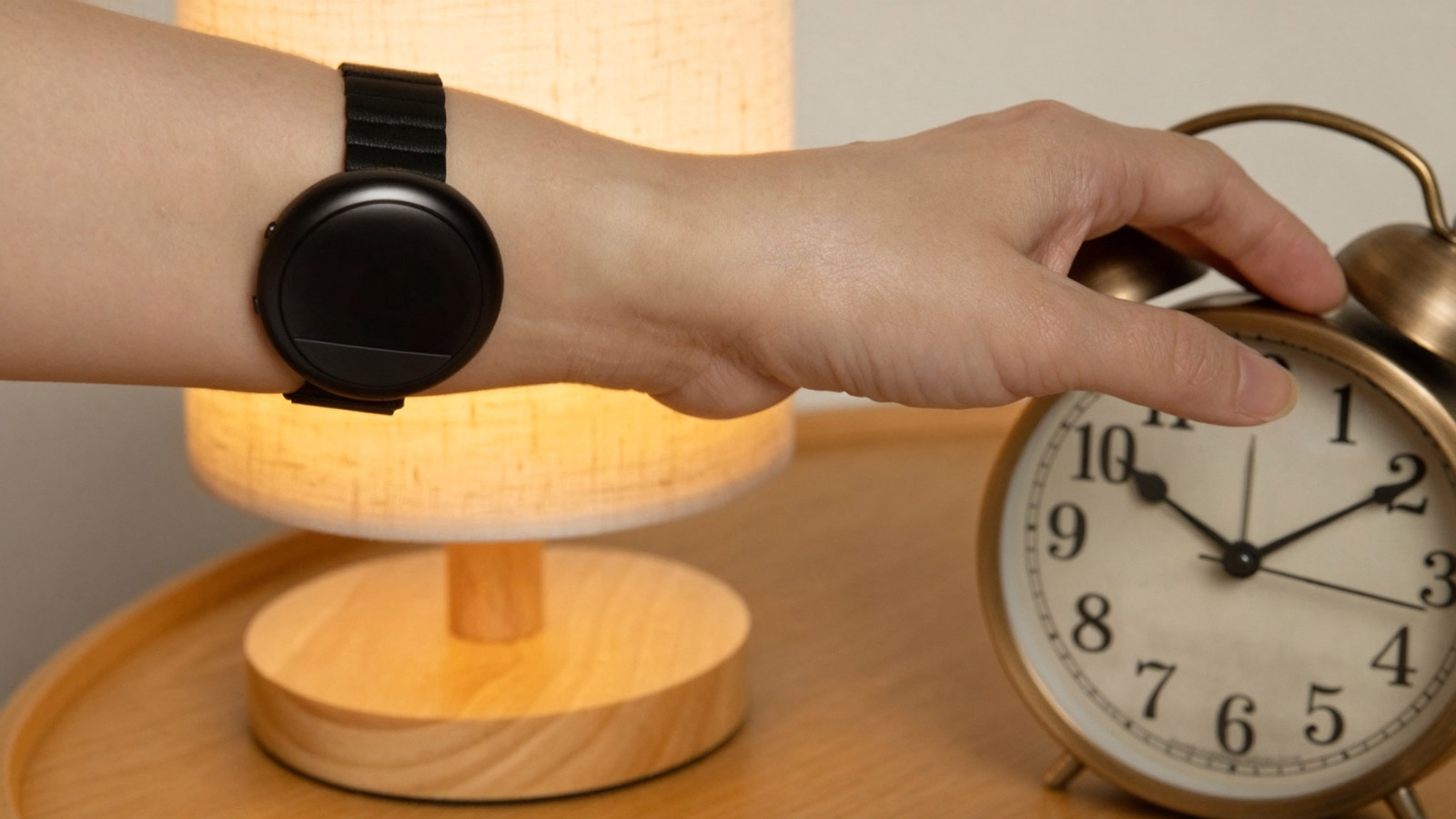
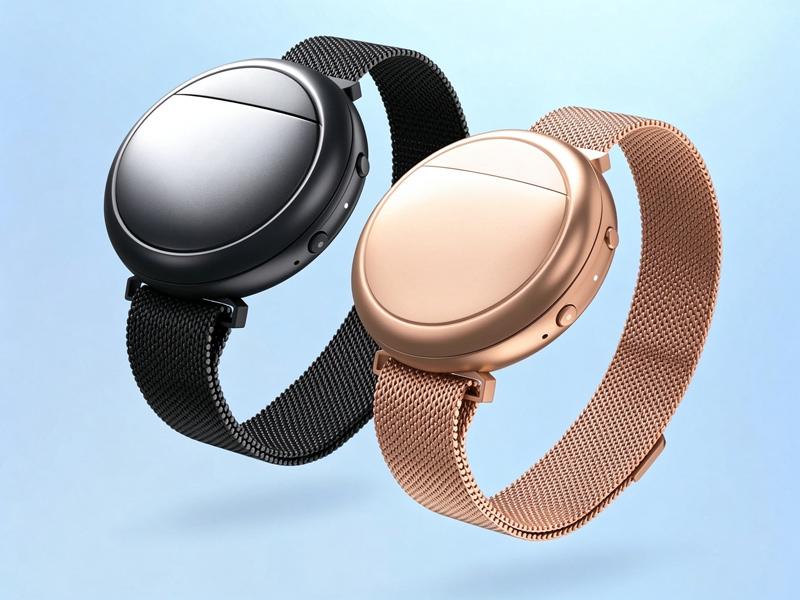
The engineering is deliberately minimal. A thermoelectric Peltier module sits against the inside of the wrist, cooling or warming the dense thermoreceptor field at the pulse point with precisely calibrated waves. The brain, receiving a strong local temperature signal, recalibrates the whole body's perceived comfort — the company's studies show wearers feel about five degrees more comfortable than ambient conditions warrant. Buttons mounted on the edge allow discreet activation, sessions are saved, renamed, and assigned to buttons in the companion app, and a Milanese-loop band makes the device read as jewelry rather than medical equipment. Cooling handles hot flashes, night sweats, and stress; warming handles chills and helps initiate sleep.
Seventy percent of hot flashes, predicted
The clinical pipeline is where Embr separates from wellness gimmicks. In partnership with the University of Massachusetts Amherst's Institute for Applied Life Sciences — a collaboration dating to 2019 — the company built the largest dataset of hot-flash digital biomarkers ever collected and trained machine-learning models that, by 2025, could predict nearly seventy percent of hot flashes before the wearer felt them. The system, described by researchers as a 'reactive digital drug,' triggers automatic cooling at the earliest physiological signatures; Embr holds a patent on biomarker-activated cooling, with a second filed on the predictive algorithms. An earlier pilot presented at the North American Menopause Society found Wave use associated with improved sleep and reduced hot-flash frequency and intensity. The market logic is stark: seventy-five million American women are in perimenopause, menopause, or postmenopause, and the Mayo Clinic estimates related workplace losses at $1.8 billion annually.
Five degrees of perceived comfort
Customer evidence is broad but genuinely polarized. Best Buy's review section holds feature scores of 4.4 for value, 4.6 for quality, and 4.7 for ease of use, with pages of testimonials from menopausal women reporting hot flashes gone 'in less than thirty seconds' and gifting second units to sisters. Against them stand the honest minority: one reviewer pressed the cool button all night only to find the unit 'got hot enough I had to take it off'; an eBay critic wrote that a piece of ice taped to the wrist would last longer than a cooling cycle; and several note the band is clunky for typing. The company itself encodes the expectation: literature on retail listings instructs users to wear the Wave for at least two weeks before judging it, since full effectiveness typically builds over time.
A two-week adjustment period, and the used market
The fine print is unusually instructive. Relief at retail runs $249 on sale against a $299 list, with FSA and HSA eligibility softening the blow — the device sits beside blood pressure monitors in flex-spending catalogs. A Try-Before-You-Buy program lets hesitant buyers test the premise. The striking wrinkle is the secondary market: used Embr Wave 2 units trade on eBay for $32 to $160, an unusually steep depreciation that tells you the product's value concentrates in the experience, not the hardware. Retail distribution spans Best Buy, Walmart — where the device carries over 2,300 reviews — Amazon, and Boots in the UK, and a limited lifetime warranty is listed by authorized resellers, with the two-week adjustment disclaimer doubling as the most honest return-prevention policy on this tag.
The last degree on the Embr Wave
Embr Labs' store sells the most scientifically armored comfort device on this tag: a thermal wearable with MIT origins, government grants, a UMass partnership that predicts hot flashes before they land, and retail ubiquity from Best Buy to Boots. Its honest limits are equally specific: it works for most sufferers, not all; the first two weeks can underwhelm; and the hardware depreciates like electronics while the relief does not. For the roughly forty million women in active menopause who want a non-hormonal option that works at the press of a button — or for anyone whose office runs on someone else's thermostat — it remains the category's reference point. For skeptics, the eBay listings offer the cheapest experiment in thermal placebo science money can buy.