Cordaroy's at twenty-seven: the garage bean bag that outlasted its shark tank deal

Official homepage: https://cordaroys.com
In 1998, a University of Florida graduate was hand-sewing bean bags in a Gainesville garage and made one lazy decision that became a patent: he cut the inner liner square instead of round because circles hurt his hands. When unexpected overnight guests arrived after a Gator football game, the square foam liner came out of the cover and became a bed — and CordaRoy's was born. Twenty-seven years, one famous Shark Tank deal, and a $195 million lifetime-sales record later, the convertible bean bag remains what Byron Young always insisted it was: not furniture, but comfort. This review examines the storefront dimension by dimension: the origin, the kiosk era, the Shark Tank redemption, the lifetime warranty, and the honest physics of shredded foam.
A Gator game, a garage, and a square liner
The founding anecdote is told by Young himself in interviews and on the company's own blog, and it is better than most marketing departments could invent. He began making foam-filled bean bags in a garage on 39th Avenue in Gainesville in 1998, cutting the fabric by hand — and the inner liner ended up square, in his telling, because cutting circles hurt. One night after a Gator football game, unexpected guests needed a bed, the sofa was unacceptable for two people, and he pulled out the square foam insert. The guests raved the next morning, and the bed-inside-a-bean-bag was patented — a happy accident of ergonomics and laziness that has anchored the company ever since.
The garage years were followed by a 2001 investment and rapid early growth that Young has since described as a lesson in growing too fast — twenty-three mall kiosks opened across the country, financed with extended credit to operators, a model that drained the company through the 2001-2009 period until he pulled out of twenty-two of them. One survivor remains at the Mall of America, a fossil of the kiosk era, while the company rebuilt around wholesale and, eventually, its own direct storefront.
Twenty-three kiosks and the 9/11 lesson
The kiosk chapter belongs in this review because it explains the company that exists today. The early-2000s expansion taught Young two lessons he has repeated for two decades: growth financed on operator credit collapses the moment conditions tighten, and a product this bulky lives or dies on logistics — foam is cheap to make and brutally expensive to move. The 2009 retrenchment left the company smaller, founder-controlled, and obsessed with the two things the modern storefront still emphasizes: factory-direct manufacturing and a warranty long enough to make quality an economic necessity rather than a slogan.
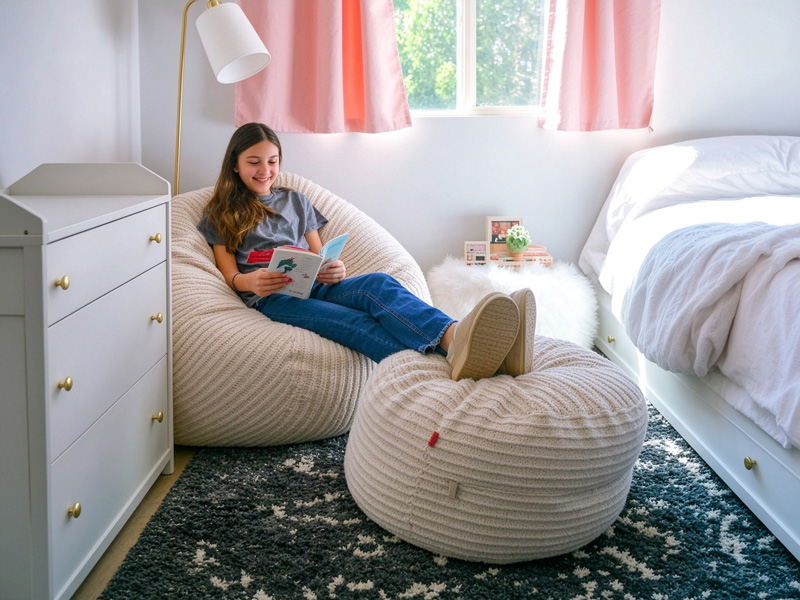
The rebuilt company spent the 2010s quietly selling convertible bean bags in full, queen, and king bed sizes — chair by day, mattress by night — through its own site and wholesale accounts, waiting for the exposure Young knew the product needed and could not afford to buy.
Fifty-eight percent, a crash, and a renegotiation
The exposure arrived via an open casting call in Orlando that Young nearly walked out of, bean bag in hand, until a producer pulled him back. On Shark Tank's fourth season, episode nineteen, in March 2013, he asked $200,000 for twenty percent of a company doing about $1.4 million in annual sales with roughly $100,000 in profit. Four Sharks went out, several citing the patent's limits and the knockoff risk it invited. Lori Greiner stayed, saw QVC potential in the wow-factor conversion, and offered $200,000 for fifty-eight percent. Young took it — and then, in the post-show renegotiation that rarely makes television, the deal changed shape entirely: he kept one hundred percent ownership, and Greiner took a percentage of profits instead, the arrangement that let him later describe the outcome as keeping his company.
The broadcast itself was chaos the brand still cites: the website's traffic jumped from twenty-three daily visitors to twenty-five thousand, crashed for two days, and returned to hundreds of orders a day. Greiner helped rebuild the infrastructure and opened the QVC door; the company landed nationwide Costco placement and, by 2018, a 20,000-square-foot manufacturing facility in nearby Alachua. Trade coverage has put lifetime sales at $195 million as of late 2023 — one of the highest-earning companies ever to swim with the Sharks.
The comfort company: foam, landfills, Alachua
Young's stated ambition in recent interviews is to convert the bean bag company into a comfort company — the same foam platform extended into cooling mattresses, hammocks, dog beds, crash pads, footstools, and blankets, all manufactured around Gainesville and Alachua. The foam itself carries an environmental claim worth quoting precisely: the company uses shredded foam that would otherwise go to landfills, processed and quality-checked as brand-new material, then blown into liners and compressed mattress-style for shipping — the same roll-and-squeeze logistics that the bed-in-a-box category pioneered.
The Gainesville factory doubles as the company's only physical retail: a showroom at its headquarters on West University Avenue, where the product, in Young's words, has to be seen and touched to be appreciated — the anti-Amazon argument in a single store, and for this category a rare surviving example of factory-floor retail.
The lifetime warranty as operating system
The storefront's boldest term is printed in the company's own philosophy: everything starts with the lifetime warranty. Defects are covered for as long as you own the product — and Young has explained the logic inverting the usual order: to offer that warranty, the company must use materials and workmanship that make claims rare, because every claim comes back to the same factory that built the piece. The warranty is not a promise appended to the product; it is the quality-control system the product is built around — double-stitched, machine-washable covers and furniture-grade shredded foam specified to survive decades of compression cycles.
This is the same warranty-as-business-model logic that the cast iron and cookware brands reviewed on this site run, executed in foam and corduroy — and it has supported twenty-seven years of iteration on the same patented form.
QVC, Costco, and the factory showroom
The omnichannel map is pure Shark Tank alumni: QVC, where Greiner's magic did its work; Costco, Sam's Club, and Ace Hardware for the warehouse-and-hardware tier; Amazon for the search economy; and the company's own Shopify flagship for the full catalog — every size, every cover, the nest-style designs with built-in head and neck support, toddler sizes, pet beds, and the factory-exclusive deals that reward the drive to Gainesville. Pricing drifts across channels as it always does for multi-channel comfort brands, and the flagship's defense is what such brands' flagships always defend: the complete range, the lifetime warranty registration, and first-party support.
For buyers, the practical protocol is by now familiar from this category: use the flagship to configure the right size and cover, verify the number across channels, and buy from the seller whose post-purchase machinery you trust.
The physics of shredded foam over decades
The honest physics belong in every review of this product. Shredded foam — even furniture-grade, even double-wrapped — settles and compacts over years of use, and the cure is the same ritual the bean bag category has always demanded: unzip, fluff, redistribute, occasionally top up. Long-term owner reviews are bimodal in the way foam products always are: fifteen-year-old chairs praised for outlasting apartments, alongside complaints — mostly about the pet beds and occasional outliers — describing inserts that compressed and would not rebound. The boxes are heavy in the way compressed foam is always heavy, and faux fur covers, in several reviews' words, love pet hair the way magnets love steel.
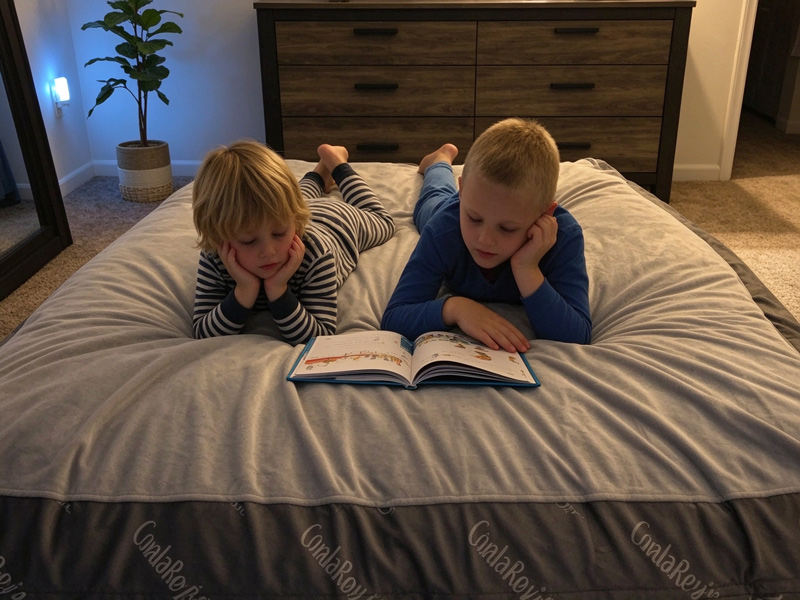
The company's answers are the lifetime warranty, the replaceable covers, and the refill ecosystem; the buyer's answer is calibration — a CordaRoy's is a comfortable chair that becomes a genuinely serviceable guest bed, not a replacement for a mattress a bad back requires.
The verdict for the guest-bed household
CordaRoy's storefront is the comfort category's longest-running one-product argument: twenty-seven years on one patented form, a Shark Tank deal renegotiated into founder control, a factory showroom in the town where it all started, and a lifetime warranty that functions as the company's constitution. The cons are the cons of foam itself: settling, fluffing, heavy boxes, faux-fur maintenance — priced honestly and answered by warranty.
Buy here if your household hosts more often than it has spare bedrooms, if a chair that becomes a queen bed solves a real geometry problem, if you will commit to the fluffing ritual, and if a factory in Gainesville standing behind a lifetime promise counts for more than showroom polish. Buy an air mattress if the guest is annual, or a proper sleeper sofa if the guest is weekly. For the dorm room, the playroom, the reading nook, and the in-laws' arrival, this twenty-seven-year-old garage invention remains the most honestly marketed two-in-one in furniture.