Cleverhood rain cape review: handmade in providence, priced for bike commuters
Official homepage: https://cleverhood.com
Rain jackets end at the waist; rain knows better. Cleverhood built an entire brand on that observation, selling one unfashionable silhouette — the cape — until it became the go-to wet-weather answer for city cyclists from Boston to Copenhagen. Founded in Providence, Rhode Island, by Susan Mocarski, the company remains stubbornly small, family-run, and vocal about street safety. This review examines the store from every side: the Copenhagen-inspired origin, the family operation, the engineering inside a $129 cape, the honest limits of its made-in-America sourcing, the store's policies and community program, and whether a poncho deserves space in your commute kit.
A Copenhagen Bike Lane, a Providence Basement
The origin story starts, fittingly, on a family trip to Copenhagen, where founder Susan Mocarski watched how effortlessly people moved through a rainy city on bikes — and came home unable to find American rainwear that was both genuinely protective and actually presentable off the bike. The company dates its founding to 2010, and in April 2012 the first rain capes launched from Providence's newly revived downtown "Knowledge District." The premise was simple and contrarian: instead of sealing riders into sweat-box jackets, a cape creates a ventilated tent over the rider, the handlebars, and whatever they are carrying. Fellow commuters noticed Mocarski's early handsewn prototypes before any marketing existed, and word of mouth did the rest — the same way the brand still grows today, mostly through cycling communities rather than advertising.
The Family Business Behind the Seams
Cleverhood is structured as a deliberate smallness. Mocarski runs design and production with a Rhode Island manufacturing base — tapping sewing shops in nearby Cranston, Westerly, and Smithfield, plus a Fall River, Massachusetts factory — while her brother Jon Coulbourn oversees marketing and communications, her son Sam serves as resident "Gen Y adviser," and longtime family friend Albania Delgado handles accounting. The cape line itself is a catalog of local affection: colorways named T.F. Green (the Providence airport), Mr. Fox Point (a neighborhood), and Ocean State Blue. In interviews with the Boston Globe and textile trade press, Mocarski has been candid that scaling is "something of an uphill ride" — first factories said no, local sewers were scarce enough that she was recruiting them in bakeries — and that the cape still accounts for roughly 85% of all sales. The catalog has since broadened to jackets, a kids' line, cold-weather accessories, and special editions, but the cape remains the business.
Thumb Loops, Helmet Hoods, and Radar Prints
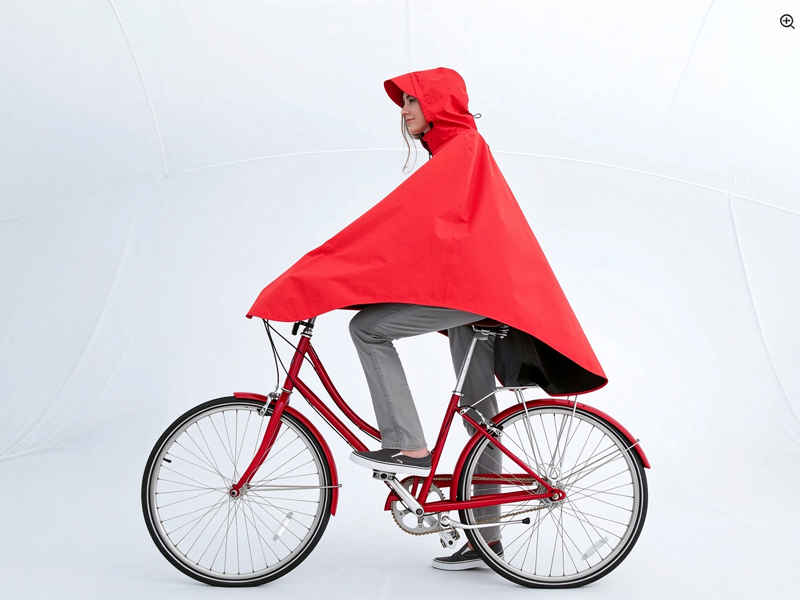
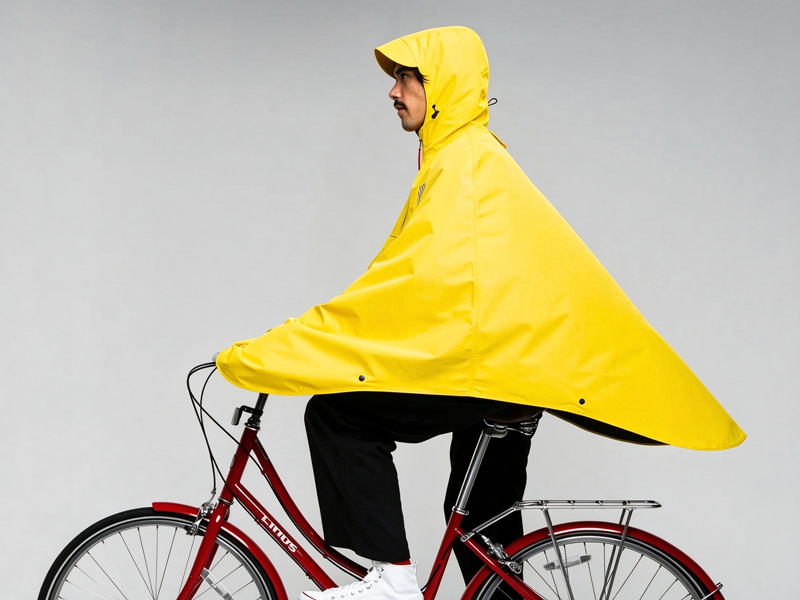
The product engineering is where the brand justifies its prices. Current capes use waterproof-breathable membranes with PFAS-free C0 durable water repellent, fully taped seams, YKK waterproof zippers, and high-lumen 3M Scotchlite reflectivity — with some patterns interweaving reflective thread directly into Glen plaid and houndstooth weaves. Cycling-specific details carry over from the original design: a hood sized to fit over a helmet with clear peripheral vision, elastic thumb loops that hold the cape over your hands on the bars, stealth magnetic fastenings, and a back cinch that keeps the garment from ballooning in crosswinds. The generous front pocket doubles as a self-stowing pouch. In September 2025 the company pushed further into design territory with Stormy, a limited-edition series printed from NOAA Doppler radar imagery of intensified storm patterns — every garment cut from the roll differently, so no two are identical. WIRED has named the line its best rain gear for cycling three years running, and the Rover 2.0 cape on the site carries a 4.76-out-of-5 average rating from verified buyers.
Sewing in America, Sourcing From Everywhere
The made-in-America claim deserves precision, and to its credit the company has never hidden the fine print. Garments are designed and sewn in Rhode Island, roughly half the fabric is sourced domestically — the black YKK zippers are American-made, while other colors are imported — and local suppliers simply could not meet every technical requirement, pushing some sourcing offshore. What the company adds on top of domestic production is a civic position: Cleverhood donates 5% of sales to organizations making streets safer and more walkable, and the store sells co-branded capes and jackets benefiting named partners — Bike Bus, The War on Cars, Black Girls Do Bike, Bike New York, Cascade Bicycle Club, and others. For buyers who treat purchases as values statements, this is structural philanthropy rather than a seasonal marketing campaign; for buyers who only care about the garment, it is simply part of the price.
The Store Itself: Returns, Ratings, and Real Support
The web shop is a straightforward Shopify storefront with a country-currency selector and a small, legible catalog: the Rover 2.0 Rain Cape opens at $129, with earlier models like the Zipster having listed near $169 and special editions running higher. Policies are reasonable and clearly written: returns and exchanges within 30 days on unworn, tagged items — the site encourages trying gear on inside, even straddling your bike indoors to check thumb-loop and handlebar reach — with free exchanges and returns in the US only; custom and final-sale items are excluded. Support runs through a published email address rather than a ticket labyrinth, and the site maintains genuinely useful long-tail content: fit guides, garment-care instructions, a retailer list for the US, Canada, Denmark, Japan, and Australia, and a "Rain Faces" photo series of actual customers. There is no app, no loyalty program, and no chat widget — consistent with a company this size, and either charming or limiting depending on your expectations.
Cape or Jacket: Committing to the Silhouette
The honest trade-offs are few but real. A cape is a niche garment: it excels for upright city riding and walking, drapes over backpacks, and ventilates far better than any jacket, but it flaps on fast descents, catches wind without the back cinch cinched, and looks like a poncho at the office — which is the point for some buyers and a dealbreaker for others. At $129 to $169-plus, Cleverhood also costs several times what generic ponchos do, and the brand's dependence on one hero product means colorway and size availability can thin out between production runs. But nothing else on the market matches the combination of cycle-specific engineering, domestic sewing, verified 4.76-star buyer ratings, and a standing 5% give-back to street-safety causes. If your commute involves rain and a bicycle, this small Providence shop deserves its cult.