Arkel, the canadian pannier maker quietly outbuilding the german industry standard
Official homepage: https://arkel.ca
Ask a room of long-distance cyclists about panniers and the German brand gets mentioned first. Ask the ones who have actually crossed a continent, and the conversation usually turns to Arkel. Founded in 1988 in a Montreal basement, the Quebec company has spent nearly four decades building bicycle luggage that treats failure as unacceptable — welded seams, aluminum Cam-Lock hooks, and a lifetime warranty with no expiry date. Now based in Sherbrooke with most production still in-province, Arkel runs a web store that ships worldwide. This review examines the company's story, its unusual factory model, the product range, and what decades of touring feedback say about whether the premium is justified.
Two Cyclists Sew Bags in a Montreal Basement
In 1988, Serge Vigeant and Diane Laplante were cyclists frustrated by the lack of bicycle bags that could survive daily commuting and long-distance touring alike. Their solution was to design and hand-sew their own prototypes in Serge's basement, and the name they chose — Arkel, borrowed from a comic-strip character — has now been stitched into luggage for thirty-seven years. The company soon outgrew the basement, moved to Sherbrooke in Quebec's Eastern Townships, and built an international distribution network on a single principle: build bags for people who cannot afford a failure a thousand kilometres from the nearest bike shop. Its oldest continuous model, the expedition-grade GT-54 pannier, has been in production since 1993 — a longer run than most bike brands have existed.
A Factory That Shares Its Work with the Community
Roughly eighty percent of Arkel's products are still manufactured in Quebec with local vendors, and the factory floor has a feature most competitors cannot copy. Around 2003, Arkel partnered with CRDITED Estrie, a local social service organization, and people with intellectual and developmental disabilities now perform final assembly and finishing work on the panniers. The arrangement is not charity branding; it is a durable production model that has run for over two decades and reflects how the company thinks about equipment — things built carefully, by people who take time to do it right, last longer. In 2022, Quebec entrepreneur Marc Desrosiers took over the reins with a stated commitment to continuing the Canadian-made tradition.
The Cam-Lock Hook That Keeps Bags on Racks
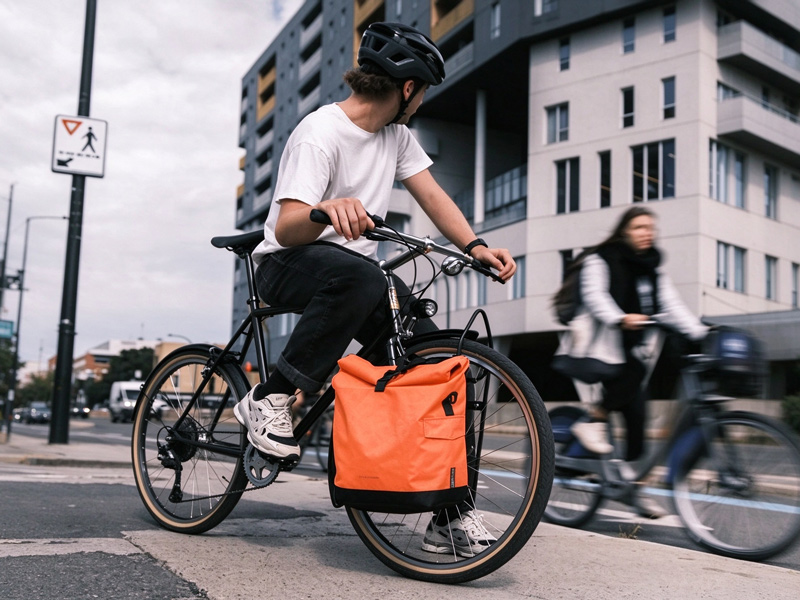
Ask Arkel owners what converted them and most will name one part: the Cam-Lock attachment system. Where most panniers hang from plastic hooks that rattle loose on washboard roads, Arkel's patented aluminum cams self-adjust and self-lock onto the rack rail, gripping at the top and braced at the side. Cyclists who have crashed on gravel, launched off speed bumps, and covered tens of thousands of kilometres report the same thing — the mounting hardware has never failed. That sounds like a small thing until you meet another tourist waiting in a random city for replacement hooks from a rival brand. For expedition luggage, the part you never think about is the part that matters most, and the Cam-Lock is why Arkel's reputation among people who actually tour exceeds even its marketing.
Roll-Tops for Purists, Pockets for Everyone Else
The modern catalog splits neatly into two philosophies. The Orca line — 25, 35, and 45 litres — is the minimalist's choice: radio-frequency welded seams with no stitches to leak, a roll-top closure, side straps to prevent unrolling, D-rings for an optional shoulder strap, and light tabs with reflective panels. It is 100 percent waterproof, hose-down washable, and famously stiff to roll until broken in. The Dolphin series adds sewn-and-taped construction with separate compartments and mesh pockets for about two hundred pounds a pair. And then there is the GT-54, the pocket-rich expedition classic that reviewers have called the Rolls-Royce of touring panniers, plus a Randonneur rack, Seatpacker and Rollpacker seat bags with aluminum hangers, and lines for commuting and e-bikes. Whatever your packing style, there is an Arkel built for it.
What a Year in South America Proved About Durability
The reviews that matter for this category come from people who cannot pop home for a warranty claim. One couple rode their Orca 45s more than ten thousand kilometres through South America — Amazon rainstorms, Colombian mud, repeated crashes — and reported zero mounting failures and gear that stayed completely dry overnight in thunderstorms. Testers in other comparisons chose the Orca over the industry-standard German rival for exactly one reason: stability, with the bag glued to the rack at top and side. The recurring criticisms are equally consistent — the fabric is heavier than ultralight options at around 2.2 kilograms a pair for the 45s, the stiff roll-top is less elegant than a strap closure, and colour choices sit at grey or red. Owners tend to concede every point and buy another set anyway.
A Lifetime Warranty Without Fine-Print Escape Hatches
Every pannier and bag Arkel sells carries a lifetime warranty against defects in materials and workmanship, covering the stitching, the aluminum hooks, rails, nuts, screws, and the internal stiffening backplate. There is no registration window to miss and no prorated schedule — the company's stated logic is simple, since its bags routinely outlast their first owners. Because production is local and in-house, a warranty conversation goes directly to the people who built the bag rather than through an offshore supplier. For luggage that might carry your passport, tent, and dry clothes through a foreign monsoon, that accountability chain is a genuine feature, and it is one the store states plainly rather than burying in policy pages.
The Price of Never Buying Panniers Twice
The honest objection is cost. An Orca 35 lists around $235 and the 45 around $260, with the GT-54 pushing past five hundred Canadian dollars — firmly above budget roll-tops and roughly neck-and-neck with the premium German competition. The weight, too, is real: two kilograms of welded fabric and aluminum is not for racers. What the price buys is amortization — owners routinely report fifteen, twenty, thirty thousand kilometres on a single set, which makes the per-kilometre cost trivial and explains why the brand dominates the used market at surprising prices. Arkel's own site shows Orca owners rating the bags 4.7 out of 5, and the pattern across independent reviews suggests the people who complain loudest about the price are the ones who have not yet worn out a cheaper bag's third set of hooks.
Who Should Load These Bags and Ride Away
Arkel makes the most sense for a rider whose trip has a return date measured in months, whose route includes places without bike shops, or whose commute abuses luggage daily for years on end. It also suits the pragmatic sentimentalist: the bags are not fashionable, the colours are conservative, and nobody will photograph your panniers — but they will still be on your rack in 2045. If you count grams, chase aesthetics, or replace gear every season, you will find cheaper and lighter options easily. If you want to buy luggage once, load it, and forget it exists until you need what's inside, this store has spent thirty-seven years making exactly that product.