A trapeze, a sorbonne degree, and the crib that built brooklyn's kids' design scene
Official homepage: https://oeufnyc.com
When Sophie Demenge's mother — an antiques dealer in Paris — wanted her daughter to look closely at the world, she used one word: regarde. Demenge grew up schlepped through flea markets and auctions, studied philosophy at the Sorbonne, flew trapeze in San Francisco, and eventually earned an industrial-design degree at Pratt. When she and her husband Michael Ryan — a political-science graduate turned antiques dealer turned Greenpoint metal fabricator — could not find a crib they would want to live with for their first child in 2002, they built one. That crib became Oeuf, and Oeuf became the brand that made children's furniture a design category. This review examines the storefront dimension by dimension: the founders' improbable path, the Latvian factory marriage, the Andean material ledger, the Passive House office, and the honest physics of premium kids' furniture.
A trapeze, the Sorbonne, and a first crib
The founders' biographies read like a casting director's idea of a Brooklyn design couple. Demenge was raised in Paris by an antiques-dealer mother who dragged her daughters to markets and auctions across Europe; the French word for look — regarde — still conjures those trips, and her childhood was built from artists' studios, museums, and a bohemian mother's constant travel. She moved to the United States in her early twenties after her mother's death, spent years in San Francisco — where among other things she took flying-trapeze classes — then applied to Pratt for industrial design. Ryan, born and raised in upstate New York, studied political science, became an antiques dealer, and ended up running a metal-fabricating business and design studio in Greenpoint, Brooklyn. They met when she was finishing her degree; the studio was already making furniture, ceramics, and objects together when a pregnancy in 2002 changed the subject.
The company's own blog describes the moment without nostalgia: at the time, no other kids' brand was producing modern furniture or clothing in natural materials and colors. Their response — a crib designed and built for their daughter Mae — was the first Oeuf product, and the name is the philosophy: oeuf, egg, the symbol of simplicity, strength, and fragility, with a wink at the French term for a nurturing parent. The motto that emerged, Be Good, is printed more often in interviews than on products.
Greenpoint metal and the design studio years
Before Oeuf there was R+D Designs, the couple's home-goods studio, whose ingenious pieces established their working method: Ryan's engineer's eye for construction and minimalist detail, Demenge's playful-practical instinct. Those years matter to the storefront because they explain its texture — furniture that reads as studio work rather than juvenile merchandising, clothing that reads as small-batch fashion rather than licensed characters. When the baby arrived, the studio's skills turned toward the nursery, and a chance encounter with a Bolivian woman in Manhattan opened the clothing side almost as accidentally as the crib had — a mini collection that grew into the Peru and Bolivia production the brand runs today.
The pattern of Oeuf's expansion — furniture from the needs of their own children, clothing from a serendipitous human connection — has remained the company's product-development engine for two decades.
The twenty-year factory marriage in Latvia
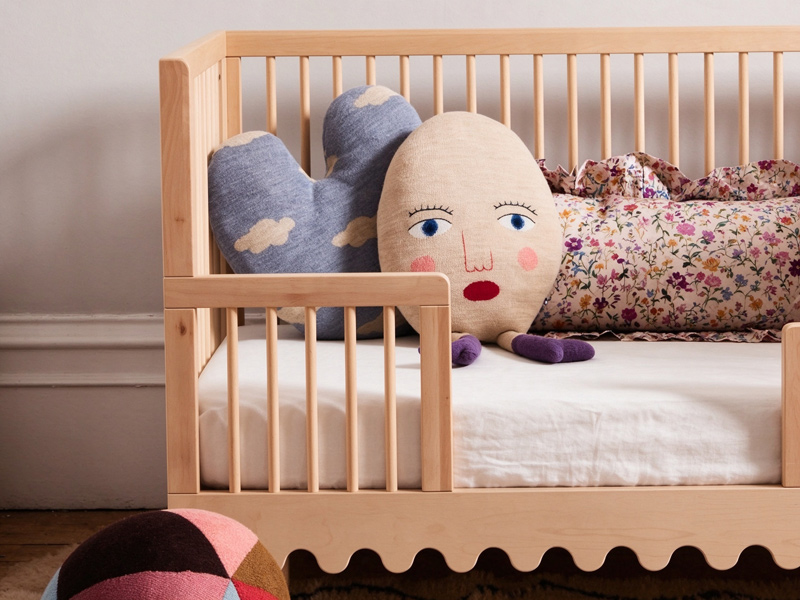
All Oeuf furniture is made in Europe, and the anchor is a remarkable supply-chain statistic: a roughly twenty-year relationship with the same FSC-certified factory in Latvia, a country with a deep woodworking tradition. The factory runs on renewable energy and European environmental and labor standards, and the furniture — cribs, the Perch bunk system, dressers, the Mini Library bookcases — is built from Baltic birch plywood and eco-MDF with non-toxic, water-based finishes that carry GREENGUARD Gold certification for low chemical emissions. The brand's product pages name the certifications the way the cookware brands reviewed on this site name theirs: FSC for the wood, GREENGUARD Gold for the air around it.
In an industry where kids' furniture is frequently rebranded import catalogs, a two-decade single-factory relationship is the store's deepest moat — the consistency reviewers notice across fifteen-year-old pieces and new arrivals alike.
Peru's Pima cotton and Bolivia's alpaca
The textile ledger extends the ethics south from Europe. The clothing line runs on 100 percent GOTS-certified organic Pima cotton produced in Peru, chosen for its softness and durability, and on baby alpaca wool sourced in Bolivia from farmers committed to animal welfare — the company's founding fair-trade partnerships, running for two decades alongside the furniture factory. Hand-loomed rugs join the line, hand-dyed in small batches with water-based dyes. The material vocabulary is consistent across categories: natural fibers, honest dyes, named countries, named certs.
The baby-alpaca program in particular functions as the brand's aesthetic signature — the chunky knits and whimsical animal silhouettes that appear on product pages beside FSC cribs, tying the apparel and furniture halves of the catalog into one recognizable sensibility.
A Passive House office in Prospect Heights
In 2022 the company applied its design principles to its own building, moving into a new office in Brooklyn's Prospect Heights built to the Passive House standard — the aggressive European energy framework requiring roughly ninety percent less energy for heating and cooling. The specifications read like the product pages inverted: triple-pane windows for insulation and soundproofing, twelve-inch walls packed with cellulose insulation, airtight construction, heat-recovery ventilation, thermal-bridge-free design, and rooftop solar panels. The founders chose the site for its walkable proximity to their home — the same intentionality the brand applies to materials applied to commuting.
For a store review, the office is evidence of coherence: a company that sells parents on low-emission nurseries operating from a building engineered to the strictest energy standard on the continent is the same claim at two scales, and the company's own copy frames it exactly that way — as a full-circle demonstration.
Convertible by design, and the hand-me-down economy
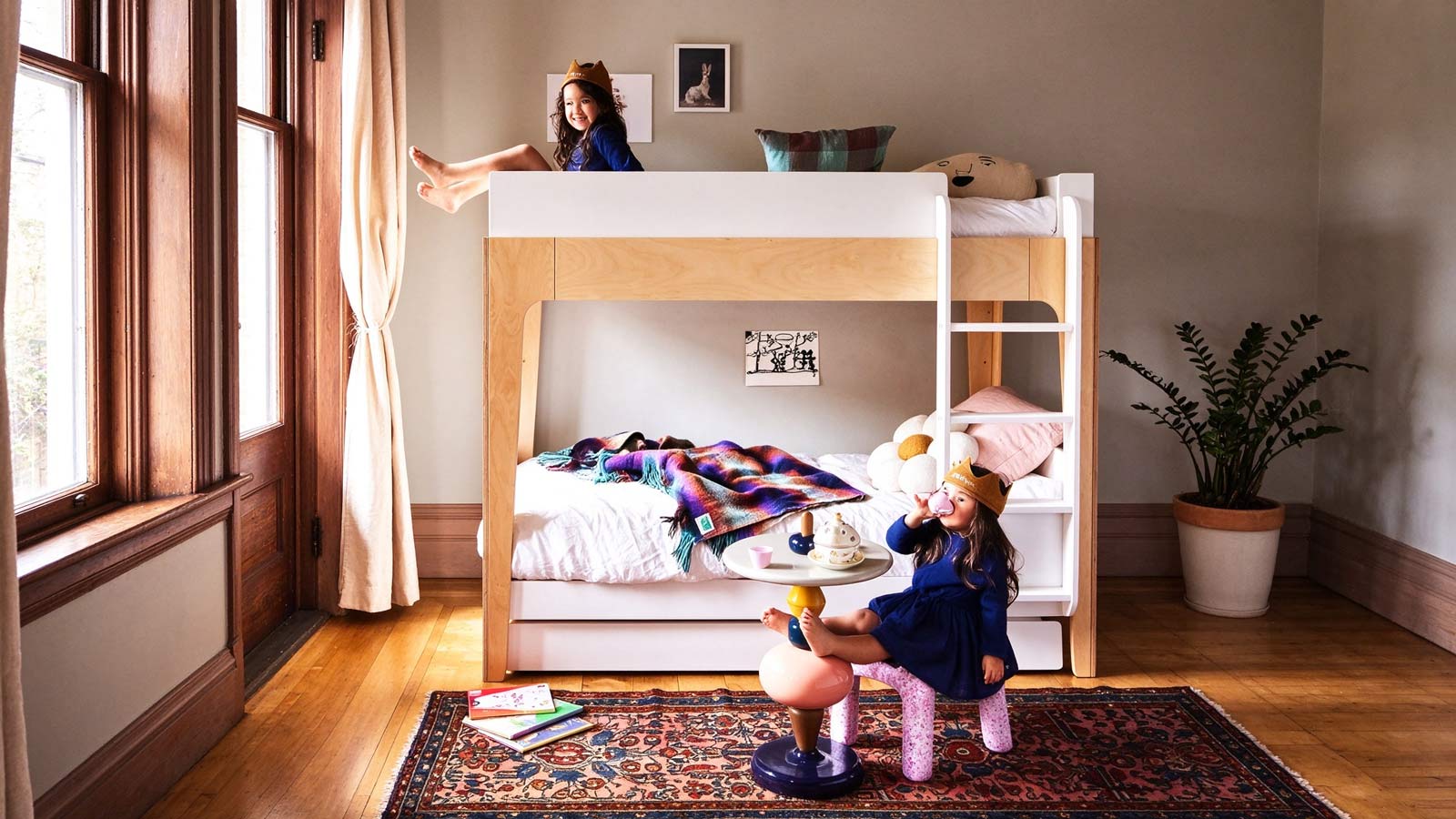
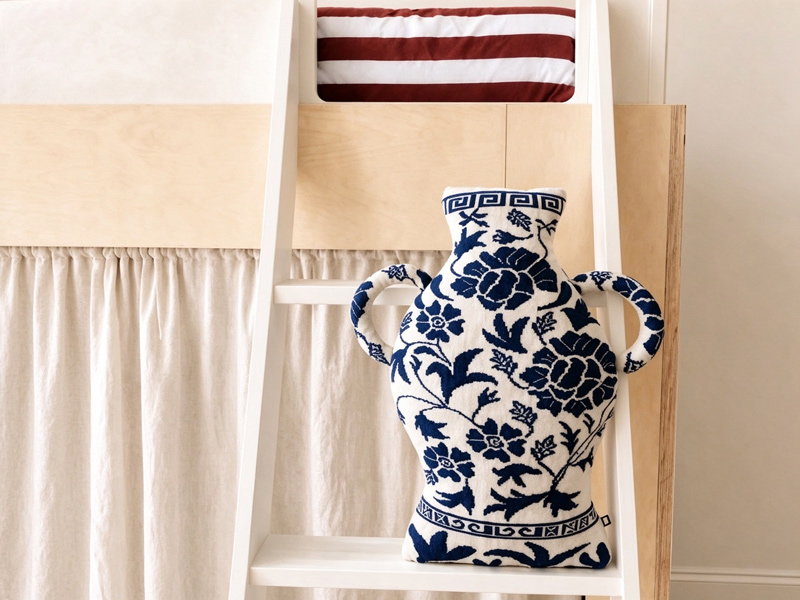
The furniture is engineered around the hand-me-down thesis the brand states plainly: pieces made to be loved hard and handed down. The Sparrow crib converts to a toddler bed with a side-rail kit that carries the same child to roughly age six; the Perch bunk — designed for their son Marius, launched in 2011 — is a low-rise bunk with an angled staircase and reversible configurations, convertible between bunk, loft, and twin-plus-trundle so a room can evolve without new furniture. The Mini Library bookcase and Toy Store storage system complete the room's architecture. When families are done, the brand encourages the second life explicitly, curating a pre-loved shop on a resale platform and celebrating community resales of its clothing and furniture.
This is the anti-fast-furniture argument executed in a category where it matters most — furniture for people who outgrow everything in eighteen months — and it converts Oeuf's premium pricing into an amortization story: one crib, two children, a toddler conversion, and a resale value at the end.
Moss, and the brand's maximalist turn
For two decades the furniture line was minimalist by constitution — Ryan's engineer's restraint dominating the forms, Demenge's boldness living in the clothing. In 2024 the balance shifted: the Moss collection was designed by Demenge alone, a wave-motif suite in saturated Tomato red and Peapod green alongside classic birch, photographed in the founders' own brownstone with props from their children's younger years. The company's framing was candid — maximalism is having its moment, but for Demenge it is simply how they live — and the collection reads as the brand acknowledging that its original minimalist customers have become wallpaper-and-antiques collectors like her mother. In 2026 the curation extended further with Marché, a shop of sustainable favorites from Europe, America, India, and Japan selected by Demenge — the antiques-dealer's eye turned retail curator.
The strategic signal matters: a brand entering its third decade refreshing its aesthetic register rather than defending it, under the same two founders who built the original.
The verdict for the design-led nursery
Oeuf's storefront is the kids' furniture category's founding document: the 2002 crib that started a design movement, still produced by the same Baltic factory after twenty years, wrapped in the same ethics — FSC wood, GREENGUARD Gold finishes, fair-trade Andean textiles — and backed by conversion engineering that treats furniture as a multi-child investment. The honest texture belongs in the ledger: premium prices that demand the hand-me-down math to work, lead times that stretch four to six weeks on out-of-stock pieces, warranty terms shorter than the heirloom positioning implies, and boutique-first distribution that makes the flagship the research hub rather than the only door.
Buy here if you are furnishing a nursery or a shared room and intend the pieces to survive two children and a resale, if GREENGUARD Gold and FSC paperwork are the language of trust you speak, if the Perch's low-rise staircase beats a ladder for your climbing toddler, and if a brand run by the same couple who built its first crib still counts for something. Buy the mass-market convertible cribs if the amortization math does not close, or the flat-pack giants if the room turns over faster than the furniture can. For the design-led nursery — the one that started this whole category — this Brooklyn storefront remains the original and, two decades in, still the reference.