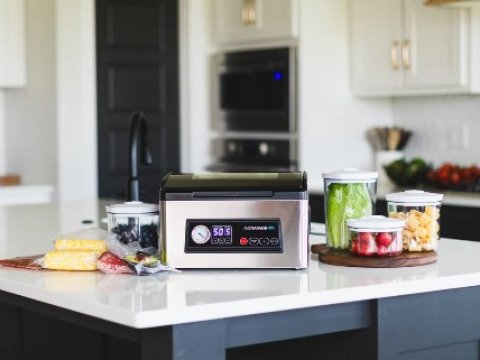
A sous vide machine with no screen sent him back to the drawing board
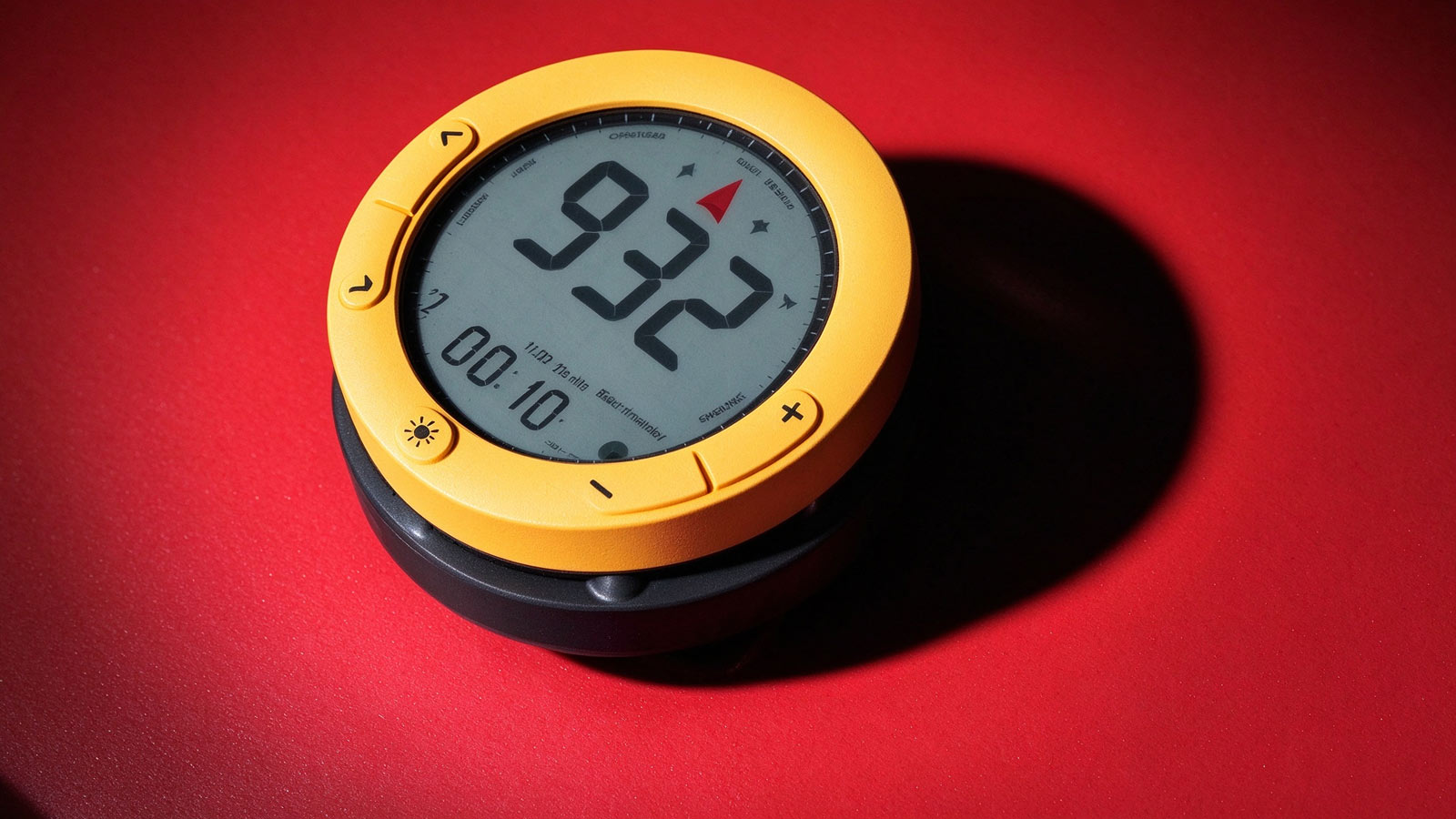
Official homepage: https://combustion.inc/
Combustion is the kind of store that exists because its founder made an expensive mistake once and refused to repeat it. Chris Young built ChefSteps into the company behind the Joule sous vide circulator, watched it get acquired by Breville in 2019, and then started over with a thermometer that answers a question most probes never even ask: not how hot is the food right now, but when will it be done? This review looks at Combustion from every angle — the founder's history, the eight-sensor probe, the prediction engine, the oversized display, the battery and connectivity, and whether a thermometer this clever earns its price.
The Exit That Taught Chris Young What Kitchens Really Want
Chris Young's résumé reads like a history of modernist cooking: he co-authored Nathan Myhrvold's Modernist Cuisine volumes, then founded ChefSteps in Seattle in 2012 to teach the science of cooking through videos and interactive content. In 2015 the company launched Joule, a $179 sous vide circulator controlled entirely by smartphone, and it became a cult favorite — until funding dried up, layoffs gutted the team in April 2019, and Breville Group acquired the company that July. Young has said publicly that skipping a screen on the Joule cost it half its potential customers. In February 2021, GeekWire reported he was back with a new Seattle startup called Combustion Inc., and pre-orders for a predictive thermometer opened at $139, with shipping planned for mid-2022. Every design choice in the store seems to be a correction to something the Joule got wrong.
Eight Sensors Where Most Probes Use Two
The Predictive Thermometer's core trick is density. Where a typical wireless probe hides one or two sensors at its tip, Combustion packs eight temperature sensors along the shaft, reading the center, the surface, and the ambient air around the food at the same time. That gradient matters: the surface temperature is what the food is actually cooking at, and it can run far below the oven's set temperature as the food sweats and evaporates. From those readings the probe estimates the size and shape of what you're cooking, which is what makes prediction possible at all. The probe is also marketed as the thinnest wireless thermometer on the market — about 36 percent smaller in cross-section than competing probes — and it doubles as an instant-read for quick checks. It is a laboratory instrument shrunk into a cooking tool, priced at $149 on its own.
The Countdown That Guesses When Dinner Will Be Done
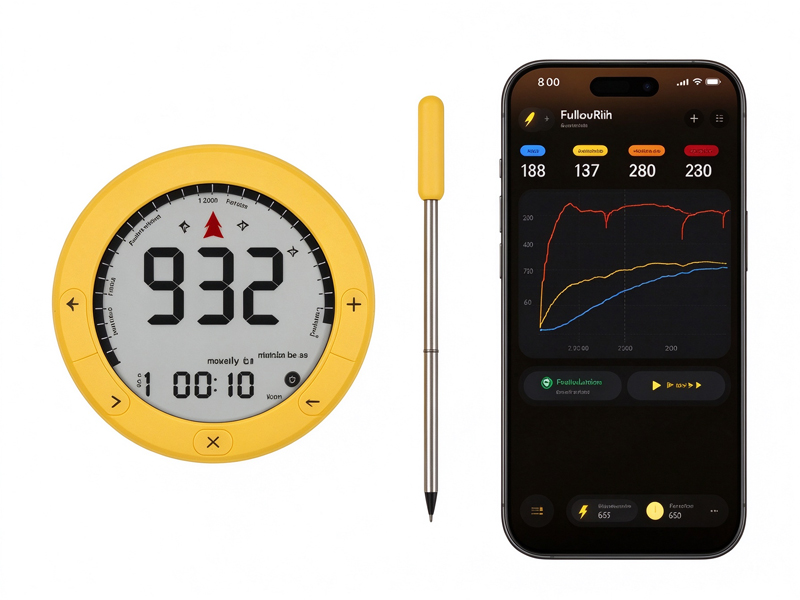
Prediction is the whole pitch. Because the probe knows the temperature throughout the food rather than a single point, the Combustion app and display can show a live countdown to the moment your roast hits its target doneness — and, just as usefully, how long the food should rest, since carryover cooking continues after it leaves the heat. The algorithm recalculates if things run hotter or faster than expected, so the countdown stays honest when your grill flares or your oven drifts. In practice, reviewers describe the experience as genuinely liberating: insert the probe, set a target, walk away, and come back when told. It is the rare smart-kitchen promise — set it and actually forget it — that survives contact with a busy weeknight.
A Display Big Enough to Read Across the Patio
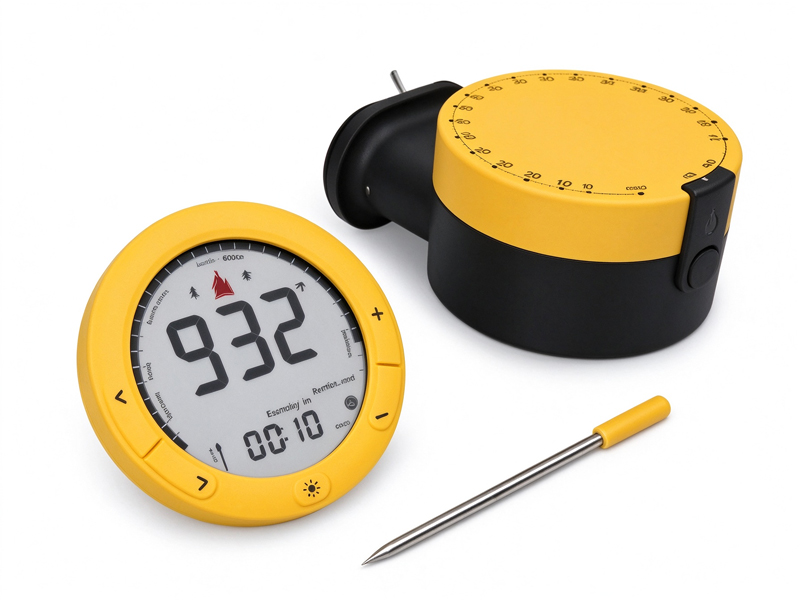
The Joule's app-only philosophy is inverted here. The flagship bundle pairs the probe with a WiFi Display ($119, or $199 with the thermometer), a chunky countertop unit with a bright multicolor backlight that shows core, surface, and ambient temperatures plus the countdown, readable from across a kitchen or a dark patio. It manages up to four Predictive Thermometers at once, stretches Bluetooth range by roughly 330 feet, and doubles as a plain kitchen timer; a phone is optional, not mandatory. For outdoor cooks there is even a Giant Grill Gauge kit at $298 with a mounted outdoor display. The whole lineup reads like a company that decided screens were never the enemy — hiding data behind an app was.
Charging, Range, and the Quiet WiFi Backbone
The hardware details hold up. The probe logs for up to 30 hours on a charge and sleeps for up to 100 days on standby, and the charging case refills it to about 80 percent in ten minutes — a full charge takes roughly twenty, so a dead probe never means a ruined cook. The optional WiFi Booster bridges the probe to your network for monitoring from anywhere, feeding the free Combustion app on iOS, Android, macOS, and even Apple Watch, with cloud access through the company's MeatNet service at no subscription cost. Kits are tiered cleanly: thermometer alone at $149, the Booster bundle at $189, the Display bundle at $199, and bigger bundles for pitmasters running multiple probes. Every product carries a two-year warranty, and the store keeps parts, mounts, cases, and accessories stocked rather than forcing bundle upgrades.
Who Actually Needs a Thermometer This Clever
The honest answer, as one Wired reviewer put it, is not the average cook — it's the geek willing to spend around $200 on a thermometer, and even then it won't be the only probe in the drawer, because nothing here replaces a fast instant-read for spot checks. That caveat frames the whole store. Combustion sits in a crowded field against Meater, ThermoWorks, and Typhur, and its advantages — true doneness prediction, surface-temperature data, a screen that doesn't require your phone — matter most to people who cook large cuts, grill in the dark, or nerd out on the physics of it. For them, this is the most thoughtfully engineered thermometer store on the market, backed by a founder who has already lived through one hardware company's rise and rescue. For everyone else, a $25 instant-read remains the smarter first purchase.