Satechi at twenty: the apple-first accessory brand that outlasted the dongle era
Official homepage: https://satechi.net
In December 2005, two San Diego college friends named Alan and Brock started an accessories company in a garage; their first hit, an FM transmitter for iPods, arrived by April 2006. Twenty years later, Satechi sells brushed-aluminum hubs, docks, chargers, and keyboards in more than sixty countries, counts Apple, Disney, Netflix, and Major League Baseball among its enterprise customers, and took home nine CES awards in 2025. This review evaluates the Shopify storefront behind that longevity — its design-led product strategy, its eco-premium positioning, its B2B machine, and whether the famous aesthetic premium is still justified in 2026.
Two college friends, one garage, December 2005
Satechi's origin story follows the classic Southern California template. Founders Alan and Brock — the About page gives only first names — were college friends who decided in December 2005 that tech accessories could work better and look better than the sea of uninspired gadgets then surrounding the iPod. Working from a San Diego garage, they shipped their first big hit in April 2006: an FM transmitter that turned any car radio into an iPod dock, years before Bluetooth audio was standard.
The company remains privately held two decades on — corporate registries list the operating entity as Sariana LLC — with design, engineering, and support in San Diego, a second office in Asia, and manufacturing in China, the standard arrangement for precision aluminum consumer electronics. That independence is rarer than it sounds: unlike Belkin (sold to Foxconn) or countless Kickstarter brands absorbed into larger groups, Satechi has spent twenty years answering only to its own roadmap.
Twenty years of product waves, from FM transmitters onward
The catalog's evolution tracks the industry's connectors. After the FM-transmitter era, Satechi's 2009 breakthrough was a line of sleek presentation remotes that became office and classroom staples — a reminder that the brand sold simplicity before it sold aluminum. Between 2010 and 2012 it pivoted hard toward Apple, defining the brushed-aluminum, minimalist, Space Gray product language it still uses, and in 2012 it launched on Amazon UK, expanding across Europe by 2014.
Today's storefront is organized into clear waves: USB-C hubs and dongles anchored by the Aluminum Pro Hub family designed around specific MacBook generations; docking stations including a Thunderbolt 4 multi-display dock and the Dual Dock Stand for MacBook that Macworld reviewed; power products from slim travel adapters up to the ChargeView 240W desktop GaN charger; input devices such as the SM-series slim mechanical keyboards; stands and ergonomic risers; plus two newer lifestyle collections — OntheGo for travel and FindAll for tracker-equipped accessories. The breadth means the store functions less like a peripheral shop and more like a full desk-outfitting catalog for Apple users.
The aluminum design language that matches your Mac
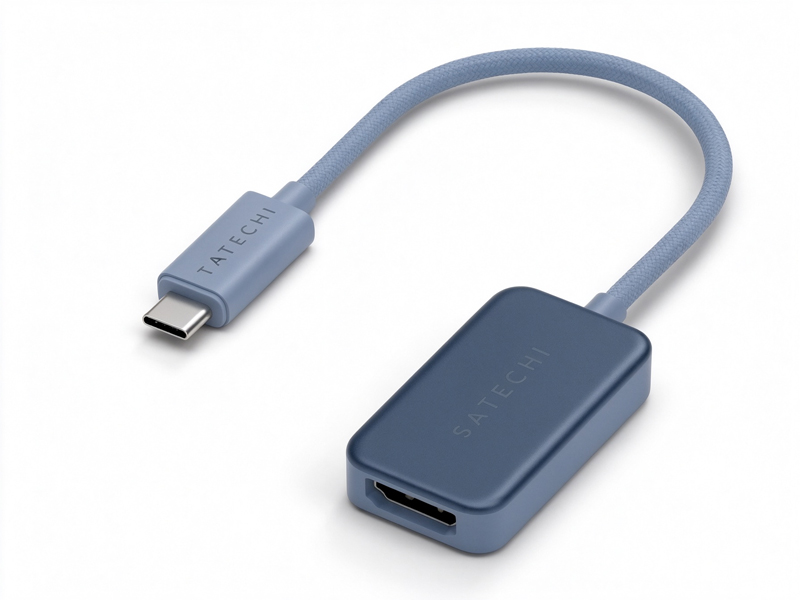
Satechi's core promise is visual coherence: accessories that look like Apple designed them. Precision-milled brushed aluminum, minimalist silhouettes, Space Gray and silver finishes, and tight dimensional tolerances — the Mac Mini Stand & Hub, for instance, sits under the Mini like a factory base while adding USB ports, card readers, a headphone jack, and on some versions an M.2 SSD slot. For buyers who curate their desks, this coherence is the product; functionally equivalent black plastic from Anker or Ugreen offends the same eye that bought a $1,500 laptop.
The trade-offs hide in the spec sheets. Several of the slimmer, cheaper adapters cap HDMI output at 4K 30Hz rather than the 60Hz office workers increasingly expect, and the premium finish comes with a price tag typically twenty to forty percent above functionally similar competitors. The design-led approach also means Satechi refreshes its line to follow Apple's industrial-design cadence — wonderful when your Mac is current, occasionally awkward when a new MacBook port layout arrives and last year's form-fitting hub no longer quite fits.
Hubs, docks, chargers, keyboards: the catalog's weak spots
Not every Satechi category earns equal marks. The hubs and docks are the mature, heavily reviewed core — generally reliable, thermally well-behaved in recent generations, and honestly spec'd. The keyboard and mouse lines are weaker: the slim SM-series mechanical keyboards trade keycap material and switch choice for thinness, and reviewers consistently note that specialist keyboard brands deliver more typing quality per dollar. Satechi's input devices are better understood as desk-completing furniture than as enthusiast tools.
Support and warranty terms are adequate rather than exceptional: a one-year warranty sits at the industry minimum, and the support experience is email-first, competent, and unremarkable. The Shopify storefront itself is polished — clean navigation, product finders, and frequent bundling — though promotional pricing rotates often enough that patient buyers are rarely punished. None of this is a scandal; it simply marks the boundary between a design brand at the top of its categories and one competing in categories where engineering depth matters more than finish.
Sustainability claims, packaging, and eco-premium positioning
Since roughly 2022, Satechi has wrapped its design story in an environmental one, marketing itself as an "eco-premium" brand. The verifiable claims are modest and specific: 100% recyclable packaging across the catalog, a stated shift toward recycled aluminum and reduced-plastic construction, and longevity-by-design messaging that leans on the argument that an accessory kept for five years beats three cheap ones replaced annually. The company exhibits the sustainability posture at trade shows like IFA alongside the standard CES awards circuit.
Cautious buyers should note what is absent: no published lifecycle analyses, no third-party certification program comparable to B Corp, and no take-back or recycling scheme for end-of-life accessories. Within a category where "green" marketing ranges from meaningless to substantive, Satechi sits in the honest middle — real packaging and materials work, framed with more enthusiasm than evidence. It is a legitimate consideration, not a reason to pay the premium by itself.
Enterprise accounts and global distribution beyond the storefront
The consumer storefront is only half the business. Satechi's enterprise page describes wholesale and resale tiers, purchase-order procurement with named account management for IT teams, corporate gifting with customization, and education pricing for K-12 and universities — a B2B machine substantial enough to count Apple, Disney, Netflix, and Major League Baseball as named customers. Distribution spans sixty-plus countries through Amazon marketplaces, regional distributors, and localized storefronts such as Satechi's Nordic operation.
For individual buyers, the practical upshot is availability and legitimacy: products are rarely out of stock for long, regional warehouses shorten shipping, and the brand's retail presence makes price comparison easy. The Shopify flagship itself handles the full catalog, bundles, and loyalty-style promotions, and it is where limited colorways and newer collections tend to appear first. The storefront experience is mature — the twenty years show in small details like compatibility filters that actually map to current Mac, iPad, and iPhone generations.
The Apple-tax question: value versus aesthetics
Every Satechi purchase decision eventually arrives at the same question: how much is coherence worth? On raw specifications, the brand rarely wins. Anker, Ugreen, and Baseus ship equivalent port counts, wattages, and resolutions for meaningfully less money, and engineering-first brands offer deeper compatibility documentation. What Satechi sells is the absence of visual compromise — the hub that looks like it shipped with the MacBook, the stand that continues the monitor's line, the charger that doesn't embarrass a client-facing desk.
The honest answer depends on the buyer. Design professionals and client-facing setups routinely pay the premium and consider it a work expense; spec-driven buyers who hide their hubs under desks are simply overspending here. Satechi's keyboards sharpen the point: if typing quality outranks looks, the same money buys demonstrably more elsewhere in this very category.
The verdict for loyalists of the Apple ecosystem
Two decades in, Satechi has earned something few accessory brands achieve: default-option status for a specific buyer. If your desk runs on current-generation Apple hardware and you care how it looks, the storefront is a one-stop catalog with genuine breadth, mature retail operations, enterprise-grade legitimacy, and design coherence nobody at this scale matches. The eco-premium framing is partially earned, the CES hardware is real, and the B2B machinery means the brand will still be here when the warranty question matters.
Skip the store if your priority is maximum ports per dollar, 4K60 on a budget, mechanical keyboard enthusiasm, or open-platform tinkering — every one of those desires is served better by specialists reviewed across this site. But for the Apple-loyalist mainstream, Satechi in 2026 remains what it has been since the Space Gray era began: the safe, beautiful, slightly expensive answer.