Jumpsport: the man who made trampolines safe and got almost nothing

Official homepage: https://www.jumpsport.com
JumpSport is the store with the most bittersweet origin story on this tag. In the late 1990s, Mark Publicover built the first trampoline safety enclosure in his garage, patented it, and watched it become standard equipment on nearly every trampoline sold in America — while copycats took the market and lawsuits consumed his company. Today the store sells a different product entirely: premium fitness rebounders with cord systems engineered to survive a million and a half bounces. This review traces the safety crusade, the patent war, and the pivot that saved the company.
A garage prototype and a patent, 1995 to 2000
The invention began where most backyard anxieties do: watching children. Mark Publicover built the first trampoline enclosure in his garage around 1995, formed JumpSport in 1997, and spent five years and more than a million dollars — much of it his own money — before turning a profit. The patent, granted in April 2000, described a net completely surrounding a trampoline, held by a frame above the bed; by 2002 the Los Angeles Times found him selling roughly eight hundred enclosures a day at about two hundred dollars each. The engineering obsession never stopped: after breaking his own leg on a rival's trampoline, he patented shock-absorbing bed technologies — StageBounce and DoubleBounce — that later earned safety recognition from the Consumer Product Safety Commission. Silicon Valley's Band of Angels funded the growth in 2000, and by 2014 he held twenty-four patents.
Eight hundred enclosures a day, then a lawsuit
The betrayal came early. Publicover sold two hundred units to Sam's Club as a market test, which led to a verbal order for six thousand that evaporated when the retailer switched to a cheaper competitor's enclosure — one later deemed unsafe by the Consumer Product Safety Commission. Low-quality knockoffs flooded the market, and in 2001 Publicover sued Wal-Mart, Hedstrom, Jump King, and others. The war lasted five years: a settlement in the seven figures — around six hundred thousand dollars — arrived from Hedstrom and Jump King, while Wal-Mart escaped liability but was barred from selling the copycats. A second suit against Dick's Sporting Goods ran from 2017 to 2018. The arithmetic still stings: Fortune's profile quotes him claiming over fifty million dollars in lost sales by 2008, and notes that his fifteen-employee company commanding thirteen million in sales held less than one percent of the enclosure market his invention had created.
Sam's Club, Jump King, and a 296,000-unit recall
The Sam's Club episode deserves its own paragraph because it became the industry's cautionary tale. The competitor the retailer chose, Jump King, saw its enclosures recalled in 2005 — 296,000 units, after the CPSC deemed the design unsafe. Publicover's version had been on the market first; the cheaper copy won the shelf, failed the safety test, and filled recall bins. The story circulates among inventors as the canonical example of patent protection arriving slower than market theft: his legal fees, he has said, should have been at least double what they were. Yet the legacy is undeniable — the same Fortune account observes that nearly every one of the 1.2 million trampolines sold annually in the United States now ships with an enclosure. The neighborhood trampolines bouncing behind American houses wear his idea, whatever the market share says.
Six hundred thousand dollars and fifty million lost
The settlement-versus-losses ledger is the story's arithmetic lesson: roughly $600,000 recovered against a claimed $50 million in stolen sales, five years of litigation against some of retail's biggest names, and a company that survived anyway. Publicover's response was to keep inventing — the shock-absorbing beds, arched-leg stability designs, and later the elastic-cord systems that would define the company's second life. The lesson he distills for other inventors is unsentimental: if you create something of value, it represents a market that huge corporations will pursue, and the patent system will not arrive in time to defend it by itself.
The pivot: from backyard nets to EnduroLast cords
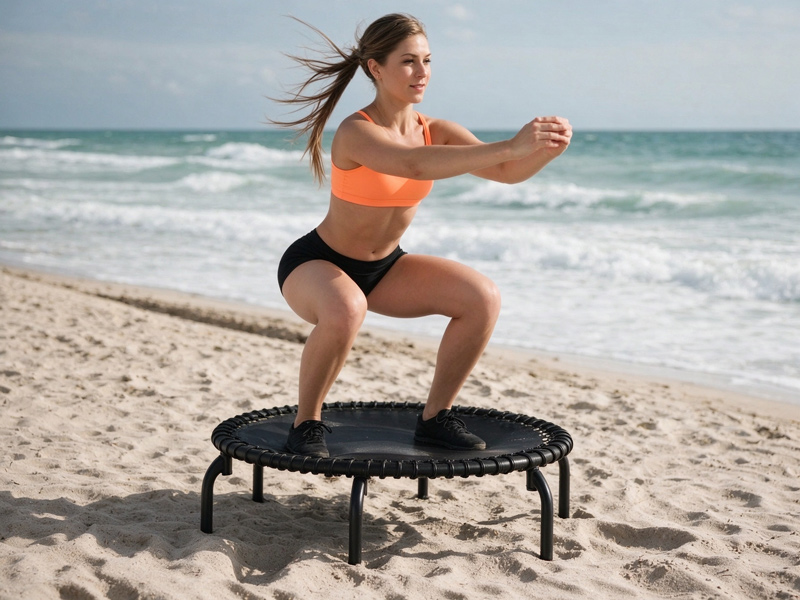
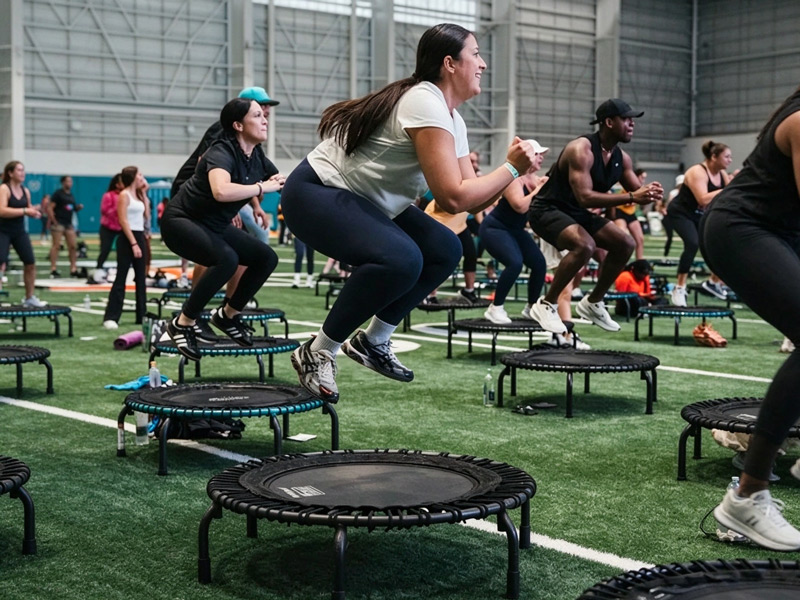
Walk into jumpsport.com today and you will find no backyard trampolines at all — the company's big-yard line lives under its AlleyOOP sub-brand on a separate storefront — but a complete system of fitness rebounders. Six models ladder from the 39-inch Essential at $279 to the 48-inch PRO at $649, each built around the engineering the patent wars made second nature: EnduroLast elastic cords tested from 400,000 to 1.6 million bounce cycles against roughly 200,000 for standard bungees; four-knot adjustable tension across seven firmness settings; patented arched legs that refuse to tip during dynamic exercise; weight ratings to 425 pounds. Warranties run lifetime on frames for home use, four years on mats and cords, and HSA/FSA eligibility now applies to orders. A 60-day free trial of JumpSport Fitness TV ships with every unit, and the accessory wall — handle bars, carry bags, weighted cuffs, even electrolyte drink mix — turns the rebounder into an ecosystem.
Twenty international stores and a bounce instructor program
The current company behaves like a fitness brand, not a wounded inventor. The site lists more than twenty international storefronts spanning Australia, Canada, Mexico, most of Western Europe, and beyond; a Find a Club directory and Become a Bounce Instructor program build instructor-led demand; a podcast and 2026 Fitness Guide publish training content; and a replacement-parts category keeps cords, mats, and feet serviceable for years. The irony is quiet and worth naming: the man who fought to cage the backyard trampoline now sells a category that needs no enclosure at all — the rebounder's low, stable, cord-suspended bed is safe by physics rather than by netting. Some crusades end in reinvention.
The last bounce of the safety crusade
JumpSport's store sells the best-engineered rebounders in the category — cords rated to a million and a half bounces, no-tip arched legs, lifetime frame warranties — wrapped in a community and content ecosystem that treats bouncing as training. Its trade-offs are the honest ones of a premium pivot: entry prices three times the cheap bungee boards, a company identity split between this storefront and the AlleyOOP backyard site, and a founding story whose $600,000 settlement will never balance the $50 million ledger. But for the garage-gym buyer who wants joints saved and cords that outlive the treadmill, this is the engineering choice — from the man who made the backyard safe, then found a safer backyard of his own.