How a redmond garage startup became the docking station IT departments swear by
Official homepage: https://plugable.com
Plugable began in September 2009 when former IBM and Microsoft engineer Bernie Thompson sold a single USB 2.0 docking station from his Redmond, Washington garage. Sixteen years later the company claims the title of the number one docking station brand, serves more than 200,000 businesses, and competes head-on with Anker, Ugreen, and the laptop makers' own docks. This review examines the store behind that growth — its founder's unusual pedigree, a compatibility-first product philosophy, Amazon-scale sales machinery, engineer-staffed support, and the honest trade-offs buyers should weigh before checkout.
From IBM OS/2 code to a Redmond garage startup
Bernie Thompson's path to founding Plugable ran through the plumbing of personal computing itself. He wrote OS/2's SVGA video driver at IBM in the mid-1990s, founded an early open-source marketplace called Cosource.com in 1998, ran the Linux division at Applix, then spent six years at Microsoft managing the USB and Bluetooth teams — he was the primary developer of Windows' Bluetooth serial emulation driver. A final stint as DisplayLink's Vice President of Software Platforms in 2008 put the last piece in place.
In September 2009, Thompson launched Plugable with the UD-160-A: a single-display USB 2.0 dock built on DisplayLink chips, offering DVI or VGA output up to 1680x1050, four USB 2.0 ports, Fast Ethernet, and audio jacks. The insight was unglamorous and durable — docks from Dell, HP, and Lenovo only worked with their own machines, and nobody else was building universal ones with real engineering support behind them. The company still occupies Redmond, minutes from Microsoft's campus, with a team estimated at roughly 45 people.
One hundred products and millions of docks later
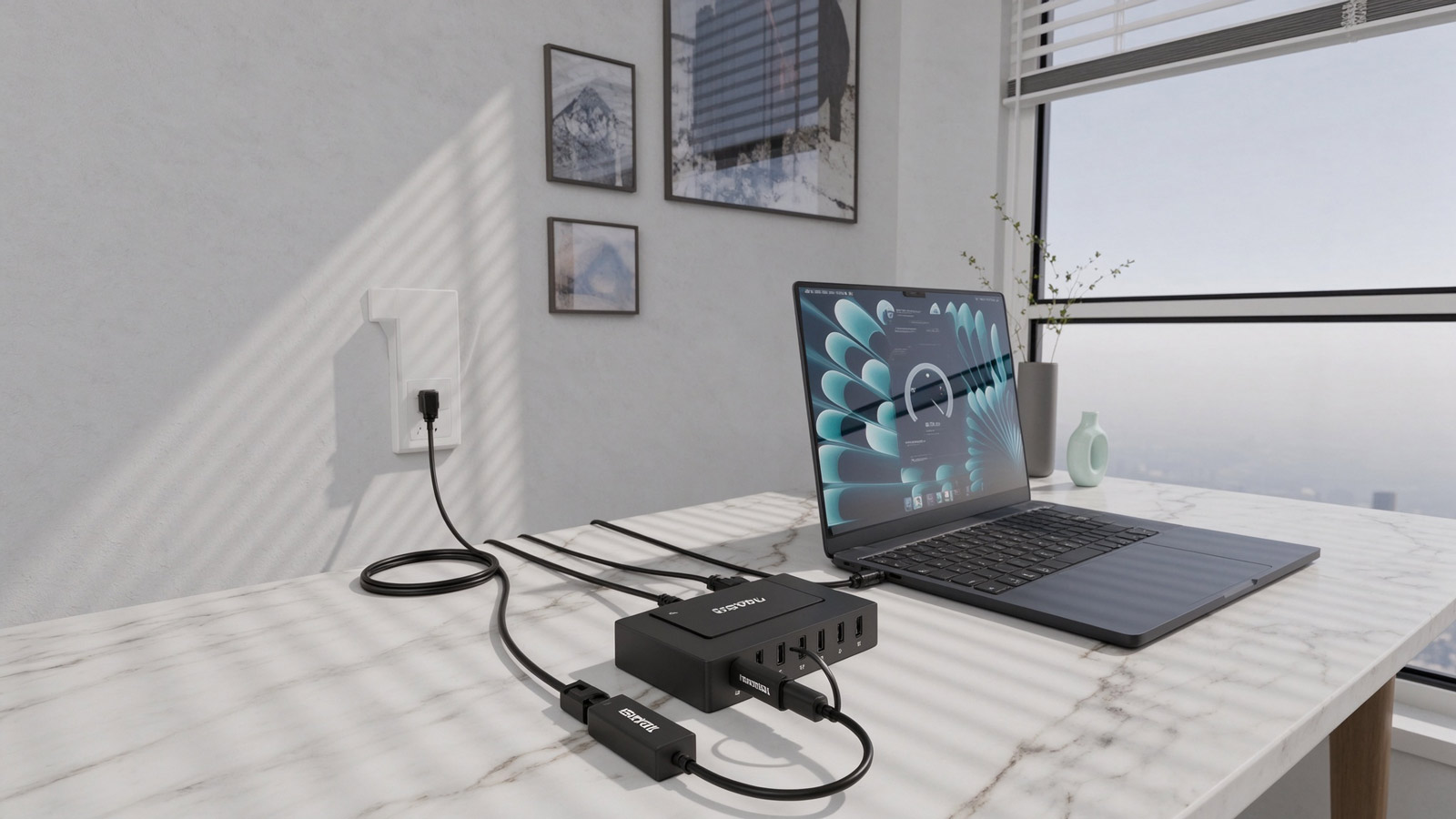
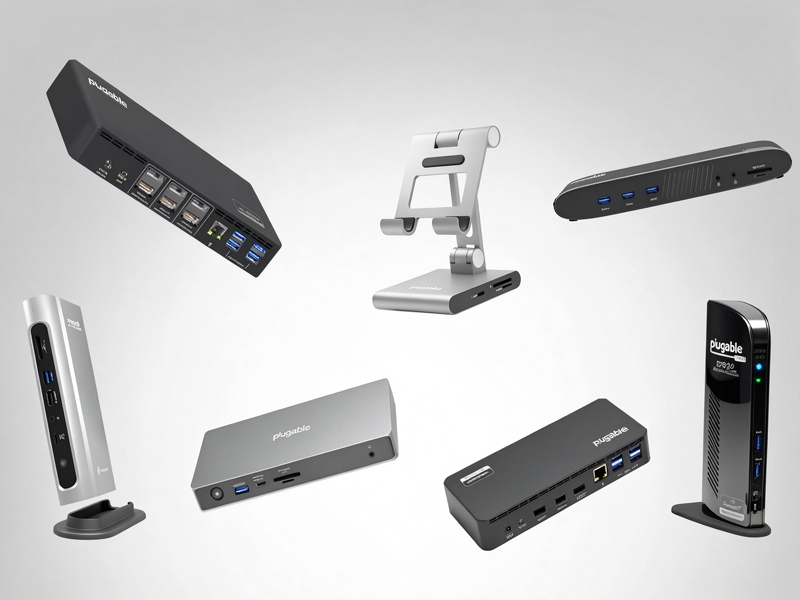
The catalog has grown from that one dock into well over a hundred products across four categories. Docking stations remain the core: USB-C and Thunderbolt models for single-cable laptop workstations, DisplayLink-equipped docks that drive multiple monitors even on base-model Apple Silicon Macs, and hybrid designs like the TBT-6950PD, which pairs Thunderbolt with DisplayLink to run up to four 4K displays while delivering 96W of charging through a single cable.
Around that core sit USB hubs and adapters, charging hardware including the ten-port PS-10CC charging station, and a security-flavored niche most rivals ignore: USB data blockers that pass power but sever the data lines, plus Works With Chromebook-certified docks for education fleets. The most telling recent addition is DockTag, a cloud-connected system embedded in the UD-7400PD that handles hot-desk booking, asset tracking, and first-line IT support — a clear signal that Plugable is moving upmarket from selling hardware to selling fleet infrastructure.
The compatibility-first engineering philosophy in practice
Plugable's stated mission is "simplifying compatibility," and the store's product pages read accordingly. Rather than chasing benchmark wins, the company optimizes for the unglamorous matrix that actually breaks docking-station purchases: which laptops, which operating systems, which monitor combinations, which Chromebooks. Each dock ships with detailed compatibility tables, and the team maintains an unusually deep library of setup guides, driver walkthroughs, and "how does this work with that" articles.
Two consequences follow. First, the hardware tends to be conservative — matte plastic enclosures, standardized port layouts, Kensington lock slots — designed for IT carts and hot desks rather than Instagram desks. Second, the company leans on open standards and software-free operation where possible, arguing that point-to-point wired connectivity is inherently more secure than wireless alternatives. Buyers who want a dock that disappears into a corporate procurement process will find this philosophy exactly right; buyers who want an aluminum unibody desk sculpture will not.
DisplayLink, Thunderbolt, and the multi-monitor fine print
Understanding Plugable's lineup requires knowing which display technology a given dock uses, because the experience differs meaningfully. Pure Thunderbolt docks are the cleanest: driver-free, low CPU overhead, full bandwidth for high-refresh displays. DisplayLink-based docks — the technology Thompson worked on directly — compress video through a software driver over standard USB, which is what lets them bypass Apple's one-external-display limit on base M1, M2, and M3 Macs and drive three or four monitors from machines OEM docks can't touch.
The trade-offs are real and worth stating plainly. DisplayLink requires a driver install (a friction point on locked-down corporate machines), adds some CPU load during video playback, and can struggle with DRM-protected streaming, which some services block on external displays. Plugable is transparent about these limitations in its documentation and increasingly offers hybrid models that route one or two displays natively over Thunderbolt while reserving DisplayLink for the extras. For everyday office work the technology is invisible; for gaming or color-critical video work, a native Thunderbolt dock is the safer pick within the same catalog.
Amazon scale, content marketing, and the tariff squeeze
Plugable's commercial engine is instructive. Thompson has operated at eight-figure revenue on Amazon for over a decade, and on a 2026 podcast he laid out the modern playbook: per-SKU channel routing rather than a blanket "Amazon first" policy, content deep enough to feed large language models as much as Google's rankings, and disciplined sourcing in the face of tariffs that have hit unexempted electronics at rates as high as 55 percent.
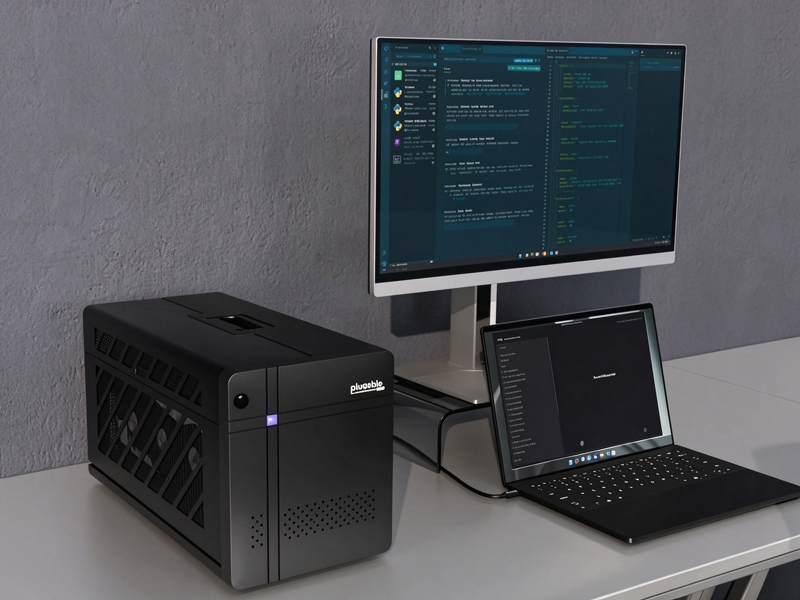
The Shopify storefront runs alongside Amazon rather than replacing it, stocked with the full catalog including fleet and B2B options, while Amazon handles the high-volume consumer SKUs. What separates Plugable from comparably sized rivals is that the founder still visibly acts as CTO — publishing technical blog posts, announcing products in trade press like Forbes, and in 2026 extending the line into local AI enclosures (the TBT5-AI Enterprise Series) that let businesses run AI models on their own hardware rather than in the cloud. Whether or not that pivot succeeds, it confirms an engineering-led company rather than a margin-stacking import brand.
Support that answers like engineers, not call scripts
Ask Plugable owners what keeps them loyal and the answer is almost always support. The "Built by Nerds. Backed for Life." tagline translates into a North American support team staffed by people who worked on the products, a documented no-script policy, and a years-long habit of answering pre-purchase compatibility questions on Amazon in unusual depth — often with charts. For IT departments deploying forty docks across mixed Windows, Mac, and Chromebook fleets, that support is frequently worth more than the hardware delta against cheaper rivals.
On policy, most docks carry a two-year warranty — double the industry's customary one year — plus a 30-day return window on the Shopify storefront. Shipping is domestic for US buyers, sidestepping the customs friction that still defines several competitors. The gaps to note: no physical retail presence, no self-service RMA portal on the level of larger brands, and support channels that remain email-and-web-form centric rather than phone-first.
Where Plugable trails CalDigit, Anker, and Satechi
Honesty requires mapping where Plugable loses. Against CalDigit — the premium dock maker reviewed elsewhere on this site — Plugable's plastic enclosures and occasional first-batch firmware quirks feel less polished, though its multi-display DisplayLink flexibility actually exceeds CalDigit's on Apple Silicon. Against Anker and Ugreen, Plugable is typically the better-documented but slightly more expensive option, without those brands' charging-ecosystem breadth. Against Satechi, it loses on industrial design by a wide margin.
The recurring owner complaints cluster in predictable places: early firmware on new models that arrives rough and improves over months; DisplayLink driver quirks on corporate-locked laptops; and documentation so exhaustive that casual buyers occasionally drown in it. None of these are scandals — community trackers record a largely clean file for the brand — but they define the realistic ceiling on expectations. This is a company that wins on engineering substance and support follow-through, not on out-of-box perfection.
Our closing take for hybrid-office buyers
Plugable is the rare peripherals brand where the about page and the actual product experience line up. A garage-founded, founder-led company of roughly 45 people in Redmond genuinely competes with Anker, Ugreen, and the laptop OEMs on the strength of compatibility engineering, deep documentation, and support that talks like the engineering team rather than a script. The Shopify storefront carries the full range, from $25 USB data blockers to Thunderbolt 4 docks with enterprise hot-desk management.
Buy here if you manage a mixed fleet of laptops, need multiple monitors on hardware that refuses to cooperate, or simply want a dock whose support line will answer a compatibility question with a table. Skip it if your priority is aluminum aesthetics, gaming-grade specs, or a phone support line. For the hybrid-office mainstream — which is most of the docking-station market — Plugable remains one of the safest choices in the category, and the two-year warranty removes most of the residual risk.