His wife suggested it at dinner; now 90 countries recycle
Official homepage: https://www.greentoys.com/
Green Toys began with a remark over dinner: a toy designer's wife observed that nobody made genuinely eco-friendly toys — and in 2007, Robert von Goeben and his USC business school classmate Laurie Hyman set out to fix that from a Silicon Valley garage. Nearly two decades later, the Sausalito company has recycled more than twenty million milk jugs into trucks, boats, and tea sets sold in over ninety countries. Here is our review of its online store from several angles.
A Dinner Comment Sparked a Recycled-Plastic Toy Company
Robert von Goeben had already lived several careers by the mid-2000s — digital pioneer at Geffen Records in the 1990s, Silicon Valley venture capitalist through the dot-com era, then founder of a toy design studio. The idea for Green Toys came not from market research but from his own wife, who pointed out at dinner that for all the talk about eco-friendly products, nobody was making environmentally responsible toys. Von Goeben called Laurie Hyman, a classmate from USC's MBA program and a mother of three staring at what she called a "plastic wasteland" of a playroom, and the pair remortgaged a home, set up in a garage, and launched in 2007 with a deliberately old-fashioned premise: make classic toys — trucks, blocks, tea sets — but prove every environmental claim with measurable facts.
Twenty Million Milk Jugs Became Trucks, Boats, and Blocks
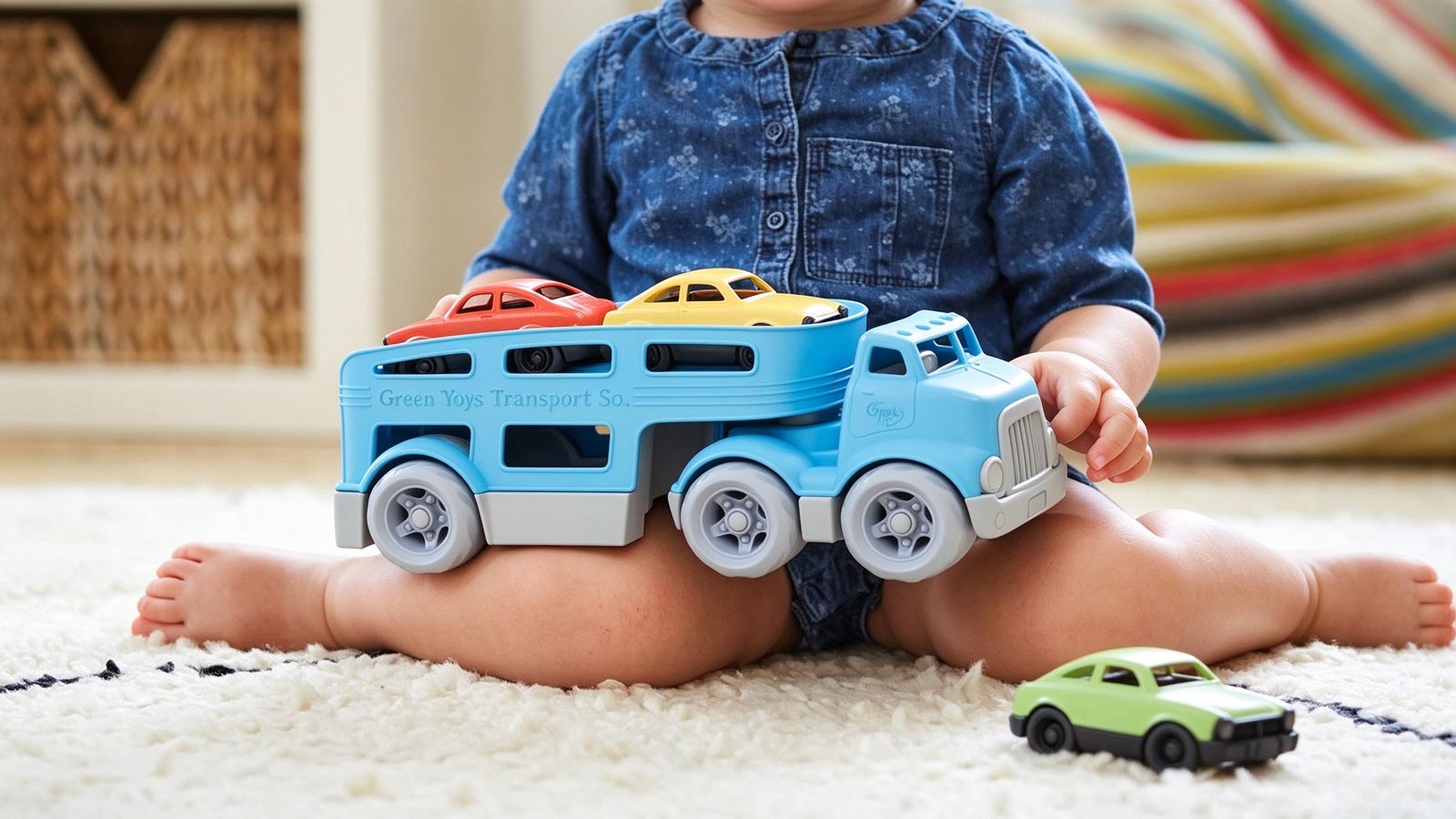
The material story is the brand's signature. Green Toys buys post-consumer high-density polyethylene — the number 2 plastic of milk jugs, with yogurt cups and similar containers in the mix — cleans and shreds it into flakes, and reprocesses it into food-grade recycled plastic mixed with mineral-based colorants. The company crossed its twenty-millionth recycled milk jug years ago and has kept counting. The products themselves are deliberately simple: a dump truck with no metal axle, a tugboat for the bath, stacking blocks, and a tea set safe enough for real snacks. Because the material is a single recyclable plastic with no paint, the toys can go back into the recycling stream at the end of their lives — the loop, as the founders like to say, actually closes.
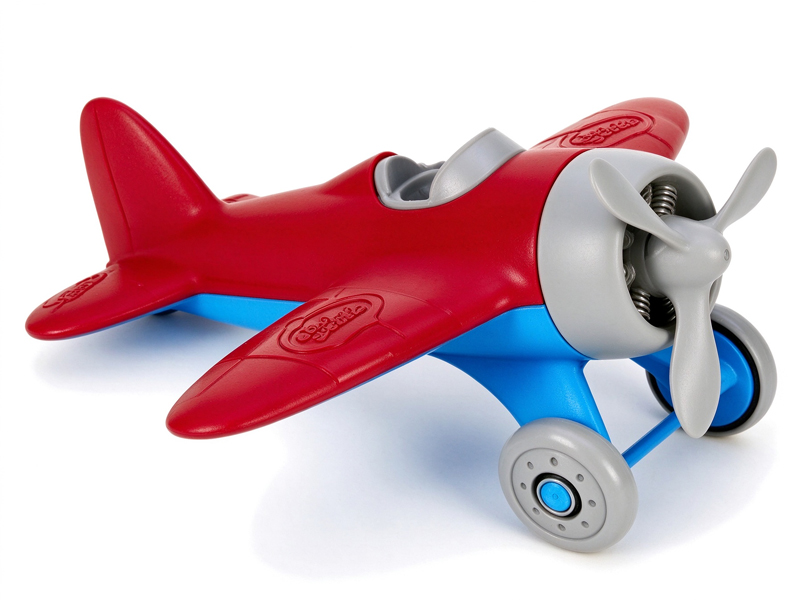
No Paint, No Glue, and Nothing Left to Waste
Examine any Green Toys product and the engineering restraint is obvious. There are no screws, no adhesives, no metal axles, no coatings — the toys are molded entirely from one material, colored with food-safe mineral pigments mixed into the resin itself. That is harder than it sounds: recycled HDPE is notoriously difficult to injection-mold, and cracking that process is the Silicon Valley technology the founders brought to bear. Packaging follows the same doctrine — 100 percent recycled cardboard printed with soy inks, held in place with recycled plastic ties where needed. The result is a catalog where virtually every claim a parent might want verified — BPA-free, phthalate-free, PVC-free — is answered by the construction itself rather than a certification badge. For households trying to reduce plastic guilt without abandoning plastic toys, it is the most credibly argued product line in the category.
Made in California, Half an Hour From Headquarters
Manufacturing location is the other pillar of the pitch. Green Toys molds its products in California — a state whose environmental and worker-safety rules the founders describe as the strictest in the world — with the contract factory historically a short drive from the company warehouse, a fraction of the 10,000-plus miles that separate most toy factories in Asia from American shelves. That proximity let von Goeben walk the factory floor weekly and, by the company's telling, is the quiet reason quality stayed high while the catalog scaled. It is also a quietly political choice: the founders openly framed California manufacturing as proof that a consumer-products company could compete without chasing the cheapest labor on Earth. Distribution kept pace — some 3,000 US retailers and more than ninety export countries by the mid-2010s, including Whole Foods, Costco, and Amazon.
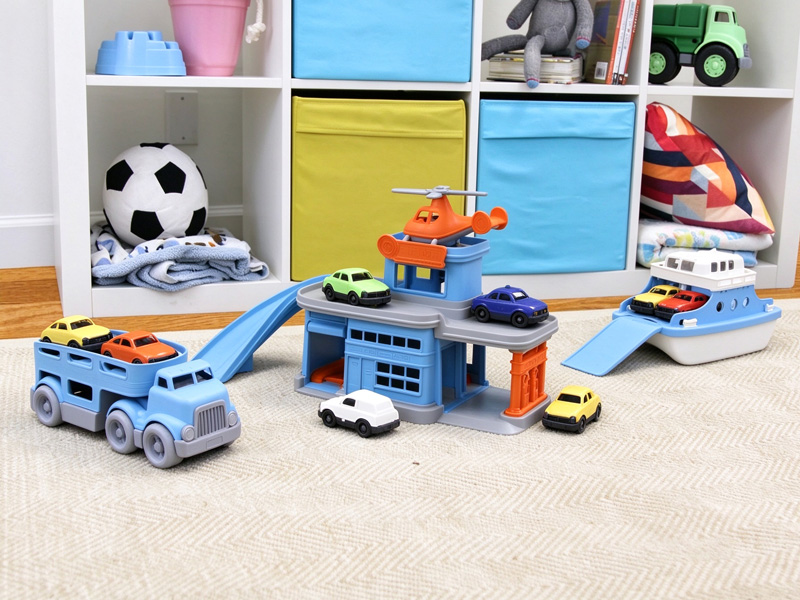
The Shelves Cover Vehicles, Bath Time, and Pretend Kitchens
Browsing the store today, the catalog divides into sensible play worlds: vehicles (the iconic dump truck, seaplane, and rocket), bath toys (tugboats and seaplanes that double as bath toys), building blocks, outdoor games, and a pretend-kitchen line — cups, plates, and cookware — that is dishwasher safe and food-contact safe. Licensed lines, including Sesame Street collaborations, add character appeal without breaking the material doctrine. Prices sit in the mainstream toy range, the aesthetic is muted and pastel rather than loud, and product pages emphasize what the toys are made from as prominently as what they do. Families hunting for curriculum-style learning tools should know this upfront: the educational value here is classic open-ended play — imagination, motor skills, role-play — not structured lessons, letters, or coding.
Our Verdict on the Original Recycled Toy Store
Green Toys earns its reputation the hard way: every environmental claim in its marketing is visible in the product itself, from the single-material construction to the recycled packaging to the California factory floor. The strengths are tangible — credible sustainability, food-grade safety, heirloom-sturdy construction, and a brand story that holds up under scrutiny — and the company behind it proved the model could scale, with a majority investment from the Friend Group in 2013 bringing in professional management while the founders stayed on in creative roles. The honest caveats: the learning content is implicit rather than explicit, the muted designs will not dazzle children raised on licensed characters, and committed eco-shoppers may still prefer to own fewer plastic toys overall. But as a store for families who want play that is safe, durable, and genuinely kinder to the planet, Green Toys remains the benchmark every imitator is measured against.