A mirror clipped to an ipad won time's best invention
Official homepage: https://playosmo.com/
Every educational toy store claims to bridge screen time and hands-on play; Osmo built the bridge first and won a place on Time's list of 2014's best inventions for it. The Palo Alto company pairs a red clip-on mirror with an iPad so the camera can see and respond to real letter tiles, number pieces, and drawings on the table. Bought by Indian edtech giant BYJU'S for $120 million in 2019, it has since weathered its parent's spectacular collapse. Here is our review of its store from several angles.
Two Ex-Googlers Watched a Child Stare at a Screen
Osmo was founded in 2013 in Palo Alto, California, by two former Google engineers and young fathers, Pramod Sharma and Jérôme Scholler. The origin story is almost embarrassingly simple: Sharma watched his five-year-old daughter with her face glued to an iPad and thought it seemed unhealthy and unnatural. Children love digital play; parents prefer the analog world — so the pair set out to build something that made both sides happy. They launched at TechCrunch's Startup Battlefield under the name Tangible Play, and their insight became the company's founding principle: the screen should be a partner in physical play, not a substitute for it.
A Clip-On Mirror Made the iPad See Real Toys
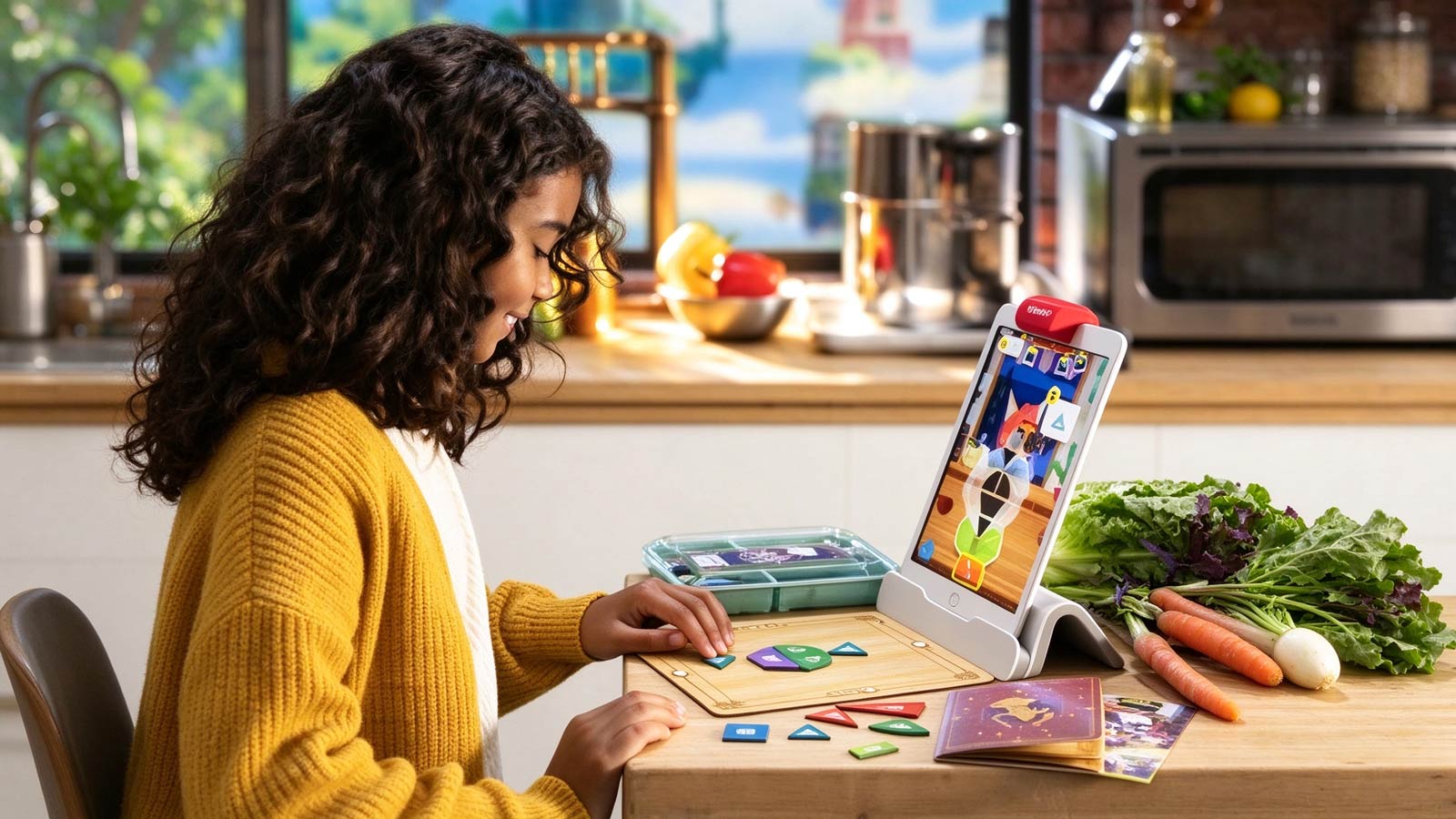
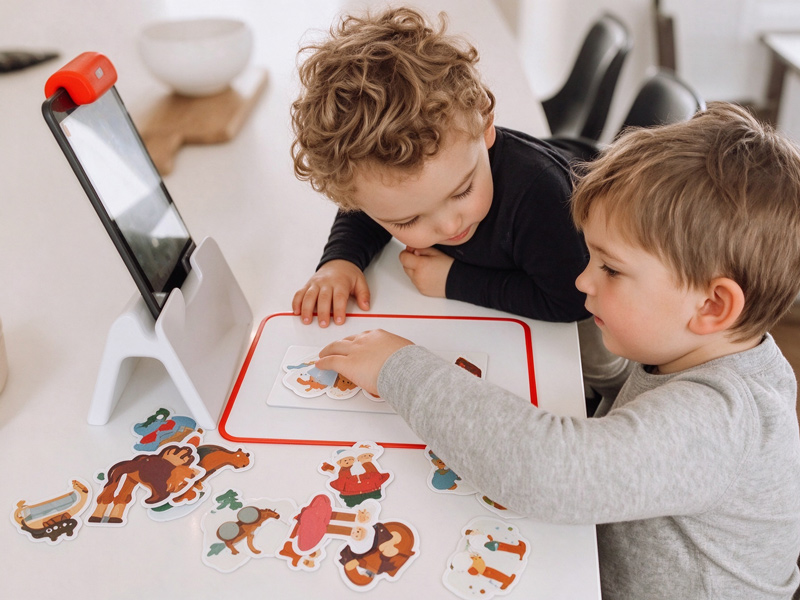
The technology that made it work is disarmingly low-tech on the outside. An Osmo kit is a sturdy base, a red plastic reflector that clips over the tablet's front camera, and a set of tangible pieces — letter tiles, number cubes, tangram shapes, or markers. The mirror angles the camera downward, and the company's "Reflective AI" reads whatever the child places on the table in front of the screen. Arrange tangram pieces and the on-screen character recreates them; spell a word with tiles and the game responds; draw a line on paper and Newton sends balls bouncing off it. No batteries in the pieces, no pairing, no wires — the intelligence lives entirely in the software and the camera.
Time's Best Invention List Arrived Very Early
The recognition came fast. Osmo's first three games — Newton, Tangram, and Words — earned it a spot on Time's Best Inventions of 2014, followed by Fast Company's most innovative education companies list in 2017, Parents' Choice awards, and an Oppenheim award. The numbers grew with the honors: by the late 2010s, Osmo reported use in more than 30,000 schools, availability in over forty-two countries, and over a million households reached — later estimates put lifetime sales above four million units. Teachers embraced it because the tangible pieces genuinely engage fine motor skills and spatial reasoning while the app supplies adaptive feedback, and retail distribution through Target and the Apple Store put it within reach of ordinary families.
A Phone Call in December 2018 Changed the Company's Owner
Then came the $120 million call. Byju Raveendran, founder of India's most valuable edtech startup, rang Sharma in December 2018; Sharma flew to Bengaluru the next day, and within months BYJU'S announced its first-ever US acquisition at exactly $120 million. The fit was logical — BYJU'S wanted offline-to-online technology and an entry into the three-to-eight age bracket, and Osmo's backers, including Mattel, Sesame Workshop, Accel, and Upfront Ventures, took the all-stock payout. Osmo continued as an independent brand, and the partnership produced visible offspring, including the Disney Frozen II app and the Little Genius Starter Kit for preschoolers. Revenue reportedly climbed from around $25 million at acquisition to over $100 million within two years.
The Store Sells Kits, and an iPad Isn't Included
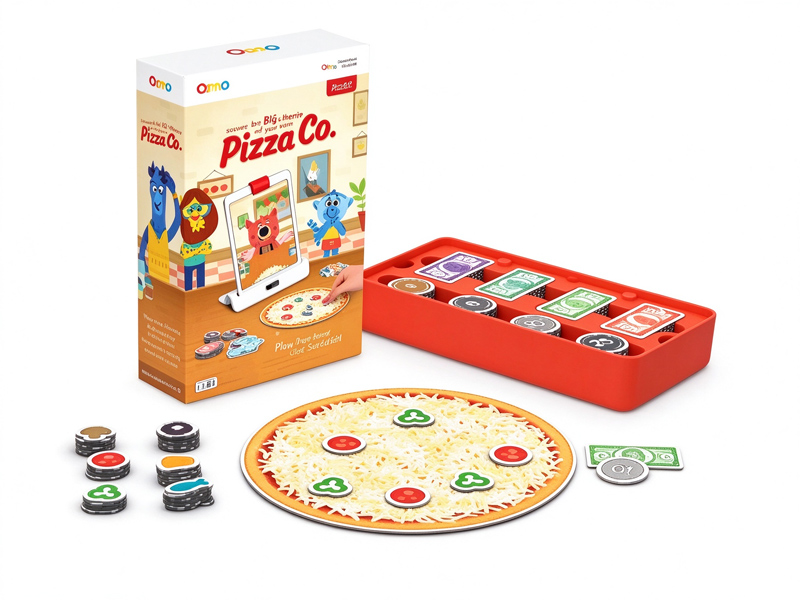
The storefront itself is straightforward. The anchor is the Genius Starter Kit at $99.99: base, reflector, and five games with their physical pieces. From there, the catalog branches into the Little Genius Kit for preschoolers, the Math Wizard series with its narrative-driven learning games, Coding Awbie for early computer science, and Super Studio for drawing. Individual apps like the Disney titles have been priced around $19. One structural caveat dominates every purchase decision: the system requires a compatible iPad or Amazon Fire tablet, which is not in the box. For households without a tablet, the real entry cost adds several hundred dollars more than the sticker price — the single biggest hidden expense in the category, and worth calculating before checkout.
The Verdict for Families Already Owning a Tablet
Osmo remains one of the cleverest executions of blended physical-digital learning ever shipped, and its store is still a reasonable place to buy into it. The hardware is thoughtfully engineered, the game library is broad, the learning outcomes are real, and classroom validation is extensive. The counterweights are equally clear: the iPad prerequisite inflates the true cost, the software depends on app support from a parent company whose US division filed for Chapter 11 bankruptcy in early 2024, and families already wary of screen time may find "screen-plus-toys" a compromise rather than an escape. For tablet-owning families who want screen time with tangible substance, this store delivers one of the most polished experiences in educational play; for everyone else, the math deserves a hard look first.