Yoto: the screen-free player that a stroller, montessori, and a beatle built
Official homepage: https://us.yotoplay.com
In 2015, Ben Drury was shopping for a stroller in a London department store when he found one with a built-in tablet holder — a screen mount, for an infant — and the sight, as he later told Business Insider, made him feel sick in his stomach. He was no technophobe: he had founded and sold two digital-music companies, including one that went public. But fatherhood was rewiring his relationship with the industry he had helped build. The company that emerged from that queasiness — Yoto, co-founded with Filip Denker — is a screen-free audio player for children, controlled by physical NFC cards, built on Raspberry Pi, manufactured in Sheffield, and backed three separate times by Paul McCartney. A decade in, it has reached more than five million children, won a King's Award, placed its fourth-generation Mini in the Henry Ford Museum beside the original iPhone, and recalled a batch of overheating Minis along the way. This review examines the storefront dimension by dimension: the stroller, the cards, the Beatle, the licensing empire, and the honest arithmetic of childhood on cards.
The stroller with the built-in tablet holder
The founding moment is documented with unusual emotional precision. Drury — whose resumé ran dotmusic.com, sold to Yahoo in 2003, and then 7digital, the streaming infrastructure company he took public before its £16.5 million acquisition — was expecting his first child in 2015 when the John Lewis stroller display confronted him. A product designed for infants, not even toddlers, with a screen mount. He has said it felt wrong, and that the unease crystallized into a question: why did every piece of technology for children seem built to addict them, and was there a better option? The cofounder who could help answer it was Filip Denker — one of the first hires at 7digital, the engineer who had built its API, and a new father facing the same arithmetic of screens and sleep.
The intellectual scaffolding came from an unlikely source for a pair of music-industry engineers: Maria Montessori. Drury's children attended a Montessori nursery, and the method's emphasis on physical objects and independent activity mapped directly onto the problem — children learn through manipulating things, not through tapping glass. The pair began with Ben's exit money, a Sheffield manufacturing partner, and an industrial designer, Tom Ballhatchet, to turn the concept into an object.
Kids love putting things into things
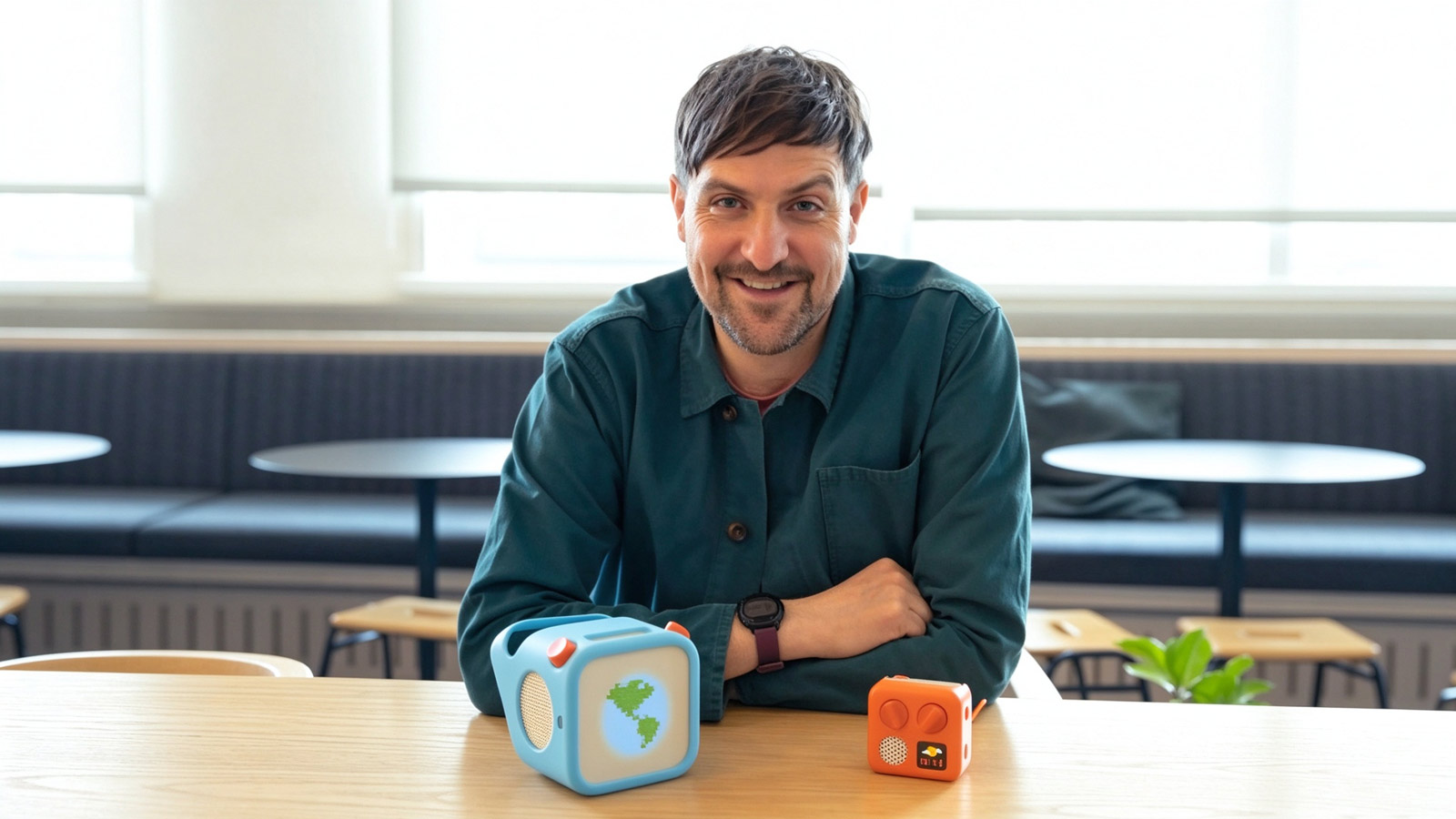
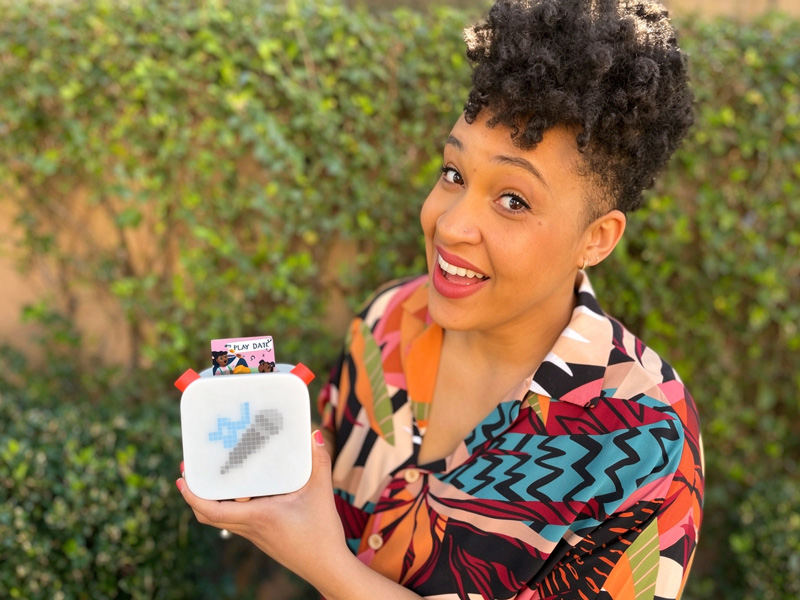
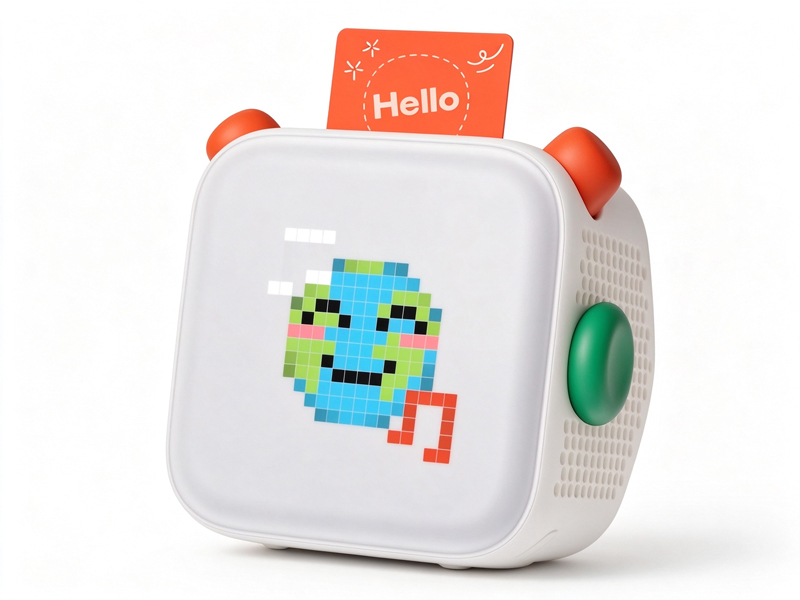
The product insight belongs in design textbooks. Watching toddlers interact with objects, the founders noticed a universal behavior: children love to put things into things. The interface arrived almost immediately — physical cards, inserted into a slot, that trigger audio. The cards carry no storage; an NFC chip in each card is a key that unlocks the corresponding audio from the player's own memory or Yoto's servers, which means a card library is unbreakable, unloseable in the way that matters, and impossible to load with the wrong content. The player itself is deliberately austere: two orange knob-buttons, a sixteen-by-sixteen-pixel display that shows icons rather than video, no camera, no microphone, no ads, and a nightlight on the back that doubles as an okay-to-wake clock.
The engineering ran on British parts. The first players were built around Raspberry Pi single-board computers — Drury, an early investor in the Pi accessories firm Pimoroni, had loved British computing since his BBC Micro childhood — and the partnership proved load-bearing when early units hit electromagnetic-interference problems; Pimoroni's hardware expertise resolved what the software founders could not. The December 2017 Kickstarter sought a modest £20,000 and hit it within days; the first units shipped through 2018, and by August 2019 the company had sold out entirely.
A Beatle who invested three times
The endorsement that changed the company's trajectory arrived through the music industry Drury knew. In 2019, with McCartney having just published his children's book Hey Grandude!, an acquaintance connected the founders to the former Beatle — who invested in the Yoto Player and, in Drury's telling, provided the affirmation that turned a project into a mission: taking any investor money is excellent motivation, but taking a Beatle's investment — well, we knew we really needed to go for it after that. McCartney would invest twice more over the following years, to the tune of a few hundred thousand pounds, joined in the investor pool by the singer Sophie Ellis-Bextor.
The content avalanche followed the same door. Roald Dahl's grandson became involved and joined the Yoto board, and the publisher cascade that followed brought Penguin Random House, Macmillan, HarperCollins, Hachette, Scholastic, and Sony to the card catalog. The strategic logic the founders stated early — getting rights is not a problem because everyone with content rights loves the idea of their content on this platform — held, and the card library grew into thousands of titles spanning stories, music, podcasts, activities, and sleep sounds.
Pentagram redesign, pandemic launch
The second-generation Player, developed with the design agency Pentagram and launched in early 2020, professionalized the object: the angled dock, the magnetic charging, the bedtime mode activated by laying the player face-down, and the pixel display's gentle iconography — designed, in Pentagram's account, to prioritize kids being in control. The timing looked catastrophic and became catalytic: the player launched weeks before pandemic lockdowns, and screen-fatigued parents facing indefinite indoor childhoods discovered the category all at once. TIME named it one of the best inventions of 2020; the company did three million pounds in revenue that year and launched in the United States months later. The portable Mini followed in late 2021, and the third generation in 2023 refined the platform without disturbing the doctrine.
The design-award ledger compounded through the decade: a D&AD Pencil, IDEA Gold honors, and — the detail the company's press room leads with — the fourth-generation Yoto Mini entering the Henry Ford Museum of Innovation's collection in 2026, displayed alongside the original iPhone, as an artifact of humane interface design.
Five million children, and a museum
The scale chapter is recent and large. Yoto has reached more than five million children globally, per the founder's 2026 account, with a licensing constellation that now includes Disney, Marvel, LEGO, the Roald Dahl Story Company, and Universal Music alongside the publisher list. The 2024 Series B — twenty-two million dollars led by the Chan Zuckerberg Initiative — gave the company growth capital at the exact moment the category matured, and the recognition followed: the King's Award for Enterprise in 2025, the FT1000 list of Europe's fastest-growing companies in 2026. The fourth-generation Player and Mini, launched in 2026, iterate on the same cards-and-knobs formula — faster, tougher, better, in the company's phrase, around the rhythms of real family life.
The storefront architecture mirrors the international footprint: dedicated Shopify storefronts for the US, UK, Europe, and Canada, each localized in currency, content catalog, and the Yoto Club subscription — a monthly card-delivery program that converts one-time hardware buyers into an ongoing content relationship.
The 2024 recall, owned in public
The trust ledger includes a documented failure. In 2024, Yoto recalled some Yoto Mini players because of overheating issues — the kind of hardware defect that defines whether a children's brand deserves the safety posture it markets. The company's recall handling, per the public record and community accounts, was prompt and complete, reinforcing the privacy doctrine that forms the brand's other safety pillar: no ads, no camera, no microphone, no behavioral tracking of children. In a category where internet-connected kids' devices have repeatedly become privacy scandals — the FTC's actions against connected-toy makers are the industry backdrop — Yoto's architecture of minimalism is itself a product feature, and the recall is the test it passed publicly.
The parental-control layer completes the safety file: usage monitoring, bedtime modes, and volume limits run through the companion app, giving parents administrative control without turning the player into a surveillance device — a calibration competitors have missed in both directions.
The economics of a card-based childhood
The commercial model deserves honest arithmetic. The players run roughly seventy to one hundred forty dollars, but the platform economics live in the cards — individual titles at eight to twenty dollars, bundles higher, and the Yoto Club subscription at around ten dollars a month for a curated monthly drop. A family that buys a player for a three-year-old and maintains a card habit through age twelve is committing a four-figure sum over the childhood — a real investment in screen-free listening, but one the marketing's hardware pricing understates. The generous commercial terms partially offset the math: a sixty-day return window and a two-year defect warranty with covered shipping are category-leading.
The feature frictions belong in the same ledger, because the doctrine produces them: no fast-forward or rewind within a track — only track skipping — a deliberate anti-distraction choice reviewers keep requesting; Bluetooth headphone support that arrived later than the community wanted; and an initial setup that requires a smartphone and Wi-Fi, meaning the screen-free device arrives through a screen. Each is defensible; each is a small tax on the purity of the promise.
The honest texture of a screen-free bet
Four honest cautions belong in the ledger. First, the content treadmill: the card ecosystem is the business model, and the same licensing empire that fills the catalog prices the family in — between the Club subscription and impulse card purchases, the ongoing spend rivals the streaming subscriptions the brand positions against. Second, the age-band ceiling: the player serves roughly three-to-twelve, and a child who outgrows the card catalog has no graduation path inside the platform — the device that saved bedtime at four is a paperweight at thirteen. Third, the recall shadow and the setup friction: the 2024 Mini recall was handled well but documented, and the Wi-Fi-and-app requirement means the screen-free promise has a screened on-ramp. Fourth, the retail volatility: Amazon availability has come and gone across model cycles, pushing buyers to the direct storefront — good for the brand's margin, occasionally inconvenient for the gift-buyer on a deadline.
None of these are contradictions; all four are the taxes on building a children's platform the way a pair of Montessori-influenced music engineers thought it should be built.
The verdict for the screen-anxious parent
Yoto's storefront is the stroller thesis run for a decade: a queasy father in a department store, a Montessori insight about things and slots, a Sheffield factory and a Raspberry Pi, a £20,000 Kickstarter, a Beatle's three investments, a pandemic that arrived as marketing, five million children, a Chan Zuckerberg round, a museum case beside the iPhone, a public recall handled properly, and a card catalog deep enough to raise a child on. The cons are the cons of the model: the cards compound in cost, the age band expires, the setup needs a screen, and the retail footprint flickers.
Buy here if the tablet-holder stroller made you queasy too, if you want your child to control their own listening without controlling a screen, if a no-camera, no-microphone, no-ads architecture is your non-negotiable, and if the card ritual — choosing, inserting, listening — sounds like the childhood you want to fund. Buy a used smartphone with parental controls if the budget rules, or a Toniebox if the figurine format suits younger hands. For the screen-anxious parent who wants technology that trusts a child with a thing instead of a feed, this London storefront remains the category's most principled answer — one stroller, one slot, and the cards still sliding in.