House of marley: reggae bass, reclaimed cotton, and the family business of sustainability
Official homepage: https://houseofmarley.com
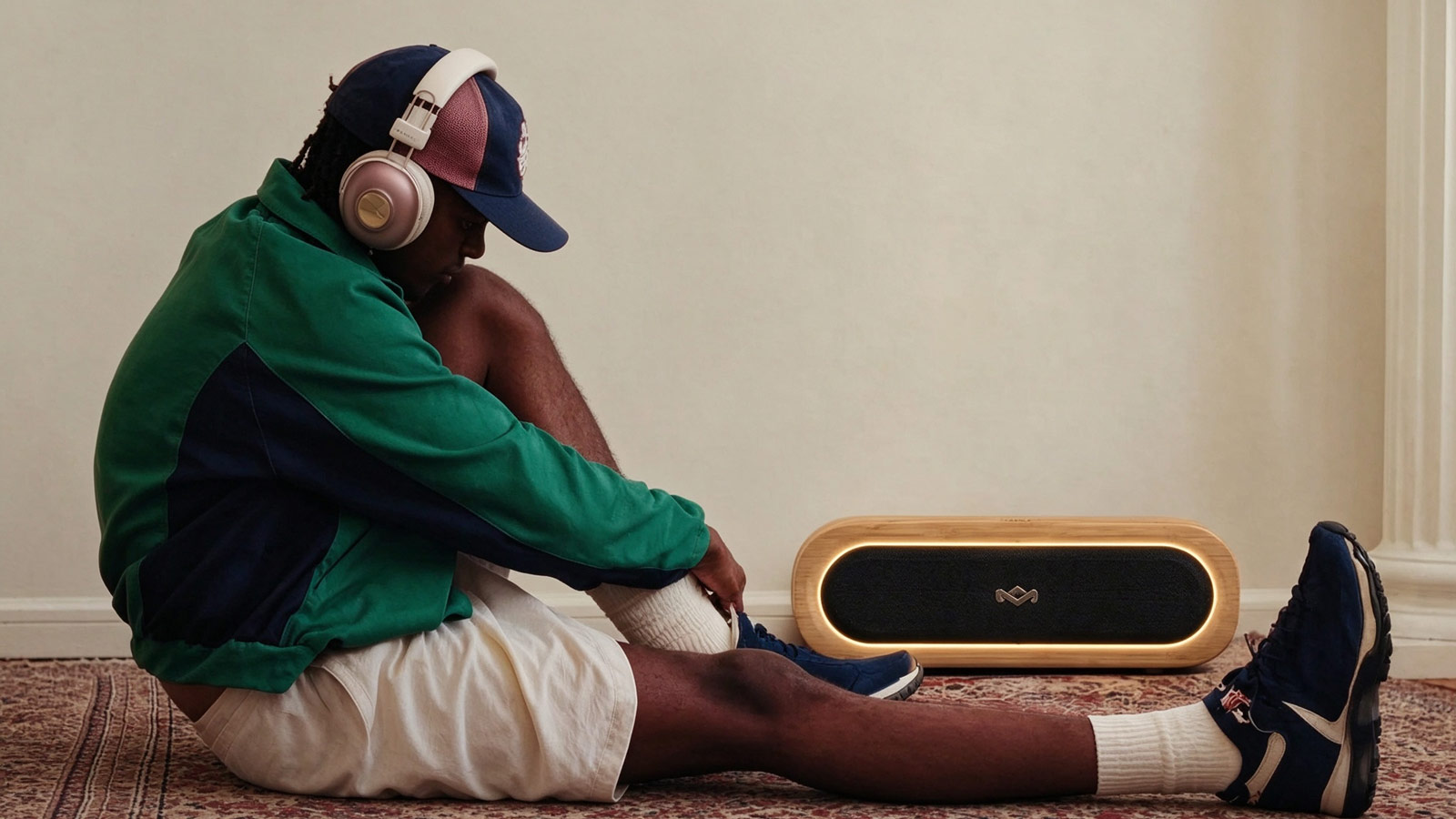
House of Marley begins with a boy working in his father's vinyl factory. Rohan Marley — son of Bob — spent his childhood in Nine Mile, Jamaica, pressing and packing the records that carried his father's music to the world, and absorbing the lesson his father taught with both his songs and his hands: bass carries the impact, and the earth deserves the respect. In 2010, the Marley family turned that inheritance into a consumer electronics brand, launching at the 2011 Consumer Electronics Show with a promise no audio company had made — that every product would be built from certified sustainable materials, tuned on reggae, and sold in service of the family's charitable foundations. Fifteen years later, the House of Marley is the first FSC-certified consumer electronics brand in North America, plants trees with every product through Project Marley, and sells turntables in collaboration with the films that tell its father's story. This review examines the storefront dimension by dimension: the factory, the materials doctrine, the giving ledger, and the honest arithmetic of a legacy brand built on a licensed name.
A vinyl factory in Nine Mile, Jamaica
The founder's apprenticeship was literal. Rohan Marley grew up working in his father's vinyl factory in Jamaica — pressing records, handling the physical machinery of music — and has traced the brand's turntable line to that childhood: a lifelong passion for records that started from working at his father's vinyl factory as a kid. The audio education that came with the factory floor was the family's own: every product, the family taught, is tested against Bob Marley's recordings, with the bass as the driving force — because in reggae the low end carries the message, and a speaker or headphone that flattens the bass flattens the music's meaning.
The founding conversion arrived a generation later. When the family decided to put the Marley name on consumer electronics — announced at CES Unveiled in January 2011 with the full family's blessing — the framing was not a licensing deal but a mission continuation. Our father shared his vision with our family and his fans through the gift of the messages in his music, said Bob's daughter Cedella at the launch, and it is our mission and responsibility to push the movement forward — the House of Marley and the MARLEY audio products that bear our family name were created to spread our father's music and vision to a new generation.
Three collections, from Jammin' to Destiny
The launch architecture was designed by the TEAMS design consultancy to carry one message across three wallets. The Jammin' Collection opened at thirty-dollar price points — the young gongs, in the family's launch vocabulary — with earbuds and portable speakers built for students and first buyers. The Freedom Collection held the middle, and the Destiny Collection closed at five hundred dollars for what the launch materials called the conscious connoisseurs. Across all three, four guiding principles were printed from day one: superior quality, sustainable sourcing, cause mindedness, and waste consciousness — and every product was tested against Bob's reggae, the bass engineered as the driving force.
The architecture solved the licensing paradox that kills most celebrity brands: the cheapest product carried the same principles as the flagship, so the thirty-dollar earbud buyer and the five-hundred-dollar connoisseur entered the same story. The brand's survival through a decade and a half of audio-industry churn — while countless celebrity headphone lines launched and died — is evidence the architecture held.
Materials as the founding argument
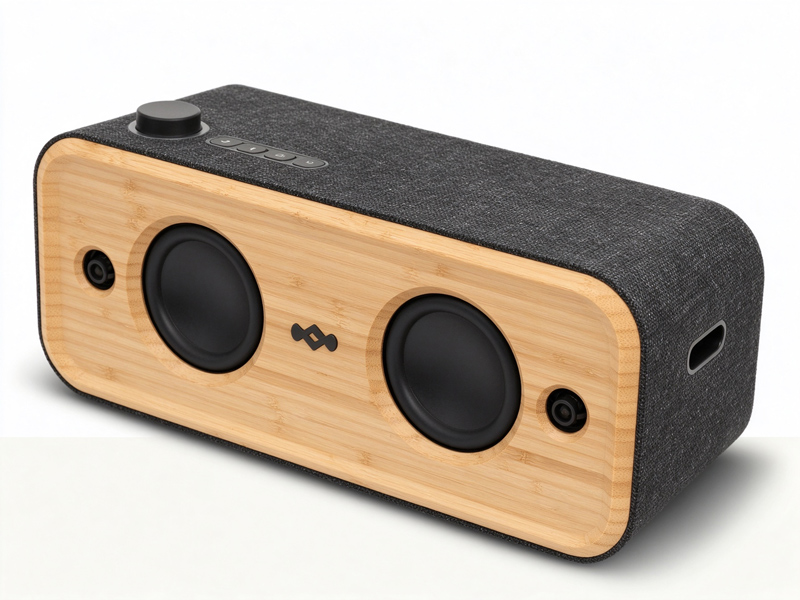
The materials program is where the brand separated from every celebrity licensee that came before it. The House of Marley built a named materials vocabulary and published it: REWIND fabric — woven from reclaimed organic cotton, reclaimed hemp, and recycled PET bottles — wraps speaker grilles and headphone headbands; REGRIND silicone, created specifically for the brand, upcycles post-process and post-consumer waste into ear gels and speaker surrounds; FSC-certified walnut, beech, maple, and sapele form the acoustic faces; solid bamboo, sustainably harvested cork, and infinitely recyclable aluminum fill out the bill of materials; and the packaging is one hundred percent recyclable paper. The company's materials pages document each choice — bamboo for its strength-to-weight and pesticide-free growth, aluminum for its closed-loop recyclability — with the specificity of a supplier audit rather than a marketing brochure.
The certification record followed: the House of Marley became the first FSC-certified consumer electronics brand in North America, per the Forest Stewardship Council's own announcement of its headphone lines, and the #MaterialsMatter campaign made the sourcing story the center of the marketing rather than a footnote — a stance the brand's leadership framed plainly: we take great pride in our efforts to work with materials that reduce our footprint on this planet.
The turntable that completes the circle
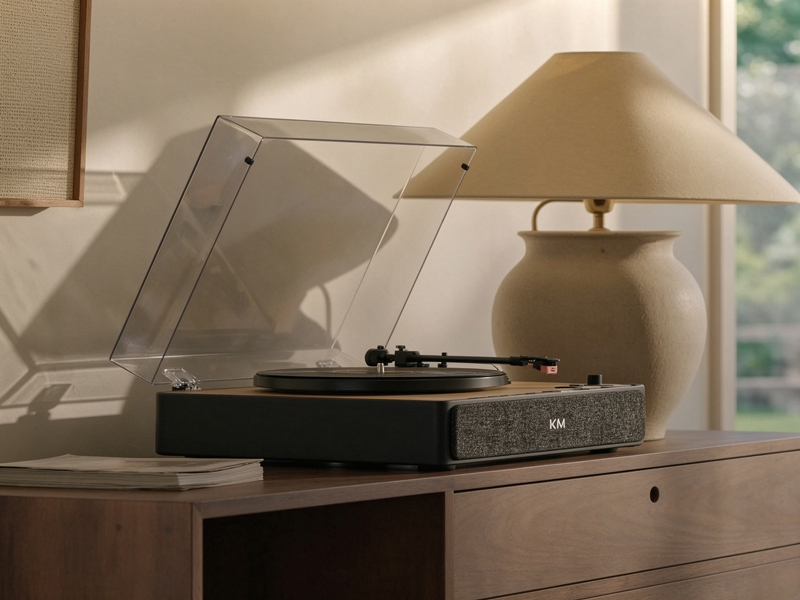
The product that carries the most story is the analog one. The Stir It Up turntable line — bamboo plinth, REWIND fabric dust cover, built-in switchable pre-amp, Bluetooth output for the modern chain — returns the family to the factory where Rohan learned the business, and the design press has treated it as the brand's soul object: The Manual called it perhaps the most handsome grab from the House of Marley, a rustic turntable with a natural warmth that photographs like the records it plays. In 2024, the brand closed a larger circle, releasing a limited-edition Stir It Up Wireless in collaboration with the Bob Marley: One Love film — the family licensing its own story back to itself, the turntable sold through the brand's site and HMV at £249.99 while the movie retold the father's life to a new audience.
The headphones and speakers carry the same materials language at scale — the Exodus flagship with fifty-millimeter drivers and thirty-hour battery in FSC wood and recyclable aluminum, the No Bounds outdoor speaker in cork that reviewers floated in Hawaiian salt water, the Bag of Riddim with its bamboo faceplate and shoulder strap. Each product page leads with the material story before the acoustic one — a deliberate inversion of the industry's usual hierarchy.
Project Marley and the giving ledger
The charitable architecture runs on two tracks. The first is the family's own: a portion of the proceeds from every product supports 1Love — the Marley family's charitable organization — continuing the structure that the CES launch materials described as a portion of proceeds given to the Marley family's 1Love.org charity. The second is environmental: through Project Marley, the brand's global-giving initiative, every product sold contributes to reforestation through the nonprofit One Tree Planted — a partnership announced in 2017 with a common goal of seventy-five thousand trees planted within a year, and one the brand has maintained through its current catalog pages.
For the storefront reviewer, the giving ledger functions the way certification walls do for the supply-chain brands reviewed elsewhere on this site: the mechanism is named, the partner is named, and the claims are checkable — One Tree Planted's public records and the family's foundation filings exist outside the brand's own marketing, which is precisely what separates a giving program from a guilt-offset.
Who actually owns the House of Marley
The corporate structure deserves its own paragraph, because the brand's story is easily misread as a family startup. The House of Marley's launch materials describe a creation in collaboration with the Marley family — and in association with HoMedics, the American housewares company that has manufactured and distributed the line since the 2011 debut. Operationally, this is a licensed brand architecture: the family supplies the name, the story, the values, and the public face — Rohan Marley appears in the press materials as co-founder and brand ambassador — while HoMedics supplies the product development, manufacturing, retail relationships, and the Shopify storefront's logistics. The design language itself was agency-built, with TEAMS Design's global studios translating the family's vision into three product collections on a tight schedule.
The distinction matters to this review for two reasons. First, it explains the brand's durability: the machinery behind the Marley name is a decades-old housewares operation, not a startup's runway. Second, it defines the trust question: when a buyer purchases the sustainability story, they are purchasing a licensed narrative executed by a corporate partner — the principles are real and certified, but the governance is commercial licensing, not family hands on the workbench.
The honest texture of a legacy brand
Four honest cautions belong in the ledger. First, the acoustic ceiling: the brand's products are competently tuned and custom-voiced for reggae's low end, but the independent guide coverage treats them as lifestyle audio — good for the price and materials, not competitive with the specialist houses at the same money — and the buyer paying Destiny Collection prices should calibrate expectations toward design and values rather than reference sound. Second, the licensing ceiling: the brand's greatest asset is a name that does not renew, and every product cycle spends a little of the finite inheritance — celebrity audio brands have a documented mortality rate, and the House of Marley's survival so far is evidence of discipline, not immunity. Third, the corporate opacity: the HoMedics partnership means no founder-inventor narrative, no independent financials for the brand itself, and decision-making distributed across a licensing relationship the customer never sees. Fourth, the sustainability paradox of volume: selling more units — however certified — is still selling more units, and the brand's growth ambitions sit in tension with the waste-consciousness principle it was founded on, a tension the materials program mitigates but cannot resolve.
None of these are contradictions; all four are the taxes on being the family business of a legend — the blessing and the burden sold together, in REWIND fabric.
The verdict for the conscious listener
The House of Marley's storefront is the vinyl-factory inheritance run for fifteen years: a boy from Nine Mile who pressed his father's records, a family that turned One Love into a materials doctrine, three collections from thirty dollars to five hundred carrying the same four principles, the first FSC-certified electronics brand in North America, headphones tested on bass lines and speakers wrapped in reclaimed cotton, turntables that complete the circle the factory started, and a tree planted for every product sold — all of it executed through a licensing architecture that has outlasted the celebrity-brand graveyard. The cons are the cons of the legacy: sound that serves the story more than the reference listener, a name that does not renew, corporate machinery behind the family face, and the volume paradox at the heart of sustainable consumerism.
Buy here if the materials story is the product — FSC wood, reclaimed cotton, cork that floats, packaging that composts — if reggae-tuned bass and the One Love ethos are the sound you want your objects to make, if a turntable that funds tree planting and family charities matches your idea of what a purchase should do, and if the thirty-dollar Jammin' earbud carrying the same principles as the flagship is the point rather than the compromise. Buy the specialist houses if reference acoustics rule. For the conscious listener who wants every component of the purchase to vote the same way, this family storefront remains the category's most principled answer — one vinyl factory, one father's message, and the materials finally matching the music.