The wrong notebook, a microwave, and five sharks who said no: rocketbook
Official homepage: https://getrocketbook.com
Joe Lemay walked into a million-dollar sales meeting carrying the wrong notebook. A sales executive at Salesforce, he looked down mid-pitch and realized the notes he needed were in the other book — the one sitting in his other bag — and the pit in his stomach, as he later said, is a feeling he can still summon today. That mistake sent him through a year of digital pens and smart notebooks that all felt wrong, to a dive bar in Somerville, Massachusetts, where an engineer named Jake Epstein suggested putting a notebook in a microwave. The result was Rocketbook — a cloud-connected, endlessly reusable notebook that every one of the five Sharks rejected on television, that became Amazon's bestselling wirebound notebook anyway, and that in December 2020 sold to BIC for forty million dollars. This review examines the storefront dimension by dimension: the mistake, the microwave, the tank, the app, and the honest arithmetic of a paper company owned by a pen giant.
The wrong notebook at a million-dollar meeting
The founding wound is an everyday catastrophe. In late 2013, Lemay — then selling enterprise software for Salesforce — arrived at a meeting worth a million dollars and discovered he had packed the wrong notebook. The meeting went sideways, and the humiliation lodged. His year of attempted fixes, as the company's own story page archives it, ran through every highfalutin digital pen, tablet, and scanning application in the universe, and none of it felt right. The breakthrough came from materials serendipity: he found Pilot's Frixion pens, whose ink turns clear with friction heat — the eraser does not smudge the ink, it makes it disappear — and the question followed naturally: if heat erases this ink, could a book be heated to erase itself? Could a notebook go in the microwave?
The partner who could answer was a drinking buddy with the right degree. Jake Epstein is an electrical and computer engineer by training, and the two founders — who met years earlier at a dive bar in Somerville on Boston's outskirts — reconvened at their favorite idea-generating space, the Sligo Pub, in December 2014. The pitch that night was the cloud-connected paper notebook that keeps us organized; the work started the next morning. Less than a year later they would launch the world's first microwave-to-erase, digitally connected notebook.
A pub, an engineer, and a microwave
The engineering problem was exactly as absurd as it sounds: build a book that survives microwaves. The team tested page materials against the physics of consumer ovens — and the experiments had real failure modes, as the founders later described: recycled paper was a bad idea, since sometimes they had little metal shavings in the pages, and the book had to consistently work in different microwaves in a safe way without it bursting into flames. They solved it with synthetic page stock and a thermal indicator on the cover, and the Rocketbook Wave was ready to debut.
The debut is the company's favorite anecdote and its origin myth's hinge. At the March 2015 Launch Festival in San Francisco, during rehearsals, the angel investor Jason Calacanis scoffed at the product and asked the founder, who do you think you are, the Elon Musk of notebooks? On stage that same day, mid-presentation, Jake and Joe launched the crowdfunding campaign — and the phones, as the retelling goes, went berserk with hundreds of notifications. The campaign closed at one million eight hundred eighty-nine thousand dollars across Kickstarter and Indiegogo, funding the first books, the app, and the integrations with Google Docs, Dropbox, Evernote, and email, with the Kickstarter tranche adding Slack, Box, and iCloud.
Five sharks, zero offers, one free commercial
The Shark Tank appearance — the season eight finale, aired in May 2017 — is the most instructive chapter. Jake and Joe arrived in silver spacesuits, seeking four hundred thousand dollars for ten percent of a company valued at four million. They had already sold $2.2 million in notebooks. Robert Herjavec microwaved the demonstration book live on set; the pages emerged blank; the room laughed. Then the groupthink the founders later diagnosed set in: Barbara Corcoran called it the funniest, whackiest, most ridiculous thing she had seen and went out; Lori Greiner found it too technical; Kevin O'Leary delivered the reusability trap — why would anyone buy it again if it never runs out? — and went out; Robert followed; Mark Cuban, who found the idea fascinating, laughed and went out. Five sharks, zero offers.
The exposure, it turned out, was the investment. The episode functioned as a free national commercial for a product the audience could immediately understand, and the founders have said they left with valuable advice and energy — plus the permanent marketing asset of the rejection itself. The retail doors that opened afterward — Best Buy, Office Depot, Staples, and Target — plus the Amazon storefront's rise to the bestselling wirebound notebook in the category, converted the humiliation into distribution. The company crossed ten million dollars in revenue by 2018 and five hundred thousand notebooks by December of that year — the Sharks' loss, quantified.
Water beats microwave: the Everlast pivot
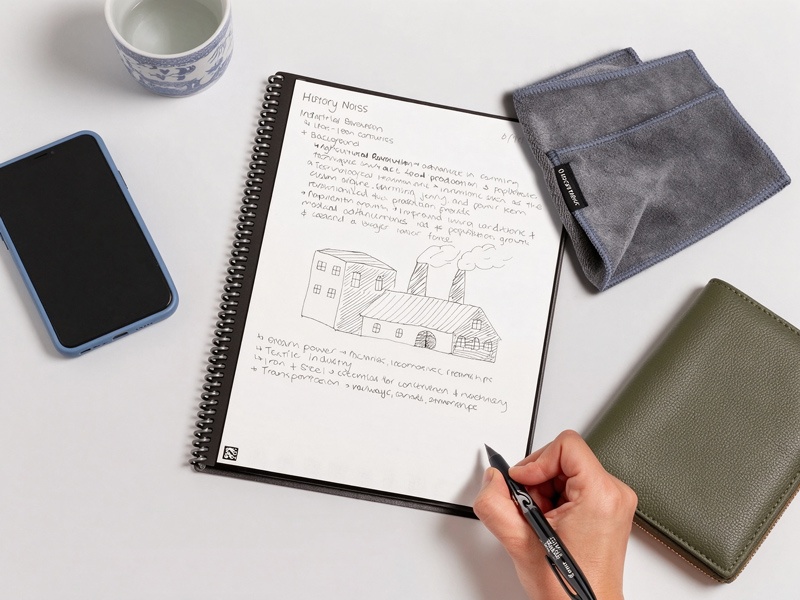
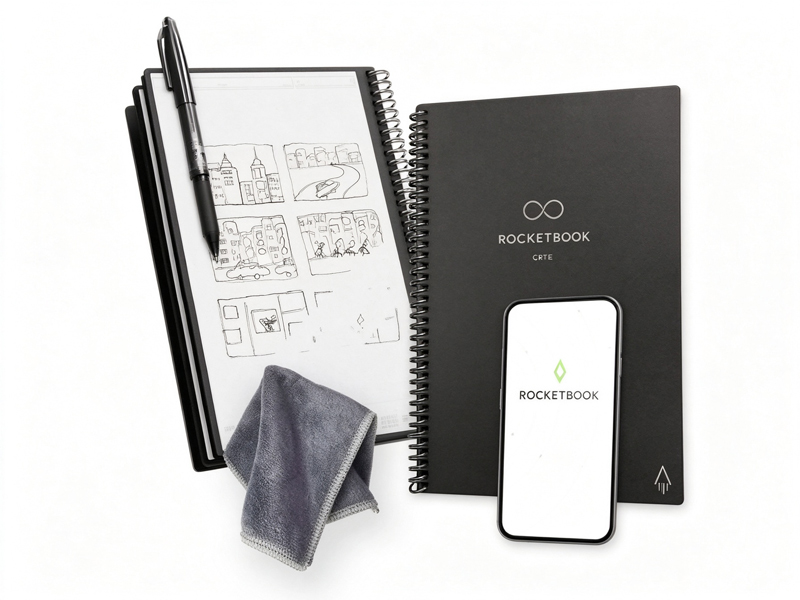
The founders themselves recognized the microwave's ceiling — the Wave's pages erased only a limited number of times, and the kitchen-appliance ritual was a gimmick with a half-life — and engineered it away. The Rocketbook Everlast replaced heat with water: pages of a polyester composite that wipe clean with a damp cloth, paired with the same Frixion ink, and paired with the app that makes the wipe safe. If the page is scanned before it is wiped, nothing is lost; if it is not, everything is. The Everlast launched on Kickstarter and raised one million eight hundred twenty-three thousand dollars from twenty-eight thousand one hundred thirty-eight backers — nearly double the Wave's original raise — and went on to become Amazon's bestselling wirebound notebook, the company's flagship, and the patented foundation for the Core, Mini, and Fusion lines that followed.
The environmental math became the quiet second engine. A notebook that erases is a notebook that never runs out, and the company adopted the slogan that folded the mission into the pitch: save your notes, save the planet. The founder's framing stayed honest — initially I created this product because it solved a personal pain point, but then I realised it had the potential to save a tonne of trees — and the single-use category of paper notebooks had, for the first time, a durable alternative.
The free app that became the growth engine
The product most people buy is paper; the product the company is built on is software. The free Rocketbook app — iOS and Android — performs the scanning, enhancement, and routing: a page photographed through the app is flattened, contrast-corrected, and filed to whichever cloud destination the user has marked, with handwriting transcription searchable afterward. The smart-destination logic, driven by symbols the user shades at the bottom of each page, turns a notebook into a physical interface for the cloud — the bridge product the founders had wanted all along.
The growth mechanics belong in a business-school case. The app became the top-of-funnel: per the Shopify Masters episode, the company collected over three million email addresses by building the app as a genuinely useful free tool, then marketed notebooks to the users it had earned. The 2025 chapter certified the philosophy with a Calm Tech Platinum Certification — third-party recognition that the product respects attention rather than harvesting it, a distinction the company's marketing now leads with, and one that positions the brand against the notification economy its users are fleeing.
BIC and the forty-million-dollar ending
The ending arrived in December 2020, and it was a homecoming as much as an exit: BIC — the French pen-and-lighter giant, a company whose origin story the dealmakers explicitly compared to Rocketbook's — acquired the brand for forty million dollars. The pre-deal numbers justified the price: thirty-two million dollars in net sales for 2020, up thirty-five percent year on year, with the sub-forty-dollar Core notebook as Amazon's category bestseller and roughly seventy percent of sales in the United States. Both founders stayed on within the group, publicly committed to developing the brand internationally.
The strategic logic, per the deal analyses, was complementary DNA: BIC brings a century of writing-instrument manufacturing and global retail muscle; Rocketbook brings the connected-paper software and the reusable-category patent estate. For the storefront reviewer, the acquisition is the question the review must hold: the brand that was born in a pub to disrupt the notebook now answers to a stationery conglomerate, and the independence the founders' staying-on preserves is real but contractual — the pitch that began against groupthink now lives inside a group.
The honest texture of a BIC brand
Four honest cautions belong in the ledger. First, the parentage: BIC is a French public company optimizing a stationery portfolio, and the brand's post-acquisition roadmap — however founder-led — ultimately answers to a conglomerate's spreadsheet; the anti-corporate origin story now lives inside a corporation. Second, the ink dependency: the product only works with Frixion-style heat-sensitive pens — cheap and ubiquitous, but a single-supplier technology under Pilot's control, and the pages are useless with a normal pen. Third, the ritual friction: wiping pages with a damp cloth is not deleting a file; it is a physical chore the buyer must actually perform, and the notebooks that wait un-wiped on a desk accumulate the same clutter the product promises to eliminate. Fourth, the ceiling: the category the company created is real but bounded — between the iPad's full digitization and the dollar pad's disposability, the reusable notebook serves a specific hybrid user, and the BIC-era expansion will test whether that niche supports a conglomerate's growth expectations or settles into a durable, profitable, modest franchise.
None of these are contradictions; all four are the taxes on being the company that turned a mistake into a microwave into a forty-million-dollar exit.
The verdict for the pen-and-paper digitalist
Rocketbook's storefront is the wrong-notebook thesis run for a decade: a humiliating meeting, a year of failed gadgets, a pub pitch, a microwave that had to be engineered not to burst into flames, a stage-side insult that preceded a $1.9M crowd, five sharks who laughed and left, an Amazon bestseller born from the rejection, a water-wipe sequel that doubled the raise, a free app that became a three-million-email growth engine, a calm-tech certification, and a forty-million-dollar BIC ending with the founders still at their desks. The cons are the cons of the acquired: conglomerate governance, pen technology it does not own, a wiping ritual that demands follow-through, and a niche whose ceiling the next chapter will measure.
Buy here if your thinking needs a pen but your archive needs the cloud, if scanning a page to seven destinations and wiping it clean beats the sync anxiety of a tablet, if the Shark Tank rejection story is the kind of company biography you want your stationery to carry, and if BIC's century of making writing tools reads as a guardian rather than an owner. Buy the iPad if the pen is a compromise you have already made, or the dollar pad if disposability is the feature. For the pen-and-paper digitalist who wants the analog ritual with the digital safety net, this Somerville storefront remains the category's most resilient answer — one wrong notebook, one microwave, and the wipe that saved a million meetings.