Thrift stores, a dead film format, and the enschede technicians: retrospekt
Official homepage: https://www.retrospekt.com
Retrospekt restores the electronics the world threw away. The Milwaukee workshop was born from a strange arbitrage: in 2010, Polaroid had stopped making film, a pack of instant film sold for thirty dollars on the secondary market, and thrift stores were letting loaded Polaroid cameras go for a few dollars because nobody knew the film inside was worth more than the camera. Two spouses headed for careers as therapists scoured those thrift stores, sold their surplus to the startup trying to resurrect Polaroid film, and ended up inheriting the restoration craft from the Dutch technicians who had maintained Polaroid cameras for decades. Fifteen years later, Retrospekt has saved more than three hundred thousand devices from landfills, builds entirely new cameras from refurbished vintage guts, and counts Pepsi, Barbie, Hello Kitty, and Fendi among its official collaborators. This review examines the storefront dimension by dimension: the thrift-store arbitrage, the Enschede lineage, the four-hour restoration, and the honest arithmetic of premium nostalgia.
Two therapists-to-be and a dead format
The founders arrived at electronics restoration from an unexpected direction. Kori and Adam Fuerst — both Polaroid enthusiasts, both headed for careers as therapy professionals, per the Milwaukee Journal Sentinel's 2019 profile — discovered their side hustle in 2010 through a market asymmetry. Polaroid had ceased film production, and the packs that remained were selling for upwards of thirty dollars on the resale market. But thrift stores, unaware that the film inside had become the valuable part, sold old Polaroid cameras loaded with a fresh pack — sometimes with a few shots left unexposed — for a few dollars apiece. The couple began scouring thrift stores systematically, accumulating cameras faster than they could use them, and turned to eBay to sell the excess.
The transition from hobby to business arrived through the same supply chain that saved the film itself. The Impossible Project — the Dutch-founded effort to restart Polaroid film production, which eventually became today's Polaroid — was making film but had no camera of its own to sell with it; its first original design, the I-1, would not arrive until 2016. The company needed refurbished vintage cameras to pair with its new film, bought from the Fuersts' eBay operation, and eventually outsourced the restoration work itself to them.
Impossible's outsourcing, and Enschede's technicians
The training the Fuersts received was the real inheritance. When Impossible decided to outsource refurbishment, it sent the couple to learn from seasoned technicians — lifelong Polaroid repair specialists from Enschede, in the Netherlands, the town where Polaroid's European operation had maintained the machines for decades — and armed them with the original Polaroid tools specially designed for the restoration process. Retrospekt formally spun up in 2015 with thirty staff and a direct line to the people who had kept Polaroid cameras alive for a generation; the company's own About page still lists the original tooling and the Enschede lineage as the foundation of its refurbishment program.
The institutional relationship compounded: Retrospekt remains an official Polaroid licensee, handling repairs, service, and collaboration for the brand that its own resurrection made possible — the unusual case of a startup's supply chain and its licensor being the same corporate ancestor.
Four hours inside a fifty-year-old camera
The process is documented to the hour. Each folding SX-70 receives roughly four hours of hands-on time: the original leatherette is removed, the camera fully deconstructed, every internal component cleaned and reworked, electronics soldered where needed, replacement parts installed, and the assembly tested to factory standards. The thousand SX-70, SLR 680, and SLR 690 cameras the company has restored — ten thousand and counting by the company's figures — represent many thousands of technician-hours, and the workshop's quality procedure is stated with the plainness of people who fix things for a living: strict testing on everything, and if a restored unit still falls short, they work overtime to make it right. TechRadar's 2024 first-person account of sending in a fungus-ridden SX-70 confirms the texture: a comprehensive workshop report listing replaced parts — mirror cover, fresnel carrier — and a camera returned in a plush customized box with a carry case.
The repair service extends the craft to customers' own heirlooms: mail in your grandfather's camera, receive it back restored, with the option of custom replacement leatherette from a wide palette — the restoration as both mechanical and aesthetic act.
Three hundred thousand devices, saved from landfill
The circularity ledger is the company's quiet pride. More than three hundred thousand devices have been saved from landfills through the refurbishment program, per the company's boilerplate — a number that grows with every press release and represents the environmental thesis of the entire operation: every restored camera is one less object in the waste stream, and every refurbished unit sold is manufacturing that did not happen. The philosophy copy is unusually specific about why the analog object matters beyond the environmental math: analog gear has a tangibility that is really enjoyable to use, in Kori Fuerst's phrasing — it forces you to slow down and be present, and at two dollars and seventy-five cents per frame of instant film, you will spend time honing your skills and composing your subject matter to get a good shot.
The stance is positioned against digital overload with a self-awareness the category often lacks: the company hopes its items provide an opportunity to slow down, step back, and enjoy a more tactile and intentional experience — nostalgia sold not as decoration but as an alternative tempo.
New housings, old hearts: the collab machines
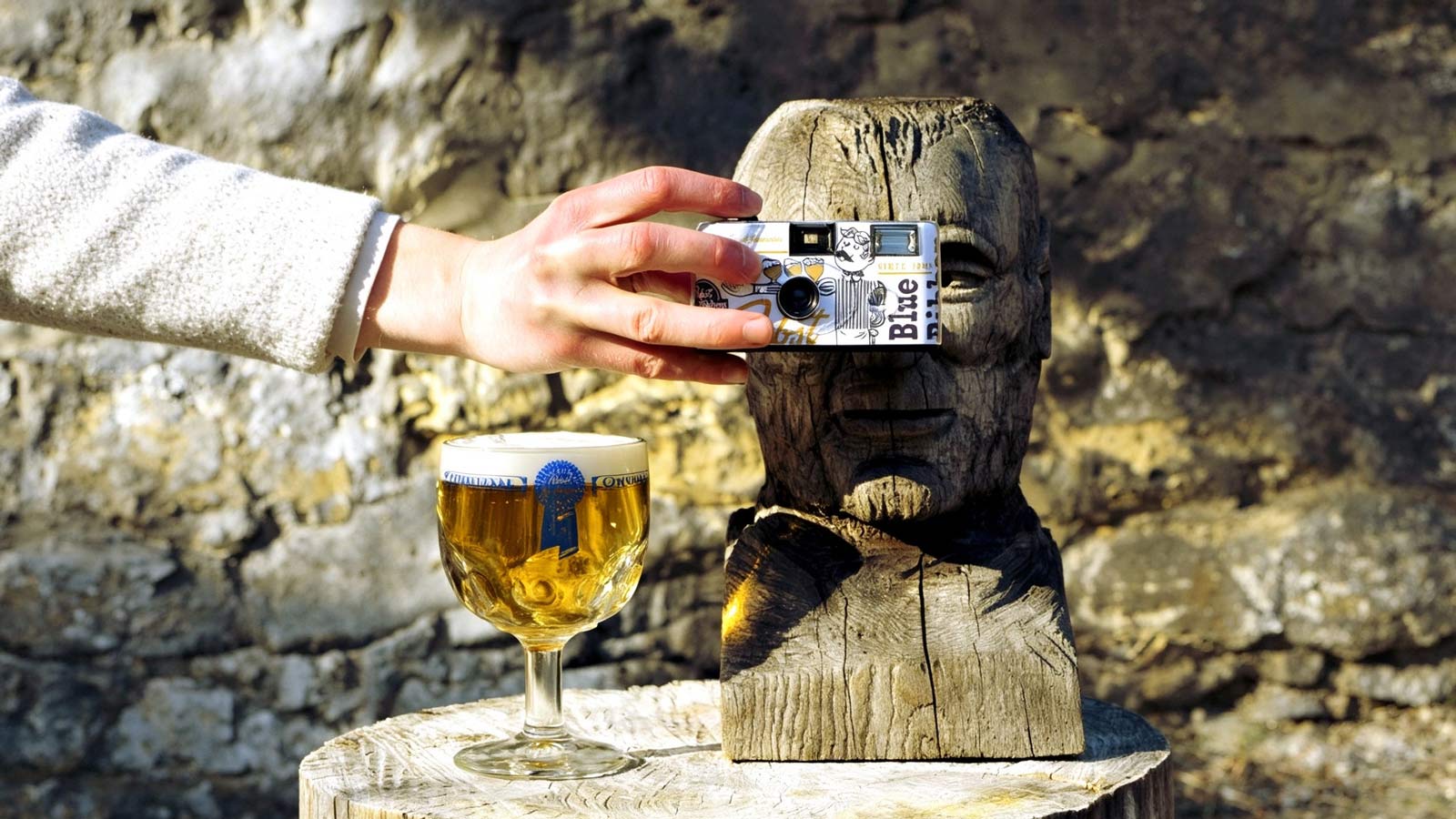
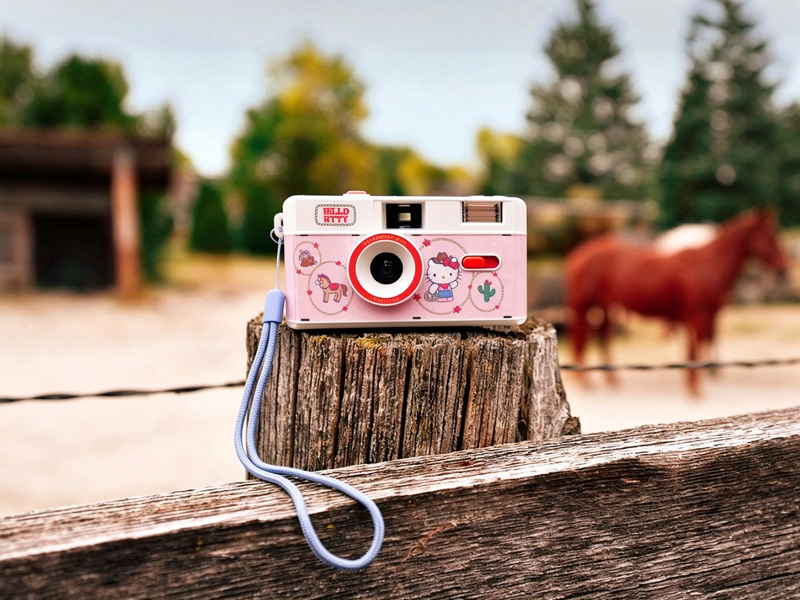
The product strategy's second engine is the collaboration: entirely new cameras built from refurbished vintage internal components and wrapped in freshly molded exterior housings, released as official Polaroid products. The Pepsi Polaroid 600 — a blue throwback built to the exact original specifications — retails at $169 and made headlines; Malibu Barbie, Hello Kitty's Strawberry Kawaii, and artist editions like Killer Acid's FC-11 35mm camera followed the same formula. The collab ladder extends beyond Polaroid: the company's press materials list Mattel, Sanrio, and Fendi as collaborators, and the Dais Records limited cassette player paired the workshop's CP-81 hardware with an exclusive nineteen-track compilation from the label's roster — a music-industry collaboration that treats the cassette player as canvas rather than commodity.
For the storefront reviewer, the collab program solves the scarcity problem elegantly: vintage internals are finite, but new housings with licensed characters create inventory the thrift-store supply chain cannot — the restoration craft monetized at the speed of pop culture.
Beyond Polaroid: Game Boys and cassette decks
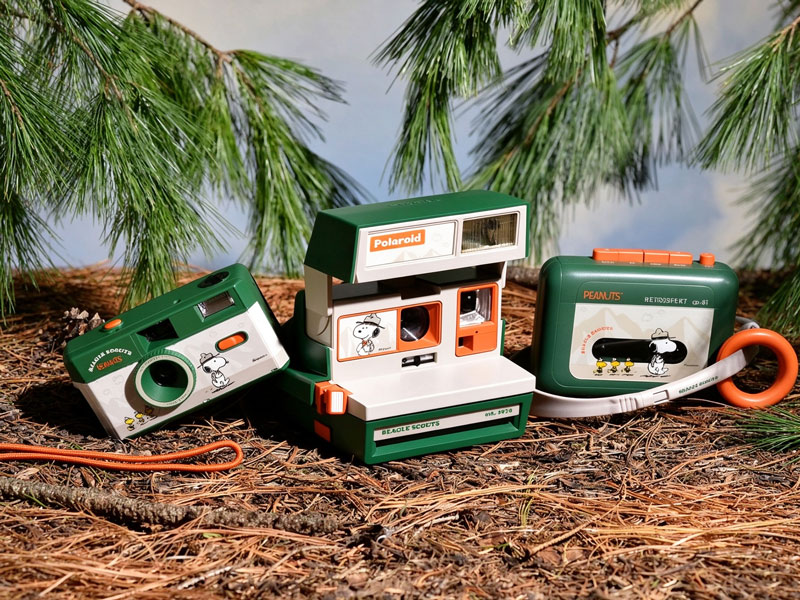
The catalog long ago escaped the instant camera. The storefront now spans vintage instant and 35mm cameras, portable cassette players, classic gaming consoles — Game Boys appearing in the company's press coverage alongside alarm clocks and cassette decks — and the oddities that define Gen X-era tech. The wholesale program extends the same restoration pipeline to retailers, with established supply channels that let the company source parts reliably in a market defined by scarcity — a capability the About page lists alongside the technicians and the tooling as one of the three things customers are buying. The Daisy and Killer Acid partnerships show the workshop functioning as a design studio as much as a repair shop: limited runs, artist co-creation, objects that sit between toy and tool.
The breadth matters commercially: Polaroid cameras are the origin story, but the cassette revival and retro gaming supply the volume — and each category brings its own film-or-format dependency that keeps customers returning.
The honest texture of the thrift-store gamble
Four honest cautions belong in the ledger. First, price: a refurbished Polaroid 600 at roughly $170 buys certainty against a thrift-store gamble that might cost five dollars and might produce a paperweight — the premium is real, and the comparison shopper will always be tempted by the gamble. Second, scarcity: the company is, by its own admission, extremely picky about condition, and the supply of restorable vintage units is finite — popular models sell out, and the collab drops are limited by the same constraint. Third, the film treadmill: the camera is the entry ticket, not the hobby — instant film runs near $2.75 per frame in perpetuity, and the refurbished camera's economics depend on a supply of film the customer does not control. Fourth, vintage wear: the company discloses that restored units will show signs of past use and may vary from photos — honest, but a reality some buyers romanticize past; and the nostalgia ceiling itself is a market boundary: the addressable audience is the analog-curious, not the mainstream.
None of these are contradictions; all four are the taxes on selling certainty in a category whose charm was the gamble.
The verdict for the analog-curious Gen Xer
Retrospekt's storefront is the thrift-store arbitrage thesis grown into an institution: two therapy students who found thirty-dollar film inside five-dollar cameras, the Enschede technicians' original tooling, four hours of hands-on time per folding camera, three hundred thousand devices pulled from the waste stream, new Pepsi-branded housings around vintage hearts, and a catalog that now spans everything from Game Boys to Fendi collaborations. The cons are the cons of certainty: premium prices against the thrift gamble, scarcity-driven sellouts, a film treadmill the customer does not control, and a nostalgia market with a known ceiling.
Buy here if you want your grandfather's SX-70 to work again without becoming your own repair project, if a certified restoration with a workshop report beats a flea-market lottery ticket, if the landfill ledger and the Enschede lineage are your language of trust, and if a Pepsi-colored instant camera is the exact object your shelf has been missing. Buy the thrift-store original if the gamble is half the fun. For the analog-curious who want the tempo of the tactile without the risk of the dead, this Milwaukee storefront remains the category's most patient answer — fifteen years, three hundred thousand saves, and still hunting thrift stores.