Positive grid at fourteen: the software company that accidentally reinvented the guitar amp

Official homepage: https://www.positivegrid.com
Positive Grid spent its first eight years as a software company, and the guitar world was content to ignore it. Founded in 2011 by a team of musicians and engineers split between San Diego and Taipei, the company built amp-modeling applications — JamUp, then the BIAS engine that let guitarists swap virtual tubes and transformers inside a modeled amplifier — earning respect among tone nerds while the hardware giants kept the practice-room market. Then, in 2019, Positive Grid shipped the Spark: a forty-watt desktop amplifier whose real product was the app behind it, capable of displaying the chords to any song on Spotify in real time and generating bass-and-drum accompaniments that learned the player's style. The practice amp market, in the trade press's phrase, was thrown into disarray — a hundred thousand units in the first year, a hundred and fifty thousand users by the end of the next. This review examines the storefront dimension by dimension: the software moat, the Spark thesis, and the honest arithmetic of hardware that depends on an app.
A team of musicians and engineers, one question
The founding question, printed on the company's own About page, is the whole thesis: how can technology make playing music simpler, smarter, and more inspiring? The team assembled in 2011 as musicians and engineers in equal measure, headquartered in San Diego with the engineering operation in Taipei — a structure that let the company keep product decisions close to players while the heavy modeling mathematics lived where the hardware supply chain could reach it. The first product, JamUp, was a mobile amp-modeling app for iOS, among the most convincing guitar-amp simulations available on any phone at the time.
The early years established the pattern the Spark would later weaponize: Positive Grid built tone engines — the mathematics of how amplifiers distort, compress, and respond — and it built them well enough that professionals started treating the software as a reference. The community that formed around the apps became the test audience, the feature request pipeline, and eventually the pre-order base for everything the company would ship in hardware.
Software first: JamUp and the BIAS engine
The BIAS line made the company's technical reputation. BIAS Amp, arriving in 2014, was a component-level amp designer: the user did not merely select a modeled amplifier but opened it — swapping the preamp tube type, the output transformer, the rectifier, the cabinet — with the simulation recalculating the circuit's behavior at each change. Guitar press coverage of the era treated it as a new category, and BIAS became one of the reference standards for professional amp simulation. BIAS FX followed in 2015 as the first cross-platform multi-effects system built on the same engine, and BIAS FX 2 extended it into recording-grade territory with a mobile version for on-the-go players in 2020.
The strategic significance only became obvious later: by the time Positive Grid touched hardware, it owned a tone engine that had been refined across a decade of brutal user feedback — ten thousand ToneCloud tones uploaded by the community, every misbehaving preset a bug report. Competitors who entered hardware first, building modeling math underneath a product deadline, were engineering uphill against a library the company had compiled for free.

The practice-room reality nobody had solved
The Spark's insight was behavioral, not technical. Practice amps had been designed for a musician who sat down with a metronome and a chord chart; the modern guitarist practiced with a phone, streaming music, YouTube tutorials, and a need to learn chord changes quickly and improvise over backing tracks without setting up a studio rig. The Spark addressed that reality as a system: a forty-watt desktop amplifier that functions as a traditional amp, as an audio interface for recording, and as a Bluetooth speaker — wrapped in a companion app that does the things the old amps never imagined. Auto Chord pairs with Spotify, Apple Music, or YouTube and analyzes millions of songs to display their chords in real time as the track plays. Smart Jam listens to the player's style and generates bass and drum accompaniment to jam over. Voice control keeps the guitar in hand.
Guitar World's verdict on the phenomenon captured the market shift: the Spark was not the most powerful or the most tonally sophisticated practice amp available — it was the first one genuinely designed around how modern guitarists actually practice.
Twenty-five thousand pre-orders before it shipped
The launch numbers read like a consumer-electronics case study. The Spark 40 was unveiled at the end of 2019 through a crowdfunding campaign and generated twenty-five thousand pre-orders before a single unit shipped; it sold one hundred thousand units in its first year and passed one hundred fifty thousand users by the end of 2020. The trade press recorded the category's reaction without euphemism: the rest of the guitar practice-amp market had been thrown into disarray — incumbents who had iterated on the same knob layout for decades were suddenly selling an object whose real product was a cloud service.
The distribution matched the product: a direct storefront running on Shopify, selling globally in the same transaction as the app's download, with the community's ten-thousand-tone ToneCloud library functioning as the retention engine — a player who has dialed in a sound on the platform does not casually switch platforms.
The Spark family, and the Amp Intelligence era
The catalog compounded the thesis across form factors. The Spark MINI shrank the format for desktop and travel; the Spark GO went pocket-sized for the genuinely mobile player; the Spark LIVE scaled the concept to performance volume with a band-ready rig; the Spark NEO refreshed the flagship; and the 2025 generation arrived under the Reactor name, built on what the company calls Amp Intelligence — a system that transforms ideas, images, and sounds into dynamic, playable tones, generating amplifier setups from a reference the way the earlier Auto Chords had generated chord charts from a song. The company's self-description on its storefront — smart, connected tools that get out of the way — has remained constant through every generation, as has the promise that millions of musicians, from the hobbyist at home to the pro on stage, trust the platform.
For the storefront reviewer, the family strategy is the standard consumer-electronics play executed unusually well: one app ecosystem, one tone library, five price points — entry at the GO's pocket money, flagship at the NEO, and a clear upgrade path that keeps the customer inside the platform at every stage of seriousness.
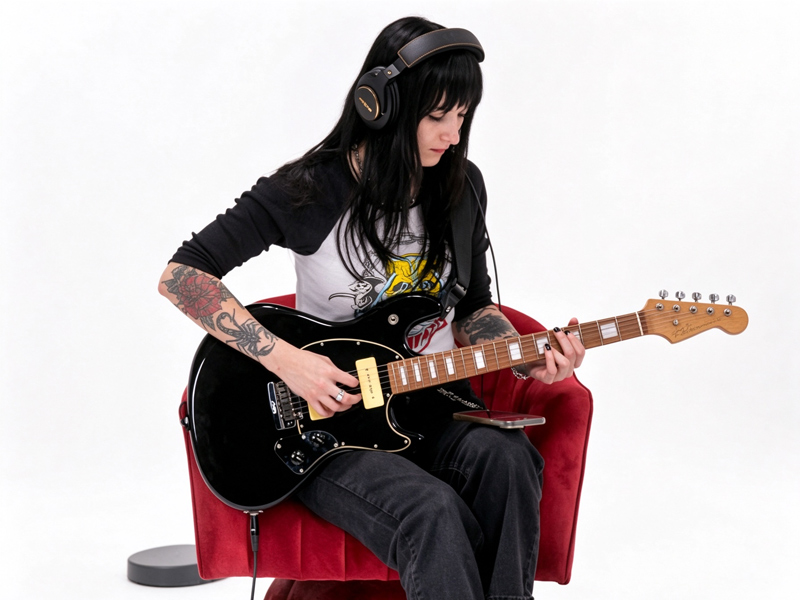
ToneCloud and the community flywheel
The community flywheel deserves its own paragraph because it is the moat competitors cannot buy. ToneCloud, the company's tone-sharing library, hosts more than ten thousand user-created amp-and-effects configurations — every one a demonstration, a tutorial, and a reason to open the app. Guitar teachers build lessons around Auto Chords; bedroom players publish Smart Jam sessions; the community that began reviewing JamUp presets in 2012 now generates the catalog's most persuasive content without being asked. The funding and team specifics the company does not publish — it is private, with revenue visible only through press estimates — but the storefront's scale claims, millions of musicians, sit plausibly on top of a hardware-plus-software base whose retention mechanism is a library the users wrote themselves.
The Shopify storefront itself performs the standard global-direct playbook competently: localized currencies, the app-store pairing at purchase, trade-in promotions cycling through the calendar, and a content engine that treats every firmware update as a product launch.
The honest texture of app dependency
Four honest cautions belong in the ledger. First, dependency: a Spark is a forty-watt paperweight if the companion app stops being supported — the amp works standalone, but the features that justify the purchase are cloud and software, and the buyer is trusting a private company to maintain them for the decade a guitar amp is expected to serve. Second, competitive response: the incumbents did not stay disarrayed — Fender's Mustang series and Yamaha's THR line answered with their own app ecosystems, and the feature lead Positive Grid enjoyed in 2020 has narrowed every year since. Third, AI commoditization: Auto Chords was a miracle in 2019 and is now a feature every music app demonstrates — the intelligence layer that justifies the premium migrates to subscription software on devices the customer already owns, and hardware margins compress accordingly. Fourth, the ceiling: the platform speaks guitar fluently and bass adequately and everything else barely at all; a drummer or keyboard player visiting the storefront finds nothing, and the company's expansion into their instruments is an announced ambition rather than a shipped reality.
None of these are contradictions; all four are the taxes on being the software company that taught the hardware industry what the product actually was.
The verdict for the bedroom guitarist
Positive Grid's storefront is the tone-engine thesis run for fourteen years: a software company that let guitarists swap virtual tubes inside modeled amps until the modeling was indistinguishable from the real thing, then wrapped the engine in a forty-watt box that displays chords for any song in the world and generates a rhythm section that listens to how you play. The cons are the cons of the architecture: an app dependency the buyer must price, a competitive field that closed the gap, an AI layer the industry is commoditizing, and a catalog that speaks one instrument's language.
Buy here if your practice room is a desk and your teacher is YouTube, if Auto Chords beats a chord chart and Smart Jam beats a metronome, if ten thousand community tones sound like a head start rather than a distraction, and if one platform that follows you from pocket amp to stage rig matches your idea of loyalty. Buy the traditional practice amp if a knob you can explain to your grandfather matters more than a feature list. For the bedroom guitarist who wants the amp to do the boring parts, this San Diego-and-Taipei storefront remains the category's most practiced answer — fourteen years of tone engines, one viral box, and still jamming.