The frame that turns your camera roll into a private social network
Official homepage: https://auraframes.com
Aura was founded by two men who built the public internet and then tried to escape it. Abdur Chowdhury — the BBC's father of trending topics and hashtags, Twitter's first chief scientist — and Eric Jensen, the engineer who ran Twitter's search and relevance, spent fifteen years at AOL, Summize, and Twitter making information flow faster and louder. Then Jensen bought his mother a digital picture frame, it was terrible, and the pair committed the heresy their entire careers had trained against: they built hardware. The Aura frame, launched in 2016, applies search-and-relevance AI to the opposite of a feed — private, domestic, deliberately slow photo sharing with no subscription fees — and a decade in it is the category's number one, the best-reviewed frame on Wirecutter and The Strategist, the giver of one billion photos a year, and now the maker of a color e-ink frame that runs for months on a charge. This review examines the storefront dimension by dimension: the escape from Twitter, the anti-feed thesis, the no-subscription economics, and the honest arithmetic of a camera roll redeemed.
The search engine that found its family
The founders' previous act is the prologue every profile leads with. Abdur Chowdhury and Eric Jensen met in graduate school and worked together across fifteen years — AOL, where Chowdhury rose to chief architect, then the startup Summize, the real-time search engine they launched in 2007 that Twitter acquired in 2008 and rebuilt into the search function the platform still runs on. Chowdhury stayed as Twitter's first chief scientist — the BBC's anointed father of trending topics and hashtags — and the two finally left in 2011, founding the software startup Pushd. The frame was not the plan. The frame, in Chowdhury's own Forbes telling, was the accident: Eric came in one day and said, I bought a digital picture frame for my mom and it sucked. I said, so did I, and it was horrible — but no way are we building hardware.
They built hardware. The reasoning was the engineers' reflex applied to the home: the digital picture frame, Chowdhury said in the same interview, was akin to the T.I.-89 calculator — brilliant in its day, but never innovated on since. Every review of the category documented the same failures — screens like gas-station TVs, interfaces requiring a computer science degree, photo uploads through SD cards and janky desktop software — and the pair concluded the fix was not more software in the cloud but a beautiful object with a sophisticated computer inside, lying squarely in the center of the smart and beautiful venn diagram.
A frame that sucked, a promise broken
The first Aura frame shipped in 2016 at $399 — ivory with rose-gold trim or charcoal with black — and it arrived with the engineering values the pair had honed on search: a genuinely high-resolution display tuned for photos rather than television, motion and light sensors that dim the screen when the room empties, gesture swipes for the next photo, and, above all, a free mobile app that made adding photos as easy as sending a text. Family and friends could be invited as contributors, and the frame filled itself from their camera rolls — the reverse of every frame that had demanded the owner curate a USB stick.
The launch validations came quickly. Oprah's Favorite Things embraced the frame in its first year; in 2018 The Ellen DeGeneres Show made it a Mother's Day recommendation; and in 2017 Spark Capital's Kevin Thau led a $7 million Series A for the company — investors betting that the search scientists could do for the living-room frame what they had done for the tweet. The founders' framing stayed modest throughout: we have the luxury to create a product for our families and selves — the only device in my home engineered to make people smile every time you look at it.

The anti-feed: curation without posting
The AI the founders installed is the philosophical inversion of their Twitter work. The Aura app applies facial recognition to feature the people you photograph most often, automatically filters the garbage — blurry, low-contrast, duplicate, or embarrassing frames never reach the display — and learns which photos earn lingering looks versus glances, weighting the rotation toward the ones that work. There is nothing to post, nothing to like, no metrics, no audience: the same machine-learning discipline that optimized public attention at Twitter was pointed, here, at private attention within a family.
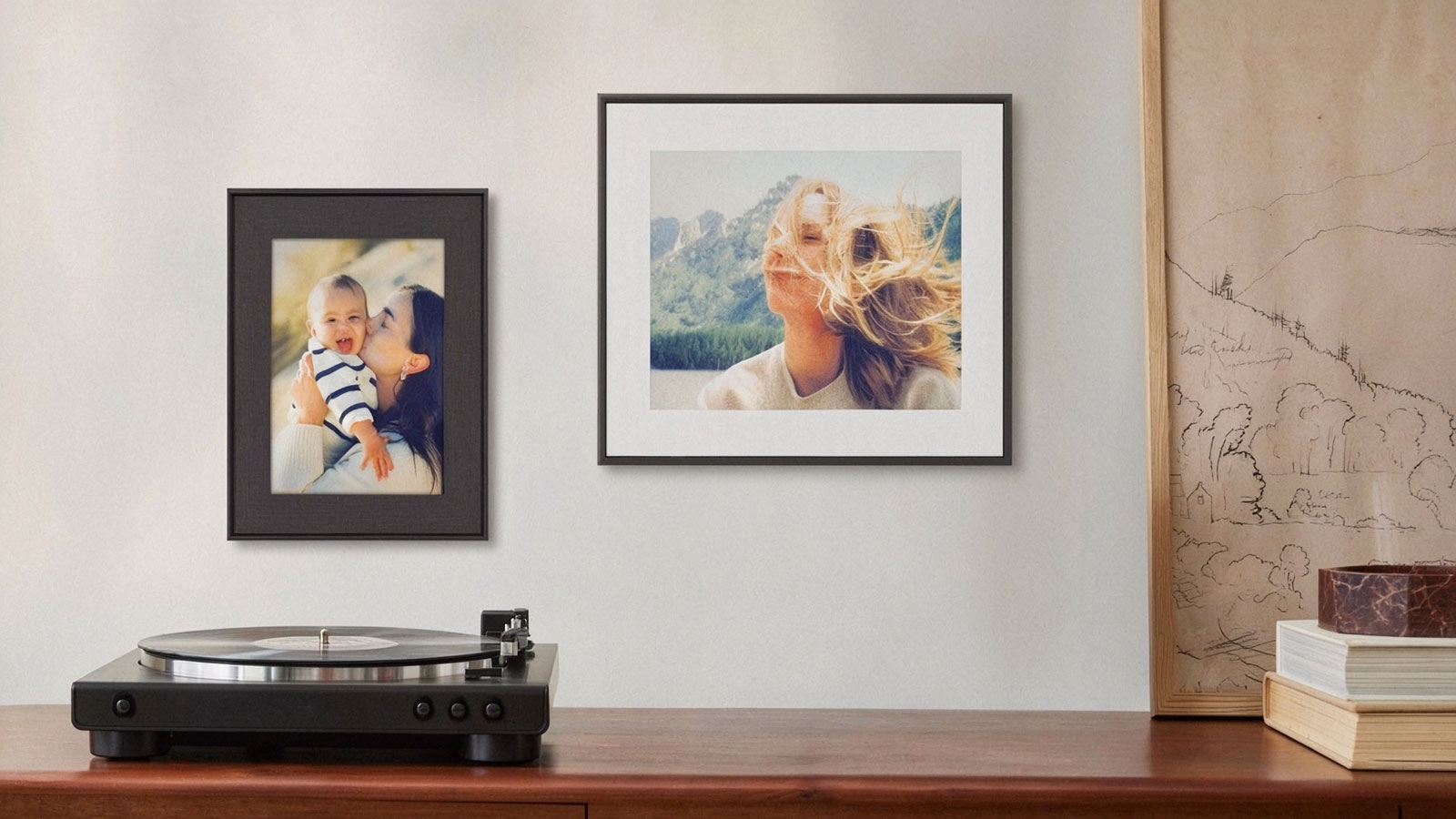
The 2026 repositioning made the thesis explicit. Adweek reported the company's new campaign framing the frame as a private social network — the strategic answer to a decade-old question the founders keep answering the same way: photos are shared constantly but disappear into camera rolls and public feeds, and Aura's answer is to put those images somewhere visible, domestic, and intentionally limited. For two engineers who helped invent the public feed, the product reads as a decade-long apology for it — connection, the campaign argues, becomes more durable when the technology asks less of people, not more.
No subscription fees, as competitive weapon
The commercial wedge is the industry's most hated word: none. Where rival frame brands built subscription tolls on top of the hardware — pay monthly for cloud storage, pay to share, pay to keep the frame alive — Aura ships unlimited photo sharing with no subscription fees, printed on the About page in the same sentence as the #1 claim. The economics run through hardware margin instead: frames from roughly $150 to $400, a gift-ready box, and the bet that families will buy a second and third frame once the first one earns its place on the mantle — a bet the one-billion-photos-a-year traffic suggests is paying.
The capital followed the traction. In November 2022 Aura raised $26 million in a round led by the Lago Innovation Fund, money the company has spent on international expansion — storefronts now serve the United States, Canada, United Kingdom, Germany, France, and Mexico — and on the e-ink program. The company also set aside one percent of itself for charity at founding, an early limited-edition blue frame raising funds for charity:water, and the founders' STEM-school philanthropy rounds out the values file: Chowdhury and his wife co-founded a K-8 STEM school in San Francisco, the same instinct that built Aura applied to the next generation's tools.
Oprah, Ellen, and the gift economy
The frame's commercial engine is the gift economy, and Aura has optimized for it methodically. Oprah's endorsement put it on the holiday map in 2017; Ellen's Mother's Day segment made it the default gift for grandmothers in 2018; Wirecutter's best-of crown and The Strategist's recommendations made it the review-aggregators' consensus pick — the company now states, without visible fear of contradiction, that ten years in it is the #1 digital frame and a beloved gift, recommended by Wirecutter and The Strategist and enjoyed by millions of families. The gift mechanics themselves are engineered: you can preload photos before the box is wrapped, so the frame lights up with memories the moment it is unwrapped, and the recipient invitation system converts every giftee into a contributor network.
The category's quiet revival is part of the story: the digital frame that died as a cliché in the 2000s came back as the pandemic's connective tissue for families separated by lockdowns and geography, and Aura — the premium, app-first, no-fee version — absorbed the revival's value end almost entirely, leaving the subscription-dependent rivals to fight over the remainder.

From LCD to e-ink: the Aura Ink turn
The 2025-26 chapter is the engineers' return to first principles. In October 2025 Aura launched the Aura Ink — a thirteen-inch full-color e-paper wireless frame with a battery measured in months rather than hours, solving the category's oldest complaint that a frame is a perpetually-tethered television pretending to be furniture. The campaign raised over a million dollars on the crowdfunding platforms — the old category relearned its AI tricks, as the Chinese press framed the crowdfunding milestone — and the Ink won the 2026 iF Design Award in April, with retail expansion into the Netherlands, Belgium, and Luxembourg through Coolblue following in the summer. The company's press materials now describe a product family spanning the LCD Carver and Aspen lines through the e-ink flagship, all sharing the no-subscription architecture.
For the storefront reviewer, the e-ink turn matters less as a product than as a thesis: the frame that was supposed to be a screen you ignore has become a page you notice — ambient, unpowered-looking, closer to a framed print than a television, and the most convincing answer yet to the objection that digital frames make homes feel like waiting rooms.
The honest texture of an app-gated frame
Four honest cautions belong in the ledger. First, the app gate: photos reach the frame only through the Aura app and Aura's servers — no SD card, no USB, no dragging files from a laptop — which is simple for the smartphone-native and a wall for the grandparent whose camera roll lives on a computer, the exact buyer the gift economy targets. Second, the setup paradox: the frame that is easiest to give is hardest to start, since the recipient must download the app, create an account, and join the invitation before the preloaded photos appear — a first-hour friction the gift packaging papers over. Third, the category ceiling: a household needs one frame the way it needs one mantel — replacement cycles are slow, the second-frame upside is real but bounded, and the company must keep expanding internationally or into e-ink variants to grow against its own saturation. Fourth, the economics of free: the no-subscription promise is also a no-recurring-revenue structure, meaning every future feature must be justified by hardware sales — the company has chosen the harder business model and the buyer should know the discipline it demands.
None of these are contradictions; all four are the taxes on building the anti-feed version of the family photo — the feed that does not feed on you.
The verdict for the long-distance family
Aura's storefront is the escape-thesis run for a decade: two search scientists who made information loud at Twitter and quiet at home, a mother's gift that sucked, a promise not to build hardware broken within a year, a frame that curates without posting, no subscription fees in a subscription-bloated category, Oprah and Ellen and Wirecutter in agreement, a billion photos a year flowing to mantles on six continents, and a color e-ink frame that finally makes the object feel like furniture instead of a television. The cons are the cons of the architecture: the app gate, the setup paradox, the single-mantle ceiling, and the discipline of a business model that refuses recurring revenue.
Buy here if your camera roll is a graveyard of photos nobody sees and you want a mantle that resurrects them without resurrecting the feed, if a no-subscription promise in hardware is the rare contract worth trusting, if your family is spread across time zones and you want the sharing to happen without anyone performing for it, and if the e-ink frame's months-long battery answers the objection you have held since the first digital frames sucked. Buy a cheap tablet in kiosk mode if the budget rules or the app gate offends. For the long-distance family that wants its photos back from the camera roll without giving them to the feed, this New York-San Francisco storefront remains the category's most redemptive answer — one search engine, one frame, and the camera roll finally relieved of its silence.