The designer who quit furniture after the first iphone changed everything

Official homepage: https://www.nativeunion.com
Native Union was named for a blurring. In 2009, two designers working from a co-working space in Hong Kong — one a Parisian who had abandoned a furniture career, one a London industrial designer — kept arriving at the same observation: the iPhone had erased the line between work and play, and everything touching the device was an insult to it. Plastic cables, rubbery cases, anonymous docks — a universe of accessories that treated the most beautiful object in daily life as an afterthought. Seventeen years later, Native Union makes marble phone cases, retro telephone handsets, charging cables with cast-iron souls, and sells through Apple Stores worldwide — on a doctrine measured in touch. This review examines the storefront dimension by dimension: the founder's two careers, the design-gap thesis, the object catalog, and the honest arithmetic of a boutique accessories house.
Three magazines and a co-working space
Igor Duc's teenage self held the whole map of his future on a newsstand. Growing up in Paris, he bought three magazines every month — Surf Session, Électronique Pratique, and Architectural Digest — and knew that whatever he built would orbit one of those three worlds. Business school pointed him to the third: at twenty-three he created a designer furniture brand, bringing beautifully crafted pieces into homes, until the harsh logistics of shipping fragile objects halfway across the world — obstacles he was too inexperienced to solve — drove him to the brick wall. The first iPhone arrived in 2007, in the same period, and Duc has said it completely changed his life: he was glued to it instantly, understood it would transform how we live, and saw that the refined objects surrounding it simply did not exist.
Meanwhile, in a Hong Kong co-working space, John Brunner — who had started an industrial-design firm in London — was working side by side with Duc, both of them almost exclusively on mobile devices. The two compared notes on the discrepancy: beautiful machines, hideous accessories. Native Union was, by Brunner's own account, the only name they ever considered — with mobile technology, the old-fashioned way of working doesn't exist anymore; their eureka was this new reality, this blurring of the lines, this union between work and play.
Three hundred touches, and a design gap
The founding arithmetic is preserved in Business Insider's profile, and it remains the company's sharpest piece of positioning: you touch your phone about 300 times each day — it seems logical to make this experience nicer. The two founders' shared diagnosis, in their own phrasing, was a very big discrepancy between the design of Apple products and the accessories used to support them — mass-produced, non-descript plastics dominating a category where the supporting cast should be as considered as the star.
The thesis produced a different kind of accessory company: one that begins with materials and objects rather than SKUs and price points, treats the cable as an interior-design problem, and accepts that the buyer who cares about the gap is a minority — a profitable, loyal minority, as seventeen years of continuity attest. The manifesto, as the company's own story page compresses it: to challenge the perception that tech accessories are purely functional and uninspired.
Marble, handsets, and the weighted knot
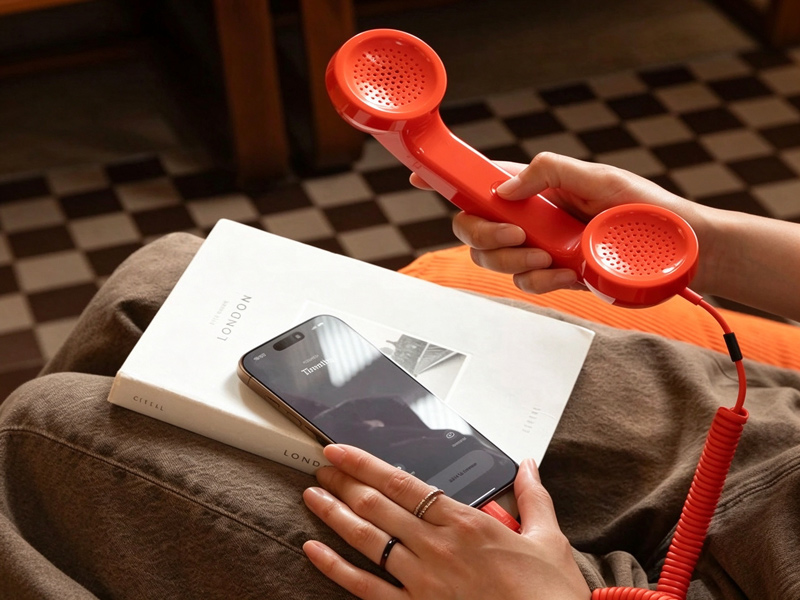
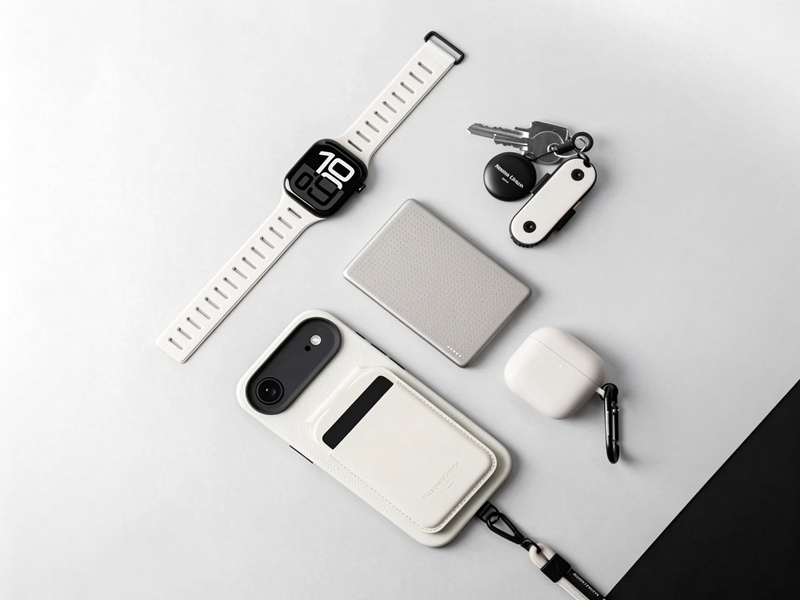
The catalog reads like an answer to what-if questions nobody else asked. The marble iPhone case — carved from richly hued green Indian marble, heavy in the hand and unlike anything the category had produced — turned protection into sculpture. The POP handset turned the smartphone into a landline: a retro telephone receiver, corded to the iPhone, that answered the radiation-anxious and the nostalgia-bitten at once, becoming one of the era's most photographed objects. The Belt Cable solved the pocket tangle with a weighted knot — a cable that stays where you drop it. The Jump combined cable and battery; the Eclipse charged devices in an ombre translucent dome; the Stow sleeves and docks and Key Cables completed a world where every object touching the device had been interrogated.
The early press framed the antidote precisely: an antidote to the non-descript mass-produced plastics that dominate the accessories market — purposeful, good-looking, built to last, thanks to clever design details and fine, hard-to-find materials. Each product serves as proof that the category's defaults were choices, not laws.
Near-death moments, and the long road to Cupertino
The company's survival story is told more quietly than most. The Banyan Workspace retrospective of Duc's journey — built around a live Entrepreneur Stories appearance — flags near-death moments alongside the Apple partnership, and its lesson-drawing summary quotes Duc's operating hunger: if you're not frustrated by how much better your product is than your competitors', you're not hungry enough. The climb to Apple's shelves was the long way around — the article's title calls it taking the long way to Cupertino — and arriving there, with Native Union products carried in Apple Stores internationally, functioned as the industry's loudest possible endorsement: the design-gap thesis, ratified by the company whose gap had inspired it.
The Apple relationship also hardened the catalog's boundaries: Native Union became, for practical purposes, an Apple-ecosystem brand — its accessories engineered around iPhones, iPads, MacBooks, AirPods, and Watches, with Android presence minimal enough that review guides describe the line as exclusively for Apple products. The gap the founders saw was Apple's gap; the moat they built is Apple-shaped.
Tom Dixon, Maison Kitsuné, and the collab ladder
The design-world legitimacy arrived through collaborations the category does not usually attract. Tom Dixon — the British design legend — chose Native Union for his first technology collection, the Stash Collection, in 2018: brushed silver and black aluminum pieces whose aesthetic, in Wallpaper's coverage, married Dixon's moody sculptural qualities to Native Union's engineering, with Dixon studying vintage performance-built analogue equipment for inspiration. Maison Kitsuné, the French-Japanese fashion house, lent its fox and its sensibility; La Boite Concept, the high-end French audio firm, brought speaker craft to a collaboration.
The collab ladder matters beyond sales: each partnership borrows an adjacent design world — furniture, fashion, audio — and lends its authority back to accessories, elevating the category the founders set out to rescue. For a boutique brand, being the natural collaborator of design houses is a positioning no advertising budget can rent.
A lifetime warranty, honored without argument
The warranty chapter is documented by the customers themselves. The standard term is two years across the catalog — but the Ultra Strength charging cables carry a lifetime warranty, and the review record shows it functioning as doctrine rather than marketing: customers report replacements issued without discussion after two and a half years of use, broken attachment points swapped proactively after a single email with a photo. The storefront's aggregate — 2,568 reviews averaging 4.8 stars by the company's count — is modest in volume next to the giants and exceptional in tenor; the complaints that appear tend to concern shipping pace rather than product failure.
The service posture completes the object doctrine: a brand that argues its accessories should be kept for years backs the argument with the only promise that matters, the standing offer to repair or replace the cable you bought when phones were smaller. The shipping reality belongs in the same ledger — orders ship from Hong Kong, five to seven business days to the United States, two weeks or more internationally — a pace that asks the buyer to wait for an object in an era trained for next-day.
The honest texture of a marble case
Four honest cautions belong in the ledger. First, price and fragility: premium objects at premium prices, with the marble case the emblematic paradox — a protector carved from a material that can itself crack, beautiful precisely because it is not the sensible choice. Second, the Apple boundary: the catalog speaks one ecosystem fluently, and the Android majority of the world's phone buyers will find the door largely closed, by design. Third, scale and speed: Hong Kong headquarters, Hong Kong shipping, a team counted in the tens rather than the hundreds — the boutique register that makes the design coherent also makes delivery slower, inventory shallower, and the price of a one-person mistake higher. Fourth, capital simplicity: with a single named investor — Leitmotiv — and founder ownership intact, the company has the discipline and the constraints of a family firm: no venture accelerant, and no venture safety net, through the near-death moments the founder now mentions in past tense.
None of these are contradictions; all four are the taxes on building a design house in a category built for volume.
The verdict for the design-first buyer
Native Union's storefront is the design-gap thesis run for seventeen years: a Parisian who read three magazines as a boy and tried furniture first, a London industrial designer met in a Hong Kong co-working space, a name chosen for the blurring of work and play, a doctrine measured in three hundred touches a day, a catalog of marble and handsets and weighted knots, Apple Store shelves as the industry's apology for the gap, Tom Dixon as the collaborator who certified the rescue, and a lifetime warranty honored by the only metric that matters — the customers who came back for a second cable years after the first. The cons are the cons of the boutique: premium prices for beautiful objects, an Apple-shaped moat, Hong Kong shipping times, and the fragility of a marble case that is meant to be admired more than dropped.
Buy here if your desk is a place and not a surface, if the object touching your phone should earn its three hundred daily touches, if Apple Store shelf legitimacy and Tom Dixon collaborations are your language of design trust, and if a lifetime-warranted cable is the correct answer to a drawer of dead ones. Buy the mall cable if tomorrow matters more than the object. For the design-first buyer who believes the accessories should be the quiet best part of the setup, this Hong Kong storefront remains the category's most considered answer — three magazines, one iPhone, and the touch finally made nicer.