Can throwing iphones off a dam build a global accessories brand?
Official homepage: https://www.mous.co
Mous's first product was killed by an Apple keynote. The company's founding case wrapped a pair of headphones around the phone itself — a clever idea that became unsellable the morning Apple removed the headphone jack, six months in, taking every penny of the founders' forty-thousand-pound life savings with it. The sequel is one of the stranger second acts in consumer hardware: the founders moved to Shenzhen on no money, ate packet noodles in cockroach-infested hotel rooms for two years learning how cases actually get made, returned with a shock-absorbing material of their own, and built the company into an internet phenomenon by throwing iPhones at the ground — off ziplines, out of helicopters, and in 2025, off a 250-meter Swiss dam at 100 miles per hour in front of a base jumper. This review examines the storefront dimension by dimension: the dead first product, the China immersion, the material science, the stunt doctrine, and the honest arithmetic of building a brand on destruction.
A first product Apple killed by announcement
The founding frustration was the same one every case buyer knows: slim cases were too flimsy, protective cases too ugly. James Griffith — a designer then working at Procter & Gamble — teamed up with his university friend Josh Shires, who had been experimenting with a 3D printer in his bedroom, to solve it. Their first design wound a pair of headphones into the case itself — a tidy integration of the era's two most carried objects — and they poured their life savings, roughly forty thousand pounds including a seven-thousand-pound Virgin StartUp loan, into bringing it to market.
Then Apple held its keynote. The headphone jack — the entire premise of the product — disappeared from the iPhone, and Mous 1.0 became unsellable overnight, six months into the company's life. Griffith has described what followed not as the glossy LinkedIn-approved failure but as the real kind: the sort that drains every hour of your day and every penny of your savings, all wiped out in a single moment. The lesson the team drew was the one that defines the company still: fear of failure made them resolve to do everything to their best ability, whatever it cost.
Cockroach hotels, and the China immersion
What it cost, first, was geography. With a few months of dwindling funds left, the founders concluded that developing a hardware product through video calls with Asia was a slow death — so they moved to China themselves, extending their runway by a year and eliminating the distance between their drawings and the factory floor. Griffith's retrospective of the period is the most quoted passage in the company's press file: we would play rock, paper, scissors to decide who was going to attempt to order the drinks; our every day became waking up in the cheapest hotel room with cockroaches decorating the floor, eating packet noodles and obsessing over phone cases. It was intense. The team spent over two years working on product development for western brands and factories — learning mass manufacturing by doing it for other people, absorbing the tooling, materials, and QC disciplines their own product would need — before repositioning Mous around protection.
The immersion was total enough that Shires remained in China, still living there when the Forbes profile ran years later — the manufacturing half of the partnership embedded permanently at the source. Piper, the private equity firm that invested in 2019, lists the China residency among the founding facts of the brand, and the company's own About page treats the move as the moment Mous stopped being a design idea and became a product company.
AiroShock: air pockets as tiny springs
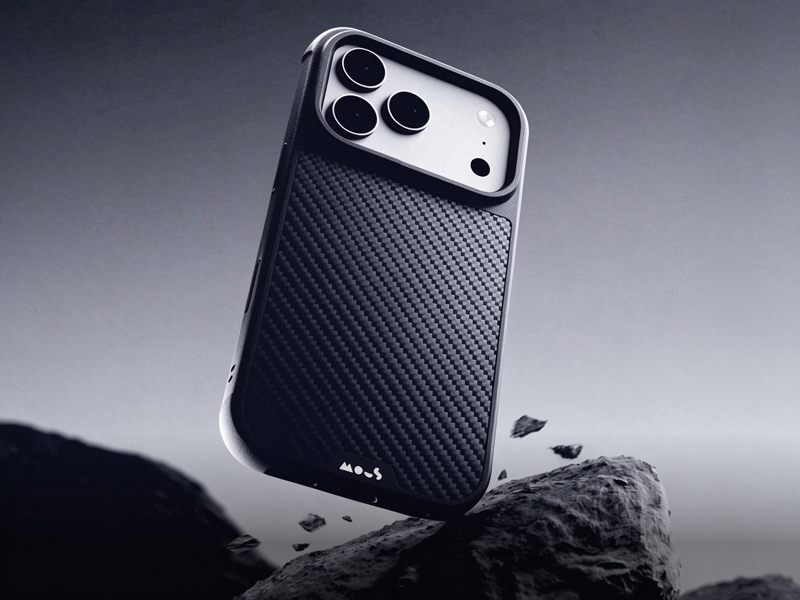
The product of the immersion is a material. AiroShock — patent-pending from launch — is a structure laced with micro air pockets that act as springs, dramatically dampening impact forces across the case body while adding only 2.3 millimeters of thickness. The development process, per the investor and press accounts, consumed many prototypes and many deliberately smashed phones: the team dropped test units until the physics worked, then kept the material in every case since. The composition is a composite of TPU for flex, polycarbonate for rigidity, and the AiroShock layer for impact, with surface coatings against scratches — a stack the third-party durability roundups credit with beating the category's legacy names in drop testing, one table showing Mous surviving drops beyond ten feet where famous rivals show scratches at six.
The honest engineering asterisk belongs in the ledger too: TPU yellows in sunlight, a property Mous does not hide in its own materials documentation — the case protects the phone better than it protects its own appearance, and the buyers who care about both cycle their cases accordingly.
The stunt doctrine, from Regent Street upward
The marketing doctrine is the company's signature: prove it in public, every year, with something more extreme than last time. The first stunt was improvised necessity — the crowdfunding campaign had stalled, and Griffith stood outside Apple's Regent Street store on iPhone X launch day throwing a cased phone to the pavement. Security moved him along; the crowd filmed; a stranger grabbed the phone and hurled it fifteen feet in the air — the first extreme test, performed live in front of Apple fanatics, and the case held. The tradition escalated methodically: an iPhone X dropped from a hired helicopter; the iPhone 13 Pro thrown at a hundred miles per hour from a zipline in Wales, aimed at a twelve-foot landing strip beside a sheer drop into a lake, in winds that made the aiming an act of faith — it landed on the strip, intact.
The 2025 chapter took the doctrine to its logical summit. A base jumper stood atop a 250-meter dam in Switzerland; an iPhone 17 in a Mous case went over the edge at 100 miles per hour; the footage crossed thirty million organic views across social platforms before the press cycle ended. Griffith's framing of the stunt economy is the doctrine in one sentence: getting noticed has clearly worked — the firm has grown into a thirty-million-pound success story without traditional advertising, connecting to a global customer base through digital and social platforms instead.
Two and a half million dollars of drops
The financial proof of the doctrine arrived in 2017-18. After the stalled start, the crowdfunding campaign ignited — Griffith has described the moment phones started pinging in a McDonald's, ten cases sold in ten minutes and never slowing — and closed at $2.5 million in pre-orders from fifty thousand backers, making Mous the most crowdfunded phone-case company in history. The Limitless 1.0 launched in 2016 to commercial and critical success, and the generations since — the Limitless line now well past its fourth iteration — have carried the same AiroShock chassis through every iPhone cycle, each launch anchored by its annual drop event.
The crowdfunding number matters less as capital than as market validation: fifty thousand people pre-paid for protection they had watched survive a fifteen-foot throw, which is the cheapest possible focus group and the strongest possible warranty advertisement in the same transaction.
From cases to carry: the luggage chapter
The catalog widened on the same physics. Real materials — aramid carbon fiber, leather, wood, and even shell — dressed the protective chassis for buyers who wanted the case to look like an object rather than armor; card wallets, mounts, screen protectors, and charging accessories filled the ecosystem; and the 2025 roadmap extends the doctrine to hardshell luggage, with the dam stunt explicitly previewing the same drop-proof claims for checked bags. The investor materials describe the ambition as a global direct-to-consumer tech-accessories brand — an ecosystem of innovative products providing ultimate protection — the case having become the beachhead for a carry-goods franchise.
The luggage extension is the strategic tell: phone cases are replaced with phones, on a known cycle, by a known customer — luggage turns that customer into a repeat buyer across a decade rather than a year, and the stunt machinery that proved a case can survive a dam applies, with equal theatricality, to a suitcase.
The honest texture of the treadmill
Four honest cautions belong in the ledger. First, the treadmill: a marketing doctrine measured in escalation has no finish line — each stunt must top the last, the physics of virality demand it, and the day a throw fails to trend is the day the customer acquisition model needs reinventing; thirty million views is a peak, not a plateau. Second, manufacturing geography: the China immersion that built the company's expertise also fixed its supply chain there, with the attendant exposure every Shenzhen-adjacent hardware brand carries. Third, the commodity ceiling: the case category is crowded with excellent rivals — the legacy protection brands on one side, the design-led leather brands on the other — and a material patent ages into a specification race within years, whatever the patents say. Fourth, private opacity: since the Piper investment the company publishes no audited numbers; the thirty-million-pound figure in the press is the founder's own framing, and the real P&L behind the stunts is known to the investors and the founders alone.
None of these are contradictions; all four are the taxes on a brand whose marketing is its product's proof — the strongest possible claim, and the most expensive one to keep making.
The verdict for the chronically drop-prone
Mous's storefront is the second-act thesis run for a decade: a product Apple killed by announcement, forty thousand pounds gone, cockroach hotels and rock-paper-scissors in Shenzhen, air pockets trained to act as springs, a stalled crowdfunding campaign rescued by throwing an iPhone at Regent Street, two and a half million dollars and fifty thousand backers, and an annual destruction ritual that has climbed from pavements to helicopters to ziplines to a Swiss dam — each one a warranty advertisement the whole internet watches for free. The cons are the cons of the doctrine: the escalation treadmill, the China supply chain, the commodity ceiling, and the private books.
Buy here if your phone has a gravitational attraction to pavement, if a case proven from helicopters and dams beats a case claimed in spec sheets, if aramid and leather are your materials and AiroShock is your physics, and if a brand that publishes its own destruction tests matches your idea of honesty. Buy the mall case if the stunt is the show but not the need. For the chronically drop-prone who want their phone's survival to be somebody else's annual publicity problem, this London-via-Shenzhen storefront remains the category's most theatrical answer — one dead headphone case, one flying iPhone X, and a dam in Switzerland still echoing.