Supernote: the tablet that wants to be paper, and tells you everything
Official homepage: https://supernote.com
Supernote is made by a company that spent two decades building cash registers. Ratta, the small independent manufacturer behind the brand, operated for some twenty years making point-of-sale terminals before concluding that the machinery of commerce was less interesting than the machinery of thought — and that the fastest way to improve how people think was to perfect how they write. The result is a line of e-ink tablets with a doctrine so strict it sounds like a manifesto: digital technology only where it enhances the experience of real pen and paper, never where it detracts. No app store to distract you. No frontlight to betray the page. A ceramic nib that barely wears out. A software roadmap published in public, because the company believes accountability is a feature. And in 2024, a flagship whose battery and motherboard an owner can replace without a single tool. This review examines the storefront dimension by dimension: the pivot, the pen, the roadmap, the repairable hardware, and the honest arithmetic of a purist device in a category built for distraction.
Two decades of registers, one pivot to paper
The corporate prehistory is refreshingly unglamorous. Ratta, the independently owned company behind Supernote, spent roughly two decades manufacturing point-of-sale terminals — the cash registers and payment hardware of retail — before branching into e-ink tablets in recent years. The transition was not a startup leap but a manufacturer's sidestep: the same disciplines of reliable hardware, long product lifecycles, and unflashy engineering, applied to a device whose entire purpose is to disappear into the act of writing. The company keeps offices in the United States, China, and Japan — a small, deliberately independent operation without the venture accelerant or the exit pressure that shapes most hardware startups.
The e-ink tablet category the company entered was already contested: reMarkable had defined the distraction-free writing tablet, Onyx's Boox line had defined the open-Android everything-tablet, and Amazon's Kindle Scribe was arriving from above with ecosystem gravity. Supernote's answer was not to out-feature either but to out-focus both — to build the device for the person who writes daily and reads occasionally, rather than the person who wants a tablet that happens to have a stylus.
Digital only when it serves the pen
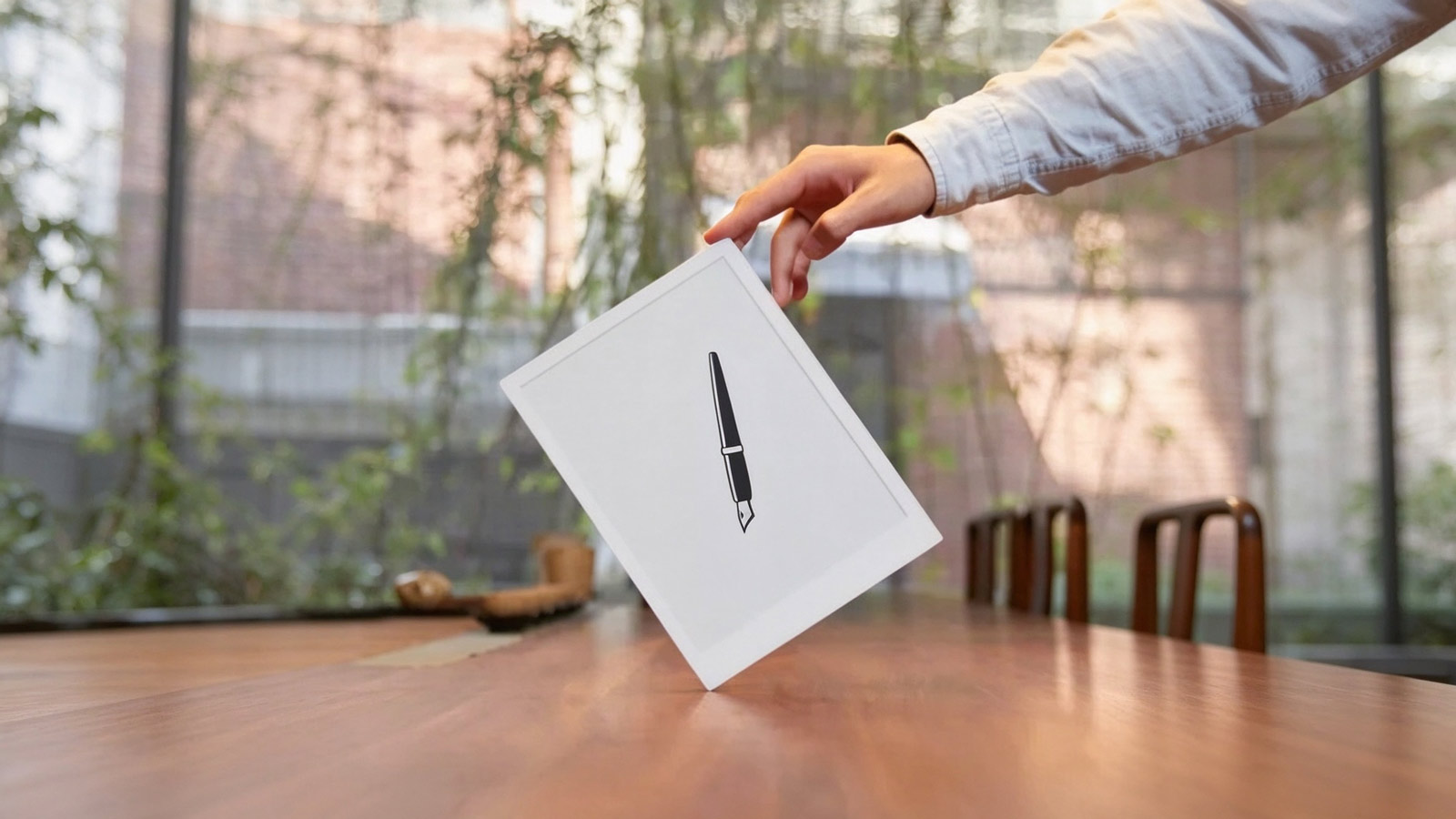
The doctrine is stated plainly in the materials the company and its reviewers repeat: an experience as close to using a real notepad and pen as possible, utilizing digital technology only when it makes sense to enhance rather than detract. In practice this produces a list of absences that read as design decisions rather than cost cuts. No frontlight: the Manta deliberately ships without one, keeping the writing surface as paper-like and low-glare as the underlying E-Ink allows — many owners prefer it, but it means the device cannot be used in the dark without external light, a fixed choice rather than a setting. No app store: the locked-down Chauvet system, built on Android, offers no Google Play by default — a few apps can be sideloaded through F-Droid or Aurora, but the device is engineered to resist becoming a tablet.
The feature set that does exist serves the writing: palm rejection, a textured soft film over the screen for tactile feedback, a two-finger eraser gesture, dual sidebars for note-taking functions, and offline handwriting recognition that converts script to text without a network. Native apps for reading, drawing, email, tasks, and calendar exist, but reviewers treat them as secondary — writing is the thing the device is built to do best, and everything else is a concession to the calendar.

A ceramic nib that outlasts the tablet
The pen is the argument. Supernote's stylus uses a ceramic nib against the company's proprietary textured writing film — a pairing the e-ink review ecosystem rates among the top writing experiences in the category, with a tactile feel closer to gel pen on good paper than to the slick glass of an iPad. The ceramic nib barely wears, which converts to a quietly radical economics: the consumable that every rival sells by the three-pack is, on a Supernote, effectively a lifetime component — you avoid replacing tips, and the pen outlasts the gadget it writes on.
The gesture layer completes the pen's grammar: a two-finger scrub erases, the palm rests anywhere, and the handwriting recognition runs entirely on the device — a privacy posture the company formalized by making its tablets HIPAA-compliant, one of the few e-ink vendors to bother. For the doctor, therapist, or lawyer whose notes are protected information, the offline-first architecture is not a preference but a requirement, and Supernote treats it as a product spec.
The only public software roadmap in e-ink
The transparency program is the company's most unusual feature, and it predates the hardware that made it famous. Supernote publishes its software development roadmap in public — the only brand in the e-ink category to do so, per the independent brand monitors — listing planned features, their development status, and their expected sequence. The reviewers who track the brand read it as an accountability mechanism: promises in public can be checked against deliveries in public, and the company invites the comparison.
The same transparency governs the mistakes. The independent brand overview that scores the company 92 percent and recommends it still documents the episode that harmed the business: the company announced release dates for its next-generation tablet — the A5 X2 — that kept slipping for undisclosed reasons across nearly a year, frustrating buyers who had held off purchasing, while the company had ceased manufacturing the predecessor, leaving no ten-inch product to sell for months. The monitor's verdict is the one the review adopts: like all organizations they get things wrong from time to time, but the difference is that they own the issues rather than ignoring them or lying to their user base.
The Manta: built to be opened, not replaced
The 2024 flagship made the longevity doctrine physical. The A5 X2 Manta — a 10.7-inch grayscale E-Ink panel at 300 pixels per inch — is engineered to be opened: internal components are accessible without tools, and the battery and motherboard are user-replaceable, so the device is designed to be repaired and upgraded rather than thrown away when the battery ages. The independent reviews treat the repairability as a core reason to choose it over sealed rivals — in a category where competitors glue their tablets shut, a Manta can follow its owner through a decade of batteries.
The economics land mid-range: $459 for the tablet with the pen sold separately from about $59, a usable setup near $518 — comparable to the reMarkable it competes with, and cheaper to keep running over years than a sealed rival because the components that age are the components you can swap. The grayscale panel and the missing frontlight are the trade-offs the price does not hide: this is a device that chose its limitations on purpose, and the reviewer's job is to price the choice rather than the parts.
Honesty that cost a year of sales
The transparency chapter deserves its own reckoning, because it documents harm as well as virtue. When the A5 X2's development ran into the delays the company disclosed only partially at the time, the candor had a measurable cost: potential buyers who had waited for the announcement grew frustrated across a year of slips, the discontinued predecessor left a gap in the catalog during the most popular screen size, and the company's revenue suffered at exactly the moment its most loyal customers were watching most closely. The independent monitor flags the episode as a business risk — a small company's longevity is a real variable for buyers who need a decade of software support — while crediting the posture that produced it: the company listened, adjusted, shipped, and kept its user base informed through the correction.
The pattern repeated at a smaller scale with support: customer service is rated genuinely good by the community, with the honest asterisk that response times stretch during busy periods — the tax of being small in a category where the giants answer in minutes.
The honest texture of a purist device
Four honest cautions belong in the ledger. First, the purist ceiling: the on-screen keyboard is widely panned as terrible, there is no real app ecosystem, the panel is grayscale, and there is no frontlight — a device this focused serves the daily writer completely and everyone else partially, and the buyer who wants one tablet for everything belongs with the open-Android Boox line. Second, the small-company variable: Ratta is independent, small, and dependent on its own cash flow; the independent monitor states the risk plainly — if the company does not have enough money coming in, there are fewer resources for improvements, and it casts doubt on the company's longevity — which is the exact question a decade-long note archive depends on. Third, the delay history: the A5 X2 episode is documented rather than rumored, and while the company owned it, a buyer on a deadline should know that shipping dates here are intentions, not logistics. Fourth, the China footprint: offices in China, Japan, and the US, with manufacturing in the Shenzhen orbit — the geopolitical and supply-chain exposure every hardware company with that geography carries, mitigated here only by the repairable design that makes the device outlast its supply chain.
None of these are contradictions; all four are the taxes on building the purest writing device in a category that rewards feature sprawl.
The verdict for the paper purist
Supernote's storefront is the focus thesis run for a register maker's second act: two decades of point-of-sale engineering redirected at the blank page, a ceramic nib that outlasts the device it writes on, a textured film that makes E-Ink feel like good paper, a public roadmap no rival dares publish, a flagship whose battery you can swap with your fingernails, HIPAA compliance for the note-takers whose work is confidential, discounts for students and first responders and veterans, and a transparency record that includes the year honesty cost the company its best-selling size. The cons are the cons of the purist: a purist ceiling, a small company's longevity question, documented delays, and a Shenzhen footprint.
Buy here if your thinking happens in longhand, if the device that holds your notes should feel like paper and resist everything else, if a published roadmap and a public record of owned mistakes are your language of trust, and if a replaceable battery reads as a promise rather than a spec. Buy the open-Android Boox if one device must do everything, or the reMarkable if the polished mainstream purism suits you. For the paper purist who wants the last notebook they will ever need to be honest about what it is, this Shenzhen-by-way-of-everywhere storefront remains the category's most transparent answer — one register company, one pen that never dulls, and the page finally, faithfully digital.