She wanted her pimples visible; retailers called it career suicide

Official homepage: https://starface.world/
Starface turned the most embarrassing moment in skincare — a fresh breakout — into a fashion accessory worn on red carpets and first dates. Launched on September 5, 2019 by a former Elle beauty director and a serial entrepreneur, the New York brand bet that people would rather decorate a pimple than hide it. A billion star-shaped patches later, that bet built a business past $100 million in annual sales. Here is our review of the store behind the stars.
A Beauty Editor's Skin Refused to Cooperate Anyway
Julie Schott spent over a decade inside beauty magazines, rising to beauty director of Elle.com — and her own skin ignored every advantage that came with the title. She saw dermatologists, tested endless products, and still broke out constantly, which left her self-conscious despite being professionally surrounded by solutions. Her conclusion was not a formula but a reframing: nothing fixed how acne made her feel, except a change in attitude. The idea crystallized when she noticed teenagers decorating their selfies with digital star stickers — what if acne treatment were something you would actually want to show off? She was a creator, not an operator, so she brought in Brian Bordainick, a serial entrepreneur who had previously raised more than $11 million for Dinner Lab and led innovative ventures at Hudson's Bay Company. Their division of labor became the company's constitution: Schott owns product, branding, and voice; Bordainick runs the business — and every major decision must be unanimous.
Investors Said Loud Patches Would Never Sell
The founding premise was deliberately inverted: every acne product on the market promised invisibility, and Starface would be seen. Retailers and investors told the founders nobody would wear loud yellow stars that draw attention to their acne — a prediction the founders kept quoting back as the product sold out. The technical hurdle was real too: most manufacturers they approached flat-out declined, unable or unwilling to cut hydrocolloid into a star shape, until a medical manufacturer took the concept seriously. The math was also counter-cultural for 2019, the peak of direct-to-consumer doctrine. Bordainick, whose background was retail, rejected the cut-out-the-middleman playbook and set an accessibility goal — Starface should be as easy to find as toilet paper and gum. Early funding validated the concept anyway: a $1 million pre-seed round that included Bobbi Brown as an investor, followed by a $2 million seed led by BBG Ventures in February 2020, four months after launch.
One Star-Shaped SKU Launched the Whole Company
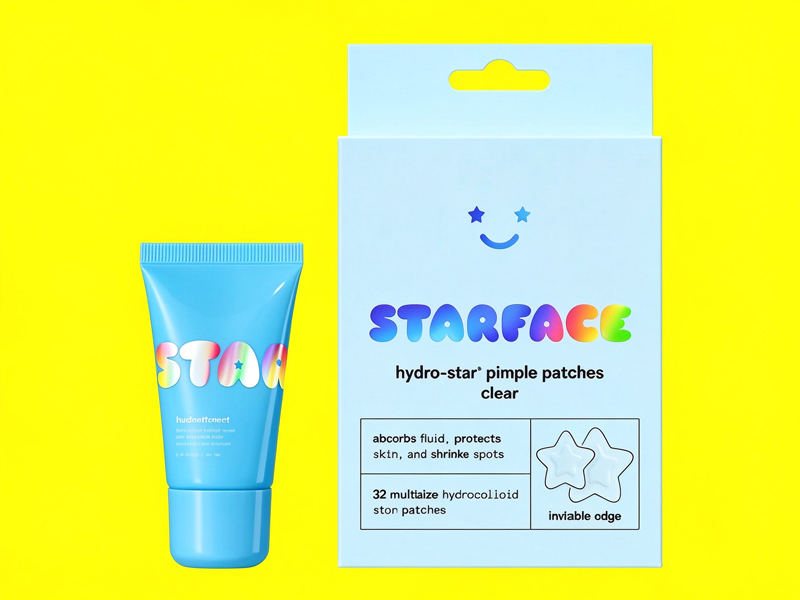
The launch assortment was almost absurdly minimal: Hydro-Stars, and the container they came in. Each patch is 100 percent hydrocolloid — the same fluid-absorbing, picking-preventing dressing hospitals use — die-cut into a bright yellow star and packaged in Big Yellow, a pocketable mirrored compact that looked more like a toy than medicine, holding thirty-two patches at roughly $18 to $22. The product worked because it split its job in two: clinical treatment on the skin side, self-expression on the visible side. The brand iterated quickly, making the stars truly opaque so the finish looked uniform across complexions, and kept the line playful with limited editions — iridescent Cyber-Stars, glow-in-the-dark Glow Stars, multi-color party packs, and licensed Hello Kitty patches that sold through repeatedly. Certification details are consistent with the clean positioning: vegan formulas and Leaping Bunny cruelty-free status.
Target One Year Later, Twenty Thousand Doors After
The retail strategy paid off faster than the DTC skeptics expected. Starface entered Target one year after launch, and today retail drives most of its sales: more than 20,000 doors across North America including Ulta Beauty, CVS, and Walmart, plus a UK presence through Superdrug, Boots, Beauty Bay, and SpaceNK. The logic was legitimacy through ubiquity — a teenager grabbing Hydro-Stars during a Target run with parents removes every friction point an Instagram ad cannot. By 2023 Amazon sales alone were projected to grow 153 percent, with overall retail up more than 212 percent year over year, and by 2024 annual revenue reached roughly $90 million with the company profitable since 2023. The direct site remains the brand's most controlled experience — shipping limited to the US, UK, and Canada with free shipping over $35 — but it now functions as the flagship of an omnichannel machine, while the founders replicated the playbook with sibling brands Plus and Futurewise, both also launched into Target.

A Billion Stars Later the Catalog Keeps Smiling
Scale arrived without losing the tone. By the mid-2020s Starface had sold more than a billion individual patches, passed $100 million in net sales with EBITDA-positive results, and closed a $105 million minority investment in 2026 led by Astō Consumer Partners and Align Ventures — with the founders, who had stepped back from daily operations in 2022 when Kara Brothers was promoted from within to CEO, retaining control of the business. The community is the moat: 2.7 million TikTok followers and 576 thousand on Instagram, organic celebrity wearers from Justin Bieber and Hailey Bieber to Florence Pugh, Dua Lipa, and Bella Hadid, and a steady stream of user-generated content — all with essentially no paid influencer program. The product line has stretched from patches into face wash, moisturizer, and Star Balm lip balm, and collaborations like the May 2026 Lemme x Starface collection at Target show the brand licensing its optimism into adjacent wellness categories.
Our Read on the Store That Celebrates Breakouts
What distinguishes starface.world from the dozens of decorative-patch followers is that the brand still owns the emotional territory it staked out: acne positivity as identity, not marketing angle. The store itself is an extension of that voice — bright, quick to shop, and organized around rituals (patch, cleanse, moisturize, balm) rather than ingredient jargon. The honest caveats: hydrocolloid is a well-understood technology Starface openly admits it did not invent, so functionally the stars perform like cheaper drugstore patches and shoppers pay a design and brand premium; the patch category treats symptoms, not causes; and with the founders' step-back and institutional capital in the cap table, some of the garage-startup texture has given way to professional scale. For Gen Z and Gen Alpha shoppers who want their skincare to feel like self-expression, this remains the defining store of its niche.