Is escort still worth it in the age of free crowdsourced radar alerts?
Official homepage: https://www.escortradar.com
Escort has been making radar detectors since before the Walkman existed. The company's predecessor, Cincinnati Microwave, shipped the category's first consumer detector in 1977; the Escort brand followed a year later and has spent five decades in an unofficial arms race with police radar technology — pioneering the Passport line in 1982, the industry's first laser detector in 1991, GPS-enhanced radar in 2007, and the first Wi-Fi-connected detector in 2017. Today its detectors pair with smartphones, share crowdsourced alerts through the Drive Smarter app, and mount dash cams on their own chassis — while the free crowdsourced navigation apps that do half the job sit in every driver's pocket. This review examines the storefront dimension by dimension: the fifty-year arms race, the connected ecosystem, the legal geography that defines the category's boundaries, and the honest arithmetic of paying seven hundred dollars for warnings a free app partially gives away.
Fifty years of blinking arrows
The corporate timeline the company publishes reads like the history of the category itself. 1977: predecessor Cincinnati Microwave launches the first consumer radar detector. 1978: the Escort brand is established to redefine radar detection. 1982: the Passport product line launches — the name that would become synonymous with the category in American car culture. 1991: Escort introduces the industry's first laser detector, answering the new laser-speed-gun threat. 1997: the company formally becomes Escort. The decades since added GPS-enabled detection in 2007, the first combined navigation-and-detection unit in 2010, and the connected era beginning in 2011 with the Escort Live app — each entry on the timeline a response to a new weapon in the measurement arms race.
The modern company sits inside Cedar Electronics, a Rolling Meadows, Illinois conglomerate that also owns the Cobra electronics brand and inherited Beltronics' Canadian engineering — the Beltronics DNA surfaces in today's Redline flagships. The heritage is real but corporate: five decades of category-defining firsts, owned today by a private holding company whose chief executive, Gail Babitt, frames the mission as road safety technology — a deliberate repositioning of what the devices actually do.
Ka band and the arms race physics
The product engineering is a study in signal warfare. Police radar operates on three frequencies — X, K, and Ka band — with Ka carrying the modern instant-on speed guns; a detector's job is long-range sensitivity on the right bands without drowning the driver in false alarms from blind-spot monitors, adaptive cruise control, and garage door openers, the false-alert soup that makes cheap detectors unusable. Escort's premium stack answers with directional arrows, GPS-based AutoLearn intelligence that learns your routes and rejects repeated false-alert locations, and firmware that continuously updates. The flagship math runs to seven hundred dollars — the MAX 360c MKII at $699.95 — where the pitch is not just range but the serenity of accurate, filtered, directional awareness.
The honest ceiling of the physics belongs in the review: instant-on guns and laser make any detector a warning, not a shield — the category's own engineering reality is that detection range and reaction time, not marketing, decide whether the warning arrives in time, and the enthusiast forums spend entire threads debating whether Cedar's current firmware actually delivers the response times the hardware promises.
Escort Live, and the crowd that drives it
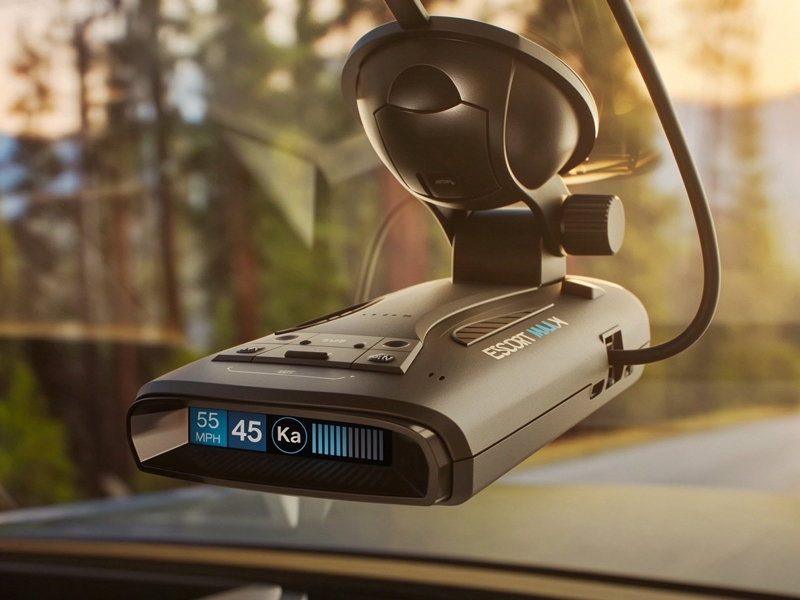
The connected pivot began in 2011 with Escort Live — the app that pooled alerts from a community of connected detectors, turning every driver into a sensor. The 2017 MAX 360c was the first Wi-Fi-enabled, connected-car-compatible radar detector, and the modern Drive Smarter app completes the architecture: Apple CarPlay and Android Auto display shared radar and laser alerts, red-light and speed-camera locations, crowdsourced road conditions, and device management across compatible detectors and dash cams — a walled-garden Waze built from hardware instead of phones, where every participant has paid for the privilege of contributing.
The strategic logic is the reviewer's point of comparison: Waze gives the same crowdsourced alerts away free, funded by ads. Escort's bet is that hardware-grade detection — direct RF sensing with directional accuracy — plus the community layer justifies the seven-hundred-dollar admission where a free app only crowdsources what its users happen to report. Both are true, and the driver's mix of highway miles, risk tolerance, and appetite for electronics decides which one pays.
Dash cams, jammers, and the widening stack
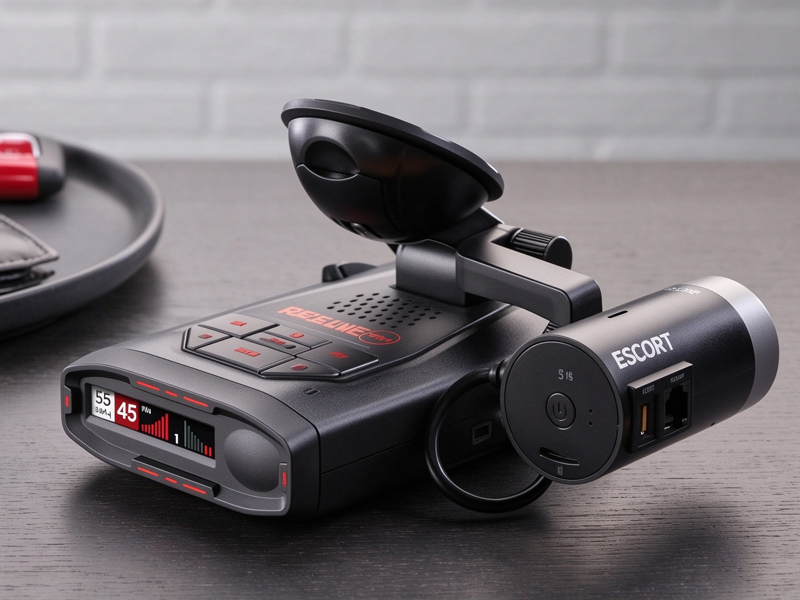
The category stack widened as the sensor platform matured. In 2018 Escort launched its first dash cam — the same chassis now hosts the M2, a radar-mounted smart camera that pairs the detector's alert with a video record of the encounter. The ZR5 and ZW5 laser shifters — the legally touchier cousins of detectors, actively jamming laser speed guns rather than merely sensing them — extend the stack into active countermeasures. The ecosystem logic mirrors the phone-mount accessory market: once the detector owns the windshield position and the power tap, every adjacent road sensor is a natural upsell.
The integration quality is where the premium shows or fails, and the review record divides: enthusiasts praise the AutoLearn filtering and the CarPlay integration; the criticism concentrates on firmware cadence and on the Redline's response-time debates that the forums keep alive years after launch — the community's willingness to audit the flagship publicly, the same dynamic that polices every enthusiast hardware category.
Where detectors are illegal, mapped honestly
The category's defining constraint is not technology but geography. Radar detectors are illegal for drivers in Virginia and Washington, D.C., on all U.S. military bases, and in commercial vehicles nationwide; they are illegal across most of Canada; and their active cousins, the laser jammers, face outright bans in several states — California, Colorado, Illinois, Minnesota, Nebraska, Oklahoma, South Carolina, Tennessee, Texas, and Utah among them. The legal texture matters to this review because it defines the honest market: a detector purchased in a legal state becomes contraband across a state line, and the buyer — not the storefront — carries the compliance burden.
Escort's own materials handle the geography with corporate care, emphasizing the road-safety framing and the legal-use jurisdictions, but the reviewer's ledger must state the category plainly: this is a driver-empowerment product sold into a deliberately contested legal space, and the purchase decision includes a geography lesson that no product page will teach.
The forum court, and the Uniden rivalry
The community court is where the category's truth is told. The enthusiast forums — rdforum and its kin — host the same adversarial review culture documented in the dash-cam category: owners and rivals arguing sensitivity figures, firmware changelogs, and K-band filtering in threads thousands of posts deep. The standing rivalry — Escort's Redline and MAX lines against Uniden's R7 and R8 — functions as the category's continuous election, with the Uniden challengers winning the value vote in recent cycles while Escort defends the integration and heritage ground. The 2024 forum thread asking whether the Redline 360c's glory has departed — answered with detailed technical critiques of detection and response times — is the reviewer's best evidence that the community polices the flagship harder than any marketing department polishes it.
The honest takeaway from the court: Escort remains the heritage and integration choice, not the unanimous performance choice, and the buyer who reads the forums before the storefront will buy accordingly.
The honest texture of a gray market
Four honest cautions belong in the ledger. First, the legal gray ceiling: the category lives in a jurisdiction patchwork, and every trip across a state line is a compliance decision — the product's utility is defined as much by where you cannot use it as by how well it works. Second, the free-alternative squeeze: Waze and its crowdsourced rivals deliver a large fraction of the warning value at zero hardware cost, and the pressure on detector pricing has been downward for a decade. Third, the corporate opacity: Cedar Electronics publishes no brand-level financials, the founder era is history without a public face, and the company's road-safety marketing language sits in deliberate tension with the product's actual purpose. Fourth, the community verdict's sting: the forums that built the category's credibility now spend as much energy auditing Escort's firmware gaps as praising its heritage — loyalty, once lost to a Uniden comparison thread, does not return with a rebrand.
None of these are contradictions; all four are the taxes on being the incumbent in a category whose very existence the phone in every pocket keeps questioning.
The verdict for the highway regular
Escort's storefront is the five-decade arms-race thesis holding its ground: the first consumer detector's corporate descendant, the Passport name that named the category, the first laser detector, the first GPS radar, the first Wi-Fi-connected unit, the app that turned drivers into sensors, the dash cam that mounts on the detector, the laser shifters that push legality's edge — fifty years of engineering inside a seven-hundred-dollar flagship that the free app in your pocket keeps pricing against. The cons are the cons of the incumbent: the legal patchwork, the Waze alternative, the Cedar opacity, and a community that audits harder than it praises.
Buy here if your highway miles are long and regular, if hardware-grade RF detection and AutoLearn filtering beat crowdsourced reports of crowdsourced reports, if the CarPlay integration and the community network justify the premium over Uniden's value challengers, and if your driving geography stays on the legal side of the patchwork. Buy Uniden if the forums' performance-per-dollar verdict rules, or use Waze if the budget and the risk tolerance agree. For the highway regular who wants the category's deepest heritage and its most connected platform, this Rolling Meadows storefront remains the arms race's original answer — one blinking arrow, fifty years old, and the Ka band still broadcasting.