He cooked the first american energy gel for his ultrarunning daughter

Official homepage: https://guenergy.com
Every category has a creation story, and the energy gel's begins in a Berkeley kitchen with a father and a daughter. In 1990, Dr. Bill Vaughan — a biophysicist at the University of California, Berkeley — watched his daughter Laura compete in ultramarathons and concluded that the available fuel was failing her: bars too hard to chew at effort, drinks too sloshy, both heavy on the stomach. So he began experimenting at home, cooking a portable, digestible carbohydrate paste he intended for one athlete and one race calendar. The first GU Energy Gel was born around 1992, the company was formally established in 1994, and within two years it was supplying the Ironman World Championship. Three decades on, GU remains family owned, still manufactures in Berkeley, and still carries the founding surname. This review measures the operation across eight dimensions — from the kitchen to the contested crown of first gel ever.
A Berkeley kitchen and a hundred-mile daughter
The founding detail that still anchors the company's identity: it was never built for a market. It was built for a daughter. Vaughan's home experiments produced a carbohydrate paste portable enough for an aid station and digestible enough for a stomach at hour six of a hundred-mile race — a specification he arrived at by watching one athlete, not by surveying one. The gel that emerged was one hundred calories of carbohydrate engineered for the specific failure points of ultra-endurance: chewing, sloshing, and gut distress.
Family owned then, family owned now
The ownership story is the other half of the rarity. Three decades on, GU remains family owned and still operates from Berkeley — Brian Vaughan, the founder's son, serves as president, with the title Chief Endurance Officer appearing beside his name in the company's own materials. The company moved its operations in 2011 from a 13,000-square-foot space to a 26,000-square-foot facility on Berkeley's 4th Street, doubling production capacity, and it still makes its energy gels at that headquarters — a physical fact most nutrition brands surrendered to contract manufacturers long ago. GU is the last of the first generation of gel makers still answering to the same surname that invented the format.
The contested crown of first gel ever
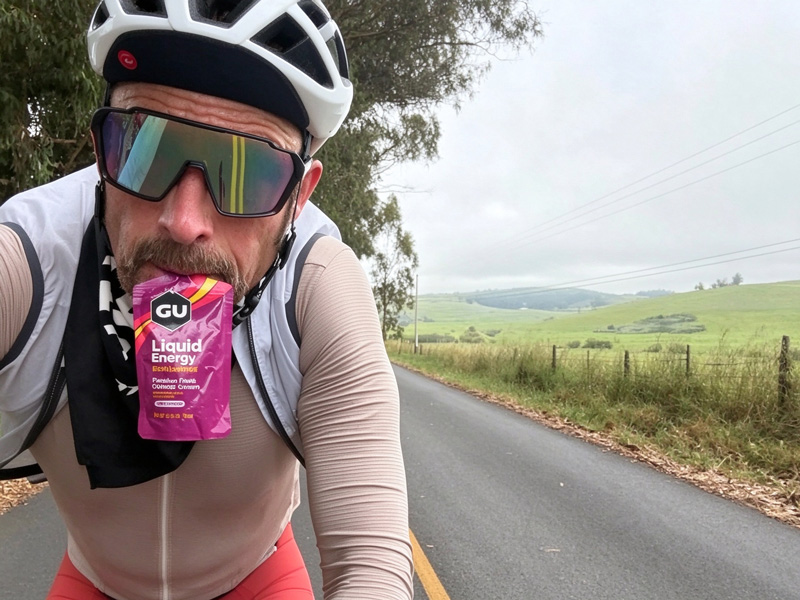
Now the honest complication, because a review that repeats marketing is not a review. GU's own language claims the first energy gel, and by a specific definition the claim survives: the first American energy gel, and the first to distribute at global scale. But the history of the format runs earlier and elsewhere — a British product called Leppin Squeezy appeared in 1986, and a South African gel developed by sports scientist Tim Noakes with roughly twenty-five grams of carbohydrate followed in 1987. GU's achievement was not being chronologically first; it was making the gel American, making it ubiquitous, and making the category commercially real. The distinction between inventor and popularizer is the kind of nuance the brand's marketing flattens and the record restores.
Gels, chews, waffles, and the Roctane line
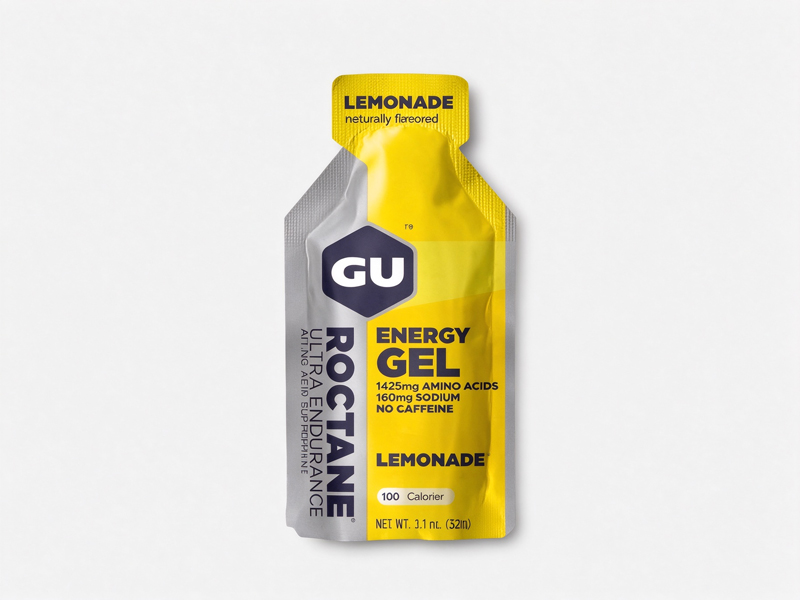
The catalogue is the widest in the category by the company's own count, and the breadth holds up. The original Energy Gel — one hundred calories per packet, dozens of flavors, caffeine and caffeine-free variants — anchors a line that extends into Roctane for the longest efforts, Energy Chews for those who prefer to chew, Stroopwafels that solved the pre-race breakfast problem with a Dutch classic, drink mixes and hydration tablets for the bottle, and recovery formulas for after. The brand sells variety packs for the undecided and bulk boxes for the committed, and its flavor library runs to entries competitors would not attempt — birthday cake, campfire s'mores, salted watermelon — on the theory that the hundredth mile deserves a small joy. Everything is manufactured in Berkeley.
Still made in Berkeley, one percent for the planet
The social texture includes credentials the category's newcomers stack against GU rather than alongside it. The company is a member of 1% for the Planet, committing one percent of sales to environmental nonprofits; it runs a GU Gives community program; and it maintains a Pro Program that supplies sponsored and qualified athletes — the same pipeline that carried the gel from Laura Vaughan's aid stations to the professional peloton and the Ironman podium. The texture is that of an established regional manufacturer with global distribution — unglamorous, durable, and proudly Berkeley.
Free shipping at sixty four and pro program perks
The commercial terms are straightforward specialty-retail. Free shipping kicks in at $64 on the direct site, with an international dealer network handling overseas markets. The storefront runs periodic sitewide sales — Black Friday historically at twenty-five percent — alongside the standing threshold, and the customer service infrastructure, FAQ library, and store locator reflect thirty years of answering the same questions from the same athletes. Returns follow standard food-retail logic: unused, unopened product within a published window, with details spelled out on the policy page. Nothing in the terms is remarkable, which is itself the point — GU's reliability is the product of a company that stopped surprising its customers decades ago.
Old school sugar in a real food era
The honest trade-off is generational. GU built the gel on maltodextrin and sugar at a two-to-one ratio, the formulation that defined the category and the one a generation of real-food brands now defines itself against. The texture is thicker than the newcomers, the ingredient list shorter on fruit and longer on chemistry, and the taste profile skews dessert-sweet — birthday cake and s'mores — where competitors skew fruit and starch. Whether that is a bug or a feature depends on the stomach in question: thirty years of finish lines suggest the format digests reliably at effort, and thirty years of aid stations suggest it will be there regardless of which brand the runner trains with.
Who should squeeze thirty years of history
GU Energy in 2026 is for a specific runner: the marathoner who wants the category's original at the category's most available price point; the history-minded athlete who likes knowing the gel in their belt was cooked for an ultrarunner before it was a business; the realist who trusts thirty years of aid stations over three years of marketing; and the bargain hunter who times the sitewide sales. For that runner, GU offers something no challenger can copy — the founding family's surname, the Berkeley kitchen, the first American gel, and a flavor library built for the hundredth mile. It is less suited to the ingredient-list purist or the buyer chasing the newest chemistry: the formulation is a classic, the sweetness is nostalgic, and the first-gel crown it wears is shared with a British predecessor history buffs will name. But when Laura Vaughan lined up at the Wasatch 100 with her father's experiment in her pocket, she was carrying more than fuel. She was carrying the category everyone else now races in.