Born to run, read in iraq: the soldier behind huma's chia gels

Official homepage: https://humagel.com
Every sports nutrition brand has an origin story, but few read like a novel. In 2009, a first lieutenant in the United States Army named Ian was leading grueling missions throughout Iraq. During his breaks he read Born to Run — Christopher McDougall's account of the Tarahumara, the native Mexican tribe who compete in epic hundred-mile races as part of their culture, fueling themselves on a special chia seed blend. Ian figured that if chia worked for ultrarunners in the canyons of Mexico, maybe it would work for a soldier in Iraq. It did. He kept experimenting with the blend through the deployment, filing away what became the recipe at the heart of everything the company would make. Back home, he and a fellow grad student named Kevin launched Hüma in 2012 as a veteran-owned company, with one conviction: energy fuel should be made from real food. Fourteen years and, by the company's count, more than twenty-five million gels later, this review measures the operation across eight dimensions.
Born to Run, read between missions in Iraq
The origin detail matters because it inverts the usual order of sports nutrition: the formula was not developed in a laboratory or a boardroom, but in theater, by a reader of running literature, during a war. Where typical brands are built by food scientists optimizing shelf stability, Huma was built by a soldier optimizing for the gut of an athlete — his own. The Tarahumara reference is not a marketing garnish; it is the founding text.
Two grad students launch in November 2012
Ian and Kevin — both, by the company's telling, tired of awful energy gels — launched Hüma in 2012 as a veteran-owned company. The gels were officially introduced in November of that year, built on the conviction that energy fuel should be made from real food. The brand has since claimed the title of the world's best-selling all-natural energy gel, a boast grounded in the only currency this category respects: repeat purchases by people whose stomachs have vetoed the alternatives.
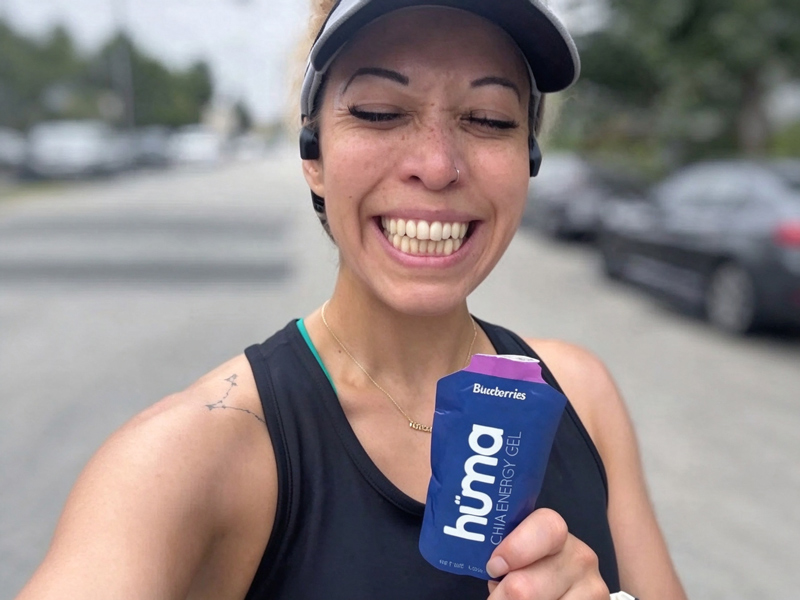
Chia, the Tarahumara, and real food chemistry
The ingredient philosophy is the product. Where typical gels are built on maltodextrin and engineered flavors, Huma's base is food a kitchen would recognize — real fruit purée, cane sugar, brown rice syrup, milled chia seeds, and sea salt, blended at a two-to-one glucose-to-fructose ratio the company describes as the ratio the body uses best. Chia's soluble fiber gives the gel its signature smooth, easy-to-swallow consistency, with no maltodextrin to trigger the osmolality spikes that plague mid-race digestion. The marketing language is characteristically plain: their gels taste like something you want to eat, while the competition tastes like something you endure.
Original, Plus, Ultra, and the hydration packets
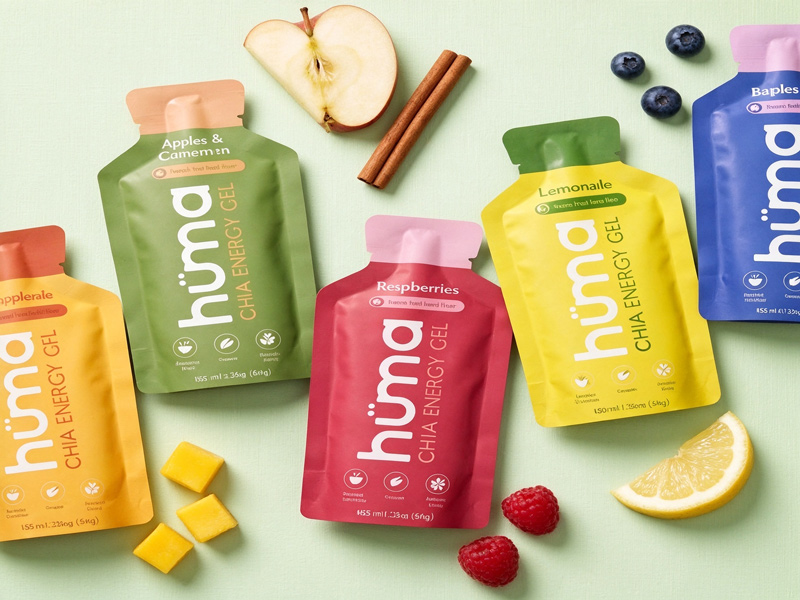
The catalogue is compact, which suits a single-recipe philosophy. The Original Energy Gels run $2.50 each in flavors like strawberry lemonade and café mocha. The PLUS line at $2.75 doubles the electrolytes for hot-weather efforts. The ULTRA line at $3.75 packs forty grams of carbohydrate per pouch for the longest efforts. Hydration packets start at $1.25 — a low-sugar, high-electrolyte option for between-meal sweating. First-time buyers get a standing offer of three free gels with their first order, and subscription pricing rewards regulars. There are no bars, chews, or recovery products; the company has clearly decided that a narrow range done well beats a broad one done adequately.
Forty five days and free shipping at sixty
The purchase terms are competitive for a premium gel maker. Returns are accepted within forty-five days of the original purchase date — the most generous window among the fuel brands reviewed in this series — with refunds processed back to the original payment method in three to five business days after the returned items arrive. The deduction is the industry's standard one: shipping charges are non-refundable. Free shipping kicks in at $60 in the United States. International orders are accepted, with a dedicated distributor network handling overseas markets.
Military discounts and race partner culture
The community texture reflects the veteran-owned identity. A race partner program supplies events with gels and sponsor presence, building the word-of-mouth that small nutrition brands live on. A military discount stands permanently on the site. A press kit, wholesale program, and international distributor network handle the grown-up side of the business. It is a small company that behaves like a professional one — which is precisely what separates the nutrition brands that survive their second decade from those that fade with their first trend.
Twenty five million gels and a self published rating
The proof, however, stays mostly in-house. The storefront advertises 4.8 stars across more than two thousand reviews — a healthy corpus, but one the brand itself publishes and curates. There is no meaningful Trustpilot presence to check it against, and independent coverage of Huma skews toward product reviews praising the taste and digestibility rather than service journalism testing the returns desk. Fourteen years in business, twenty-five million gels, and a reader in Iraq to thank for it: the plausibility of those numbers rests on the same real-food premise as the gels themselves — nothing engineered, everything accountable.
Who should squeeze real food mid race
Huma in 2026 is for a specific runner: the marathoner who has surrendered mid-race to gel-nausea one too many times; the trail runner who wants forty grams of carbohydrate without a chemistry degree on the label; the supporter of veteran-owned businesses looking for a purchase that aligns; and the gift-giver assembling a race-week care package. For that buyer, Huma offers the rarest combination in sports nutrition — a genuine origin story, a recipe you could recreate at home, the longest return window in its category, and a military ethos that shows up in the discounts. It is less suited to the bargain-hunter or the recovery-shake loyalist: the gels cost more per ounce than the maltodextrin mainstream, the catalogue stops at gels and hydration, and the social proof lives on the company's own wall. But the soldier who read about ultrarunners between missions and came home to feed them did something the industry had stopped believing possible: he made a gel people actually want to eat. Fourteen years and twenty-five million pouches later, the proof is in the squeezing.