The shoe pocket that grew into the world's running water brand

Official homepage: https://nathansports.com
Every heritage running brand has a first product, and Nathan's is delightfully humble: a small pocket that attached to a running shoe to hold a key and a few dollars. From that single accessory, the company built what it now calls more than four decades of running essentials — evolving into, by its own positioning, the world's leading hydration, visibility, and gear brand at run specialty stores. The through-line stayed constant: solve the small, annoying problems of running. Where to put the key became how to carry water without bouncing, how to stay visible before dawn, how to reach nutrition mid-stride. This review measures the operation across eight dimensions — from the Shoe Pocket to the $10 liability clause, from the Krar vest that defined a category to the corporate owner most runners never think about.
A single product called the Shoe Pocket
The brand's own history traces the arc plainly — from the Shoe Pocket to hydration vests, handhelds, waist packs, reflective safety gear, and apparel, sold in forty-five countries. The retail texture matters: Nathan grew up inside running specialty stores, the independent shops where staff fit shoes and know their customers' marathon plans, and that channel remains the brand's spiritual home even as the direct site has taken on more volume. The product philosophy reflects it — nothing flashy, everything field-tested, designed for the mile-one beginner and the hundred-mile ultrarunner alike.
Four decades at run specialty stores
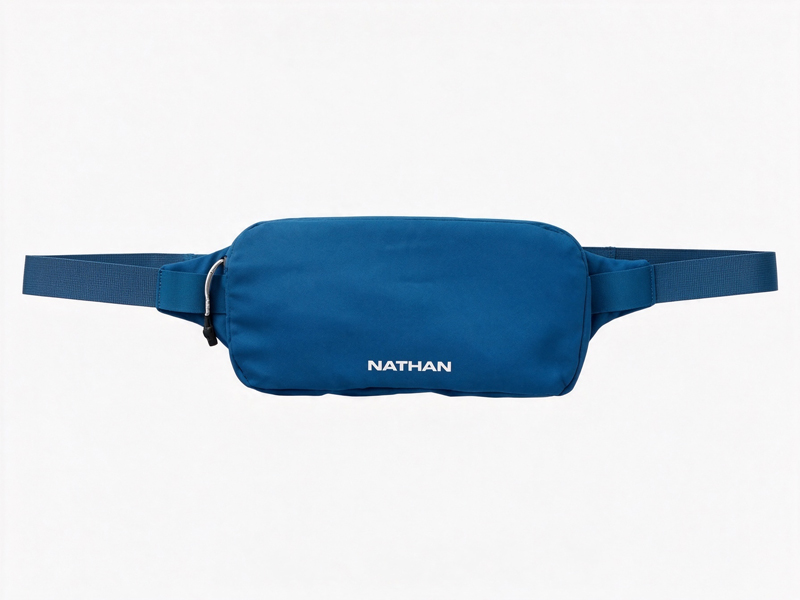
The catalogue segments by how far you run and what you need to carry — hydration vests in four-liter to twelve-liter capacities, soft flasks, handheld bottles with grip-free straps, waist belts with angled holsters, and reservoirs, plus the visibility line of reflective vests, lights, and wearable LEDs that addresses the runner's other persistent problem: being seen in the dark. Apparel rounds out the assortment, and an NS+ Trail Blazer rewards program layers membership benefits onto repeat purchases, including a lowered free-shipping threshold. Pricing sits in the specialty-gear band: handhelds from the low twenties, vests from roughly sixty to well over a hundred. It is the anti-hype gear brand — forty years of incremental, useful objects.

The Krar and Howe vests that defined a category
The product that made Nathan modern is a collaboration. In 2016 the company teamed with ultrarunner Rob Krar — back-to-back Western States 100 champion — to build the VaporKrar race vest, with a parallel women's version, the VaporHowe, designed with Stephanie Howe Violett. The vests solved the classic hydration-pack failure modes: bounce, slosh, inaccessible pockets. The secure fit and storage layout drew praise from specialty reviewers, with the magnet intended to hold the drinking tube drawing the most consistent criticism for popping loose. The Krar and Howe designs effectively defined the modern race-vest category and remain the flagship line a decade later.
Bottles, belts, vests, and safety gear
The assortment spans the full water-and-visibility problem: handhelds for the 5K runner, waist belts for the half-marathoner, vests for the ultrarunner, and reflective gear for everyone who runs before sunrise. NS+ Trail Blazer members get a lowered free-shipping threshold at $50. The brand's purpose statement reads like a product brief — intuitive design, comfort, quality, and smart storage — and the products, when reviewers and customers weigh in, generally deliver on it, with the magnet detail being the recurring asterisk on an otherwise polished range.
Free shipping at seventy five, thirty day returns
The consumer-facing terms are competitive for the category. Shipping is free via FedEx Ground Economy on orders over $75 across the continental United States, dropping to $50 for logged-in NS+ members — a threshold a single vest clears. Returns run thirty days from delivery through a self-serve portal, with defective or incorrect items routed through customer service before shipping back. Notably, the policy handles a modern complexity most stores ignore: some orders are fulfilled through Amazon Multi-Channel Fulfillment even when purchased on the brand's own site, and the policy explicitly commits to managing those returns itself rather than bouncing customers between companies — printed clarity this review series rarely sees.
The refund that always subtracts shipping
The deductions are equally explicit. Refunds come back to the original card or PayPal minus shipping and handling, and the policy repeats in bold that initial shipping costs will not be refunded. Each return label is uniquely linked to a specific item, and the store warns against combining multiple returns in one package — a mistake it says can delay or void processing. Only direct purchases qualify: products bought at specialty retailers cannot be returned to the site, and the thirty-day Satisfaction Guarantee is limited to US original purchasers and excludes unauthorized sellers. A separate terms-of-service document caps total liability at the lesser of twelve months of payments or ten dollars — legally routine boilerplate, commercially telling.
Corporate ownership since twenty fifteen
Nathan is not an independent runner-founded brand; it has been part of United Sports Brands since October 2015, when the holding company — assembled that year from the merger of Shock Doctor and McDavid — acquired Nathan as its first brand focused squarely on run and outdoor. United Sports Brands subsequently added Cutters, Glukos, and Pearl Izumi to the portfolio. The practical effect is a corporate backing that provides manufacturing scale and a real customer-service operation, but also a texture some run-specialty loyalists find diluted: the brand that built its name in independent shops now answers to a team-sports conglomerate. The products, for the most part, still feel like Nathan.
Who should carry water the Nathan way
Nathan in 2026 is for a specific and very large audience: the road runner graduating from handheld bottle to vest, the trail runner signing up for a first 50K, the early-morning commuter who needs reflective gear more than another pair of shoes, and the gift-buyer who wants the thing every runner at the club run already owns. For that audience, the VaporKrar and VaporHowe lines remain among the most proven hydration vests in the sport, backed by forty years of category knowledge, a thirty-day window with an unusually clear Amazon-MCF policy, and free shipping at a reasonable threshold. It is less suited to the buyer who wants a founder's story and a personal touch — Nathan has been corporate since 2015 — or the one who expects full refunds including shipping. But for the functional question of how to carry water while running, the brand that started with a shoe pocket still writes the standard answers.