Is maisonette really the net-a-porter of kids? we tested every policy
Official homepage: https://www.maisonette.com
The pitch has been borrowed from adult fashion since day one: Maisonette, the Net-a-Porter for kids. Launched from a Brooklyn kitchen island on March 22, 2017, the marketplace was founded by two Vogue veterans — Sylvana Ward Durrett, who began her career as Anna Wintour's assistant and rose to run Vogue's special projects, and Luisana Mendoza Roccia — after late-night frustration revealed the same problem both kept hitting: shopping for children meant ten open tabs, mass-market basics, or stuffy occasionwear. Their fix was one curated destination with a single cart. Nine years, $17.7 million in early venture capital, and 800-plus brands later, that pitch deserves a real audit. This review measures the marketplace across eight dimensions — from the Vogue résumés to the drop-ship fine print, from exclusive merchandise to the missing review record.
Anna Wintours former assistant builds a kids marketplace
Both founders became mothers at Vogue and hit the same wall — online children's shopping was a fragmented mess of boutique sites, department-store formality, and fast-fashion compromise. Durrett had spent more than a decade at Condé Nast, rising from Wintour's assistant to director of special projects, the job that runs the Met Gala; Mendoza Roccia was her colleague. The solution they sketched was fashion-industry logic applied to a neglected category: a curated multi-brand marketplace where the store's authority comes from taste, not price. The seed round made the seriousness plain — $2.775 million from NEA and Thrive, with private investors including Michael Kors and Andrew Rosen. The fashion press crowned it immediately.
From a kitchen island to eight hundred brands
The growth justified the crown, at least at the start. Within a year the company raised a $15 million Series A, launched its editorial platform Le Scoop, commissioned an Oliver Jeffers mural for its first birthday, and grew from a handful of kitchen-island employees to a staff of roughly forty. The original marketplace aggregated 125 brands from 40 boutiques — Yoya in New York, Arcade in Nashville, Bobo Choses in Spain — under one checkout, while direct relationships brought exclusives like Bonpoint, Stella McCartney's children's line, and Oeuf. By 2022 Maisonette carried more than 1,000 brands, employed over 100 people, and weathered the pandemic on the strength of toys, puzzles, and games, which grew 1,400 percent in 2020 as families stayed home. The company holds no inventory: every brand ships directly to the customer.
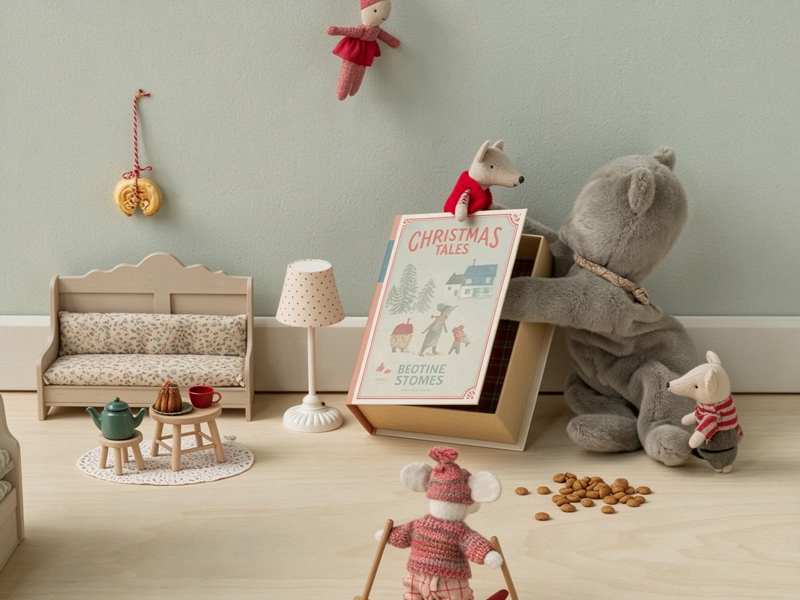
Clothing, toys, gear, and nursery under one checkout
The assortment is departmental in the way only children's retail can be, because children's retail contains a whole economy of sub-lifecycles. Apparel runs newborn through big kid; then toys, games, and books; then gear, the expensive practical layer of car seats, strollers, and carriers; then the nursery and home layer of cribs, bedding, and wall art. The shopping experience wraps around milestones: baby registries, gift guides, mommy-and-me twinning edits, and an editorial hub relaunched as a content guide to stress less and parent better. For a first-time parent, the value proposition is time — the fragmentation problem that spawned the company compressed into one cart.
Forty percent of the assortment is exclusive to them
Exclusivity is the quiet economic engine. The company has said roughly forty percent of its brand assortment is unique to Maisonette — built through a steady program of collaborations with stocked brands, plus direct lines like Stella McCartney kids. The founding Vogue logic shows: a fashion editor understands that a store's authority comes from what only it can offer, and Maisonette's buyers have spent nine years manufacturing exactly that. The celebrity halo — Chrissy Teigen, Gwyneth Paltrow, Keri Russell, and Molly Sims among early parent devotees — functioned as free authentication for a brand whose entire premise was taste.
Private labels and the tween marketplace bet
The second act is private label. By June 2022 Maisonette had launched Neon Rebels, a 37-piece line of tanks, tees, shorts, dresses, and swim for sizes 2T through 14 priced from $12 to $48 — the affordable-trendy layer the designer assortment did not cover. In 2026 the brand went further, relaunching Neon Rebels as a standalone marketplace for tweens aged seven to fourteen, betting that the age between children's clothing and adult fashion is retail's most overlooked gap. The personnel story runs parallel: Mendoza Roccia departed the business along the way, with Vogue's 2026 coverage noting her no longer involved, while Durrett remains CEO alongside president AJ Nicholas. Marketplaces that age into multi-brand operators with their own labels follow a known arc; Maisonette is walking it.

Thirty day returns and price matching at checkout
The consumer terms are, on paper, the most balanced this review series has seen in recent memory. Returns run thirty days for eligible unworn, unwashed items in original condition; domestic ground shipping is free above $95; flat rates cover every US state; and a price-match policy applies to qualifying products found cheaper elsewhere — a rarity among curated marketplaces, which usually hide behind exclusivity to avoid comparison. The fine print is structural: because no inventory is held, each brand ships directly, meaning one order of a dress, a puzzle, and a crib sheet arrives in multiple packages on different timelines. That is a feature of the model, not a bug — but worth knowing when planning a birthday.
The celebrity halo and the missing review record
Reputation is where the record gets thin. There is no substantial Trustpilot corpus; the aggregators that track the store show ratings in the fours from samples of three reviews, which is a rounding error rather than evidence. The authoritative voices are institutional — Vogue, the Business of Fashion, Forbes — and the user stories that circulate are celebrity anecdotes, not delivery reports. The drop-ship structure means Maisonette controls curation and checkout, but the box on the porch comes from a brand's warehouse, and the historical complaint pattern of such marketplaces — split shipments, vendor-side delays, returns routed to different addresses — could not be verified at scale because the public record barely exists. Buyers should treat the thirty-day window and price match as the contract, and the halo as marketing.
Who should build a baby registry here
Maisonette is for a specific parent: style-conscious, registry-building, willing to pay designer-adjacent prices for children's products, and grateful to compress a fragmented category into one checkout. For that parent it is arguably the best-curated children's destination in America, with genuinely exclusive merchandise and a return policy that respects the reality of kids. It is less suited to the bargain-hunter or the sceptic who wants ten thousand reviews before trusting a marketplace: the proof here is editorial and institutional, not communal. Nine years in, with 800-plus brands, three-plus private labels, and a tween marketplace launched in 2026, the kitchen-island idea has become precisely what it set out to be — which is the rarest thing a startup review can report.