The chaco founder's second act fixes the shoes already in your closet

Official homepage: https://treadlabs.com
Some founders build one legendary brand and retire. Mark Paigen built Chaco — the made-in-America, re-soleable sandal cult that river guides and through-hikers still swear by — sold it to Wolverine Worldwide after twenty years, and then, instead of a porch, chose a second act: fixing the shoes everyone already owns. Tread Labs, founded in 2015 from an office north of Boston, sells a two-part insole system whose rigid arch support carries a Million Mile Guarantee and whose replaceable top covers cost a fraction of a new insole to refresh. The premise is the Chaco philosophy reborn in orthotic form: build the support once, guarantee it forever, and let the wearable parts be cheap to replace. This review measures the operation across eight dimensions.
A shoe repair shop and a Colorado river
Paigen's obsession with footwear, as his own welcome letter puts it, dates to before the earth cooled. It runs through a custom shoe shop in Arcata, California called Shoestring Cobblers; a move to the Rockies and a stint as a river guide; and then, in 1989, the founding of Chaco sandals in the small Colorado town of Paonia, where he built what would become one of the most beloved performance sandal brands on earth. The hallmarks were visible from the first pairs — made in America when nobody else bothered, re-soleable when everyone else made throwaway product, sold through specialty shops while the chains knocked and were refused.
Chaco's Zee One and the cult sandal
The Chaco chapter matters because it contains the discovery that became Tread Labs. In 1993, building what became the Z/1 — named, by Paigen's own account, when his best friend announced in a cheesy French accent that it was Zee One — he brought in a German-trained pedorthist to solve an open-toe problem. The mentor taught him what straps cannot: the right arch support aligns the foot so effectively that it stops sliding off the sandal's outer edge, and the raised heel posts they stumbled on stabilized the heel into the bargain. Paigen realized he had built a generic orthotic into the shoe itself, and customers' decades of devotion taught him the commercial half of the lesson — support is the product; everything else is decoration.
Twenty years, one sale, one lesson
Chaco grew for twenty years before Paigen sold it to Wolverine Worldwide in 2009. Most founders, having built one cult footwear brand, retire. Paigen spent six years thinking, then came back to fix the shoes everyone already owns. When he founded Tread Labs in 2015, the premise inverted the Chaco formula: instead of building a shoe with orthotics inside, sell the orthotic that upgrades any shoe in any closet.
The two part insole that never dies
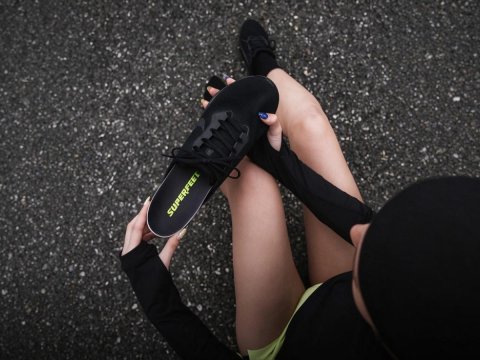
The product architecture is where the Chaco DNA shows. The two-part insole system pairs a rigid molded arch support — available in four arch heights for a semi-custom fit, in either medical-grade polymer or carbon fiber — with a foam top cover that peels off. The arch support carries the biomechanical work and, per the Million Mile Guarantee, is warrantied forever; the top cover takes the wear and, when it flattens, costs a fraction of a new insole to replace. The economics invert the category's planned obsolescence: competitors sell a whole new insole every time the foam dies, while Tread Labs sells a fifteen-to-twenty-dollar refresh and keeps the structural half for life. By 2023 the company had refurbished nearly ten thousand insoles and sandals through its renewal program — circularity that reads like the Chaco re-sole service reborn in orthotic form.
Comfort, pain relief, and carbon performance
The catalogue organizes by mission rather than material. The Comfort series, led by the Ramble, adds everyday arch support to ordinary shoes. The Pain Relief series, led by the Pace, targets plantar fasciitis — the injury that will afflict roughly ten percent of the population at some point — with firmer, more structured support. The Performance series, led by the Dash, runs on carbon fiber arch supports for athletes who want energy return and biomechanical correction in the same insert, across running, hiking, cycling, and ski boots. Each insole comes in men's and women's fits and four arch heights, and the Insole Finder quiz walks a first-time buyer through arch height and shoe type the way the old shop fitters did.
A million mile guarantee, refurbished daily
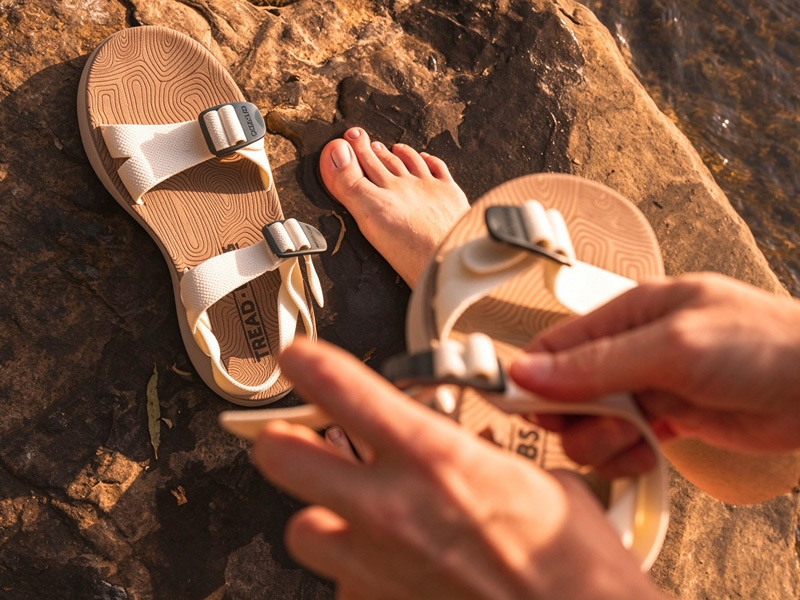
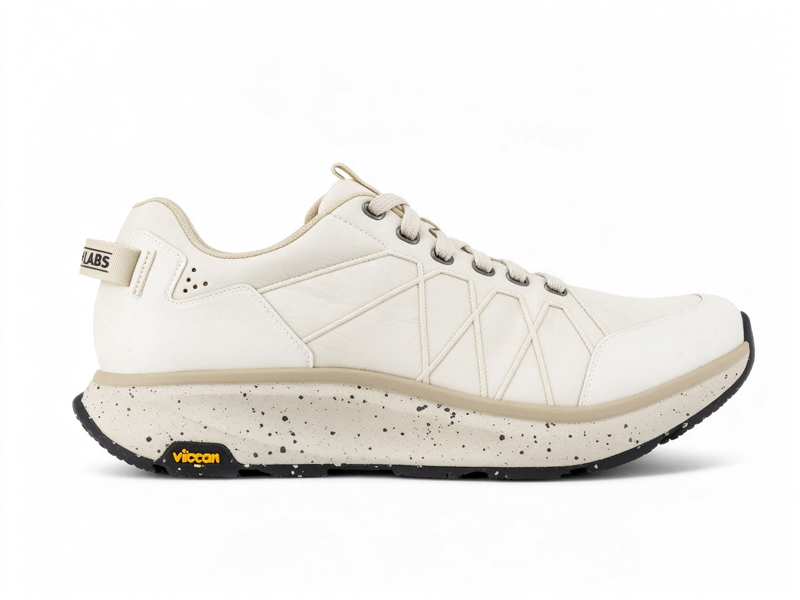
The brand has quietly grown beyond insoles. In 2022, Tread Labs launched sandals — the Albion and Covelo for men and women, priced around $110 to $120 — applying the same re-soleable, glueless construction and arch-support geometry to the category Paigen invented thirty years earlier, and reviewers from the Chaco faithful noticed immediately. Closed footwear followed, with the Dover shoe line rounding out a full closet solution. The expansion reads like a founder completing the sentence he started in Paonia: exceptional footwear can change lives, and the support group — as the company's slogan puts it — now covers insoles, sandals, and shoes alike.
Woburn, the Conservation Alliance, and HSA dollars
The operational texture is small-company-direct with institutional memory. Headquarters sits in Woburn, Massachusetts, with a phone line answered Monday through Friday, a store locator for specialty retail, and a wholesale program for run and outdoor shops. Tread Labs is a member of the Conservation Alliance — the outdoor industry's funding collective for protecting wild places — and the product is HSA and FSA eligible, the same pre-tax health-spending trick the recovery category has learned. Appreciation discounts serve military and first responders, an outlet sells refreshed products at reduced prices, and the refurbished line keeps returned units in circulation rather than in landfill. The values page reads like a Paonia transplant: quality first, specialty retail over big-box, and the conviction that a product you can repair is a product you keep.
Who should give their shoes a second life
The honest caveats are the standard ones for a semi-custom system sold at a distance. The right arch height matters enormously — the four-height system is the product's strength, but a buyer who guesses wrong will find firm plastic under a low arch, and the fit guides, though thorough, cannot replace the pedorthist's hands Paigen apprenticed under. The rigid arch feel is a deliberate choice that some runners never acclimate to, preferring the plush softness of foam-first insoles from bigger competitors. And the independent review infrastructure is thin: the social proof lives largely on the company's own storefront and in outdoor-press product comparisons, with no large third-party corpus to stress-test the service operation against. None of this diminishes the engineering; it simply means the two-part system rewards the buyer who reads the fit material first.
Tread Labs in 2026 is for a specific runner: the plantar-fasciitis veteran who has been told the next step is a five-hundred-dollar custom orthotic and wants to test the premise at a tenth of the price; the Chaco devotee who wants the same foot philosophy inside every shoe they own; the sustainability-minded buyer who counts the replaceable top cover as a feature, not a gimmick; and the performance runner curious whether carbon fiber belongs under the arch the way it belongs in the plate. For that buyer, Tread Labs offers a package with almost no analog — a founder who already proved the thesis in sandals, a structural component guaranteed for a million miles, a refurbishment program that practices the circularity it preaches, and a Boston-area workshop that answers its own phone. It is less suited to the buyer who wants marshmallow softness, big-brand retail ubiquity, or a review platform's safety net: the arch is firm, the distribution is specialty, and the proof is mostly the company's own. But the man who named a sandal with a fake French accent, sold the company it built, and came back to put orthotics in everyone's closet has already answered the skeptical question once. Zee One. Zee Next.