Drake general store proves a hotel gift shop can become a department store

Official homepage: https://www.drakegeneralstore.ca
Every boutique hotel dreams of a lobby shop that transcends its lobby. Toronto's Drake Hotel — the Queen West institution that essentially invented the neighbourhood's modern identity — pulled it off. In 2008 the hotel opened a general store fashioned after the classic hotel gift shop, sitting somewhere between flea market and curiosity cabinet, stocked with Canadiana, camp blankets, and locally made objects elevated by the hotel's design sensibility. Two decades on, it has been a national mini-chain, survived a retail contraction, and now runs one of the most complete general-store catalogues on Shopify in North America. This review measures the store across eight dimensions — from its hotel roots to the seventy-two-hour clause that generated this article's sharpest finding.
A Queen West hotel opens a gift shop in 2008
The format choice was deliberately unpretentious: a general store in the old sense, at Queen West and Beaconsfield, selling maple products, cottage kitsch, wool accessories, and locally made goods with the hotel's talent for making the familiar feel collectible. There was no expansion strategy and no investor narrative — just an extension of a cultural brand into objects. The front door became a local landmark that regulars learned to find by instinct, and the concept's identity settled into a coherent idea: Canadiana with a wink, executed with design-world rigor.
From hotel retail to a national mini-chain
For a decade the concept expanded like a franchise of charm. By 2017 the company operated five stores in Toronto plus locations in Ottawa and Vancouver, and had planted shop-in-shops inside Hudson's Bay — a reversal of the usual retail gravity, in which the boutique colonises the department store. The expansion rode a wave of national merchandising, most visibly a Canada 150 collection gathering Canadian-made goods from multiple designers under one banner. The wave receded just as quickly: by 2018, aggressive retail economics trimmed the fleet back to five Toronto stores. The format survived, anchored by the Queen West original and a Toronto warehouse that now handles all online fulfilment.
Apparel, home, gifts, pets, and food under one roof
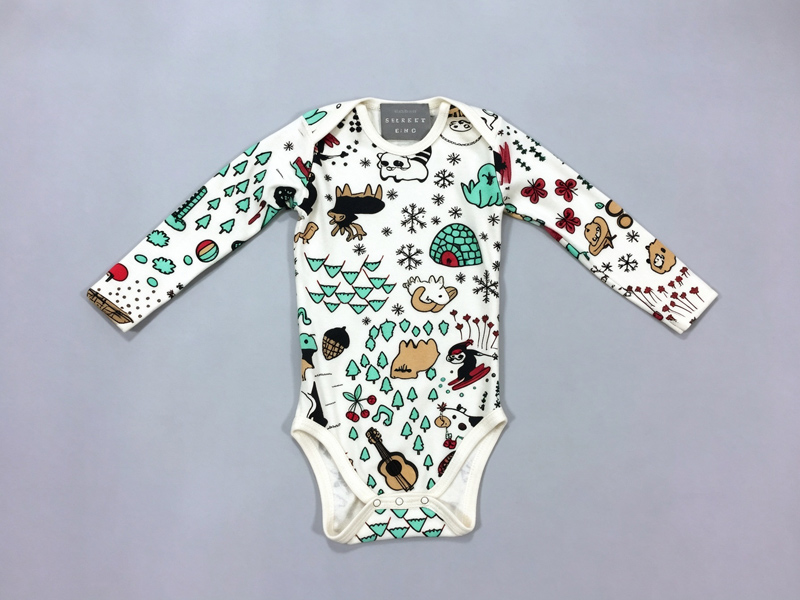
The online catalogue is the most genuinely departmental assortment examined in this series from a Canadian store. The navigation alone tells the story: women's and men's apparel with tops, bottoms, outerwear, footwear, toques and hats, bags, and jewellery; a full kids department spanning baby clothes, onesies and pajamas, plus books and toys; then the home side — kitchen and bar, office and stationery, bath and apothecary, home decor, furniture and lighting, storage and organization, blankets, candles and scents, snacks and treats, planters, and even an antiques section. Gift guides slice across all of it: Canadiana, foodie, self-care, pets, and a mischievous category called Not So General, sorted further by price point under $25 and under $100. Multi-brand buying includes names like Areaware, Da Ceramics, Doing Goods, and Indaba alongside a house line. If a department store is defined by breadth, this one qualifies on navigation alone.
Canadiana is the brand and the merchandise is the argument
The through-line is Canadiana, but the sophisticated kind. The store treats national identity as material — camp blankets, maple-infused pantry goods, art prints — while its buying digs into the emerging ceramics and object-design scenes. That combination, hotel gift-shop framing applied to serious curation, is what makes the store hard to categorize and easy to love: a candle shaped like a beaver sits two clicks from a genuinely considered stoneware collection. For gift-givers, this is the killer feature. The price-sorted guides turn the entire catalogue into a solved problem, which is presumably why the hotel group keeps funding it.
Flat rate shipping and the seventy two hour claims window
Shipping is flat-rate and honest about its limits. Orders process for fulfilment within four to seven business days from the Toronto warehouse — a window worth knowing before a birthday deadline — and then ship via Flashbox, Canada Post, or UPS. Canadian rates are flat by region: $15 to Ontario and Quebec, $20 to the Atlantic provinces and the prairies, $25 to Alberta, British Columbia, and the territories, with free shipping above $119 before tax. The United States is a flat $30 USD and the United Kingdom a flat $65 CAD. Two clauses matter more than the rates. Customs duties are explicitly not the store's problem. And any claim about an order — damage, error, anything — must be lodged within seventy-two hours of delivery, the tightest claims window documented in this review series. Orders are also subject to verification and approval before shipping, a fraud-control step that can add friction to first purchases.
Fifteen day returns, with some things you cannot send back
Returns are workable but traditional. The window is fifteen days from receipt, items must be unworn with tags attached, shipping is never refunded, and the customer pays return postage — tracked, sensibly. No in-person returns are accepted anywhere, and exchanges are not accommodated: the process is return, wait for a refund, and repurchase. Food, apothecary, undergarments, and swimwear are final sale — a list that matters more than usual here because food and apothecary are core categories rather than edge cases. Sale and promotional items come back as gift-card credit rather than money. Refunds to the original payment method take five to seven business days. The one generous exception is faulty or incorrect merchandise, which earns a prepaid return label. The shape of the policy is unmistakable: built for locals and gift-buyers, less concerned with the risk profile of distance shoppers.
The thin review record behind the famous name
Reputation is the thinnest layer of the brand. There is no meaningful Trustpilot presence for the store — the name collides with a British menswear brand that dominates the search results — and what third-party record does exist is a small-aggregator snapshot giving customer service five stars and the return policy four, from a sample too small to generalize from. The store's fame lives elsewhere: in press coverage, in the hotel's cultural halo, and in local foot traffic. That halo is real, but it means an online buyer has almost no community documentation to consult — no corpus of delivery-time reports, refund timelines, or service disputes. The store runs on institutional trust rather than verified experience, which is a different kind of assurance entirely.
Who this general store is actually for
The Drake General Store is for a specific buyer, and it knows exactly who. Canadians outfitting a cottage or sourcing a birthday gift get flat-rate simplicity, free shipping above $119, and an assortment no mall in the country assembles under one roof. Fans of the hotel brand get the lobby, shipped. International shoppers get a charming catalogue with a $30 flat rate to the US and a duty caveat, and collectors of Canadian design objects get a legitimate primary source. What nobody gets is a modern risk profile: no in-person returns, a fifteen-day window, seventy-two-hour claims, and a review record too thin to verify any of it. For its home market, that trade is invisible because the brand is everywhere. For everyone else, it is a trade worth pricing in.