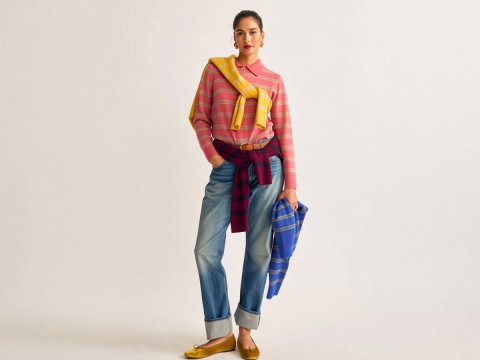
Is kotn the most ethical t-shirt you can buy online?
Official homepage: https://kotn.com
In 2015, three friends living in New York looked into their T-shirt drawers and found only two options: cheap tees that lasted three washes and designer tees they saved for special occasions. They quit their jobs and launched Kotn — named for Egyptian cotton — with three shirts in three cuts. One founder then flew to Egypt and lived with a cotton-farming family for six months, and the T-shirt company became something the apparel industry had never built: a direct-trade reconstruction of a dying cotton economy, with the schools to prove it. A decade in, Kotn works with more than two thousand farming families, has built fifteen schools in the Nile Delta, carries the fourth-highest B Impact Score of any apparel brand in North America, and serves Egyptian brunch inside one of its stores. This review examines the storefront dimension by dimension.
Three friends and a drawer of bad T-shirts
The founding problem was domestic in the most literal sense. Working in New York in different industries, Benjamin Sehl, Mackenzie Yeates, and Rami Helali discovered they shared a uniform — the T-shirt — and shared its failure modes: their closets contained not-so-great tees and the wear-only-occasionally kind. The gap between disposable and precious was the entire business plan. In 2015 they launched Kotn in Toronto with exactly three shirts, in black, white, and grey, in three cuts — a minimum viable wardrobe.
The three founders' paths explain the company's later shape. Helali, the Canadian-Egyptian chief executive, spent grades three through five in Cairo while his civil-engineer father helped modernize the country's infrastructure, watched two uncles build a tourism business near Lake Nasser, and found his own light-bulb moment in an Ivey Business School social-entrepreneurship class — case studies of companies that made money by doing verifiable good. When the trio needed to source their perfect cotton, his heritage pointed at Egypt, and his curiosity did the rest.
One dinner, six months in the Delta
The trip that defined the company was not a sourcing mission. Helali traveled the Nile Delta with questions rather than contracts — wandering between villages, asking locals about cotton, the country's most famous export — until a farmer invited him to dinner. The meal became six months: working the fields by day, listening to the family's stories by night, learning the industry from the farm level up. What he found was an economy in free fall. Egyptian cotton production had declined roughly ninety percent between 2001 and 2015 after the government withdrew support, and small family-run farms were switching to rice and wheat because they lacked funds, logistics, and support systems.
His conclusion became the company's founding doctrine: if Kotn was going to exist, it could not be built the old way — buying raw materials and leaving. It had to be about building a shared future; fashion had to be as much about people and dignity as about product. The six months in the Delta are why Kotn's storefront sells traceability before it sells softness.

Direct trade as reconstruction of a dying crop
The supply-chain model that resulted bypasses the traditional factory-first structure entirely. Kotn buys directly from the farming communities themselves — more than 2,390 smallholder family farms across the Nile Delta and Faiyum regions — and works directly with the yarn mills, dye houses, and cut-and-sew facilities downstream, keeping the entire chain within roughly four hundred kilometers to minimize transport emissions. The first interventions were agricultural: subsidies so farmers could buy seeds and fertilizer, keeping operations alive when the market would not. Fair prices above the commodity rate and long-term purchase commitments came next — the economics of staying, not the optics of visiting.
The doctrine's test is duration: a decade of repeat growing seasons, not a launch-season photo essay. Kotn's published farmer relationships function the way the cookware brands' factory certifications do in this site's other categories — as the kind of proof that can only be accumulated slowly and cannot be purchased wholesale.
The ABCs Project puts schools before sales
The education program began with the founders' second discovery in the Delta: children sitting around the farms, some working, because the nearest school was an hour's drive away and few families owned cars. Kotn's response was the ABCs Project, launched in 2016, which has since built more than fifteen schools in rural Egypt with a student body that runs approximately eighty-eight percent girls — and funded many more through a signature retail inversion: since 2017, the company has skipped Black Friday sales and donated one hundred percent of that weekend's proceeds to construction, with artist-designed charity tees supporting the annual push. The stated goal is fifty-three schools.
The project's logic is the brand's in miniature: education is the multiplier that lets a cotton community outgrow cotton — the same long-game reasoning the founder absorbed watching his uncles build a tourism economy around ancient temples, and the reason the community impact, not the fabric, leads every interview the company gives.
Farm-to-closet traceability as the storefront's spine
The website operationalizes the supply chain: a traceability feature lets a buyer follow the cotton from named farms to the finished garment, and the company's materials pages publish what most brands treat as secrets — fiber origins, dye chemistry, facility geography. The third-party architecture is unusually deep for a company its size: Kotn is a certified B Corporation, was voted Best for the World in the Community category, and holds the fourth-highest B Impact Score of apparel brands in North America. Fabrics carry OEKO-TEX certification for non-toxic dyes. All three founders made the Forbes 30 Under 30 list in 2018, and the company took the Canadian Arts and Fashion Awards' Sustainability prize — the institutional validation stack that lets a T-shirt brand charge for its paperwork rather than its logo.
In a category — basics — where the product itself is nearly indistinguishable across dozens of competitors, this stack is the differentiation: the traceability page is the product page.

Beyond cotton: the fiber ledger widens
The catalog that began with three tees now spans men's, women's, and kids' lines plus a growing home assortment, and the fiber ledger has widened with it: Egyptian long-staple cotton remains the core, joined by European flax linen, ECOTEC cotton spun from production waste, closed-loop lyocell, and temperature-regulating merino. The denim program illustrates the doctrine in miniature — recycled-cotton blends dyed with certified-safe indigo and finished with power washing in place of the toxic sandblasting and acid treatments conventional denim uses. An underwear line extended the natural-fiber argument to the one category where synthetics dominate. Prices sit in the accessible-premium band — roughly Zara-to-Aritzia territory per customers quoted in coverage — which is the entire founding thesis: quality worth buying in multiples, without the markup.
The honest asterisk is cotton itself: a thirsty fiber in a water-stressed region, a fact the company addresses with efficient processing but cannot erase — the standing environmental counterweight to every social-impact claim.
The Egyptian cafe inside the store
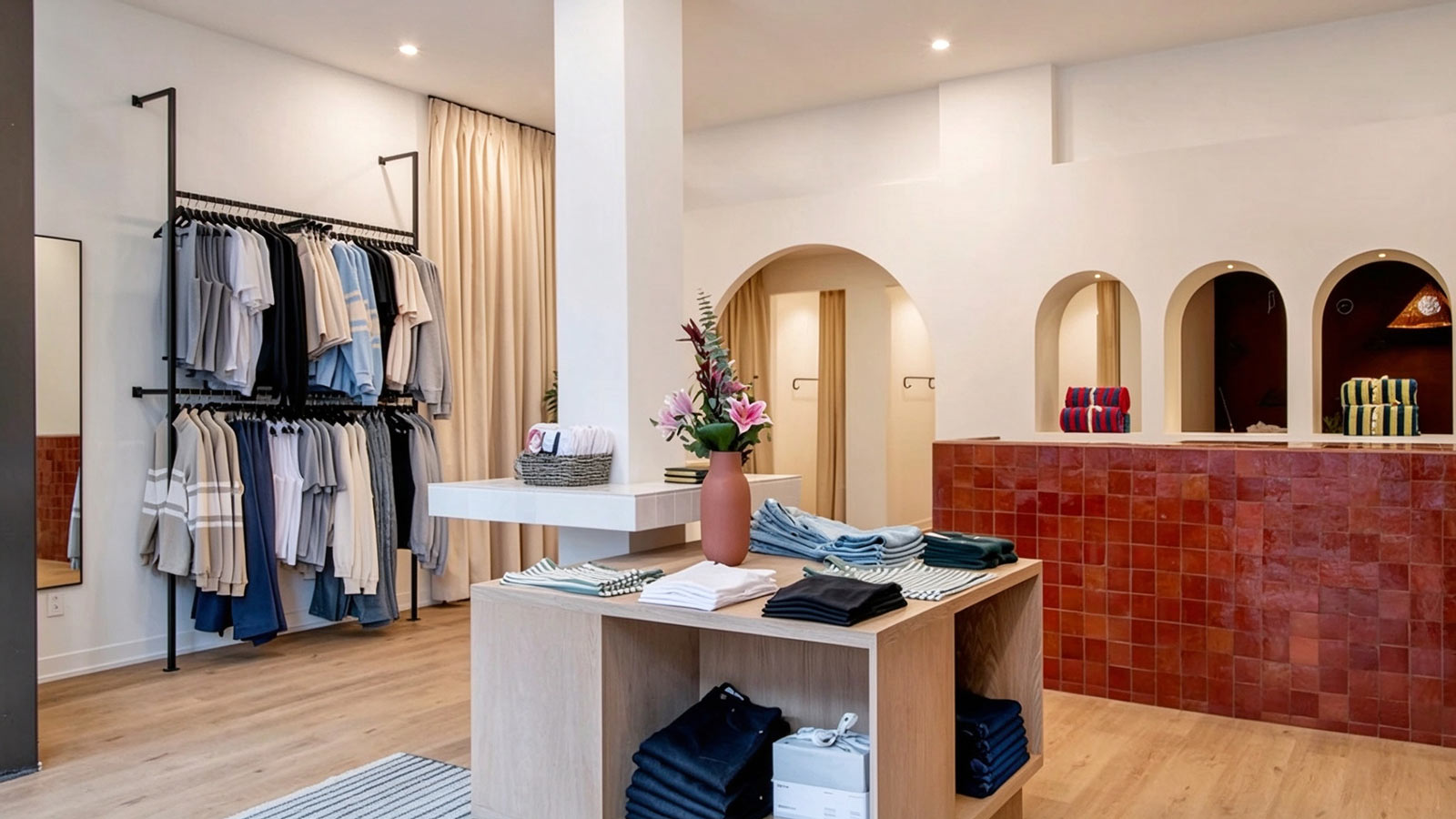
The retail program extends the identity into physical space with unusual wit. The Queen Street West shop opened in 2017 with the logic that cotton must be touched; the Leslieville store went further and installed Maha's Brunch — a beloved Egyptian family restaurant — inside the shop, so customers buy Egyptian cotton and eat Egyptian food under the same roof, a concept the co-founders described as deeply on-brand for a company whose production and CEO both trace to Egypt. Stores now span Toronto, Montreal, Calgary, Vancouver, Brooklyn, and Los Angeles, with London and Middle East ambitions announced; the team ran roughly seventy people as of the most recent profiles — a modest headcount for the footprint, consistent with the slow-build doctrine.
The store-as-community thesis — shops as neighborhood anchors rather than conversion funnels — mirrors the farm thesis: permanence over extraction, presence over transaction.
The verdict for the conscious basics wardrobe
Kotn's storefront is the apparel industry's proof-of-concept that a basics brand can be built on the supply chain rather than on top of it: three shirts, six months in the Delta, twenty-three hundred farming families, fifteen schools where girls outnumber boys four to one, a B Corp score that embarrasses companies ten times its size, and a brunch counter inside the store to make the whole story edible. The cons are the cons of the model: basics are the most contested category in fashion, the price band invites comparisons with Uniqlo and Muji that traceability alone must win, cotton's water footprint shadows every social claim, and a supply chain anchored in Egypt carries geopolitical risk no brand page can edit out.
Buy here if your wardrobe runs on staples and your conscience runs on receipts, if a traceable T-shirt beats a cheap one in your personal ledger, if you will pay Aritzia prices for Zara-simple clothes because the difference funds a school an hour's drive from the farm, and if a brand that skipped Black Friday sales to build classrooms matches your idea of what commerce is for. Buy the bulk basics retailers if price per wear is the only column. For the buyer building a conscious basics wardrobe one verifiable shirt at a time, this decade-old Toronto storefront remains the category's most documented answer — and its most patient.