A bathtub of coffee-stained underwear, ten minutes, and a $5 billion second skin
Official homepage: https://skims.com
Kim Kardashian spent fifteen years hacking shapewear before she built a company around the hacks — dyeing undergarments darker in bathtubs of coffee and tea, cutting pieces up so they would work under dresses with slits, searching for shades the industry refused to make. When she finally launched that company in 2019 with operators Jens and Emma Grede, it sold out in ten minutes; six years later it is on track for a billion dollars in annual sales, carries a five-billion-dollar valuation, dresses Team USA, and has traded its Shopify-native origins for a flagship on Fifth Avenue. This review examines the storefront of the century's most instructive celebrity-brand case: the origin hacks, the six-week rebrand, the partnership stack, and the honest texture of a business whose largest asset walks around in it.
Fifteen years of dying underwear in the bath
The origin story Kardashian tells on her own launch announcement is gloriously unglamorous: a fifteen-year problem, solved by hand. She wanted shapewear that matched her skin tone and her life — slit dresses, pregnancy, long shooting days — and the industry's beige one-shade answer forced improvisation: steeping undergarments in coffee and tea to darken them, slicing pieces into configurations the designers had not imagined, effectively prototyping the product she would eventually trademark. The solution short, a one-legged bike short designed for high-slit garments, was born from this period — a product the category's incumbents had never thought to make because they were designing for mannequins, not wardrobes.
The insight generalizes: the first collection was not a fashion statement but a bug report, and the brand's mission language — solutions for every body — is a direct quote from the problem list. Kardashian's launch post called it fifteen years in the making, and the number reads less as marketing than as evidence.
Kimono, Kyoto, and the six-week rebrand
The launch nearly detonated before it shipped. Announced in June 2019 under the name Kimono Intimates, the brand drew immediate backlash from Japanese cultural commentators — kimono are government-recognized cultural artifacts, not a pun available for trademark — and the criticism reached the mayor of Kyoto, who wrote formally in protest. What happened next is the case-study move: within weeks, Kardashian apologized, renamed the brand, and explained the new logic in a single sentence — the pieces skim the skin, so the brand is Skims. The relaunch shipped September 10, 2019, and the first collection did two million dollars in minutes, selling out entirely inside ten.
The rebrand speed matters to the reviewer's ledger for what it telegraphed: a celebrity founder with adult supervision. The operators behind the rename were Jens and Emma Grede — the couple who had already built Khloé Kardashian's Good American — and their presence is the difference between a licensing deal and the company Skims became.
The Grede operating system for celebrity brands
The Grede partnership is the store's hidden architecture. Jens Grede, the chief executive, co-founded FRAME denim in 2012 after running the Saturday Group agency; Emma Grede, the chief creative officer, built Good American on a size-inclusivity thesis the year before Skims. Together through their holding company they operate what amounts to a celebrity-brand factory — the product, the supply chain, the retail math — with the celebrity supplying the creative brief and the audience. Forbes' ownership reporting has Kim Kardashian at roughly thirty-five percent, the Gredes near fourteen, and the founding trio in majority control.
The system's output in Skims' case is a company that behaved unlike a celebrity venture: it raised institutional capital in disciplined tranches — crossing a billion-dollar valuation at Series A — and the numbers compounded rather than spiked and faded the way licensed celebrity brands typically do.
Nine skin tones and the solution short
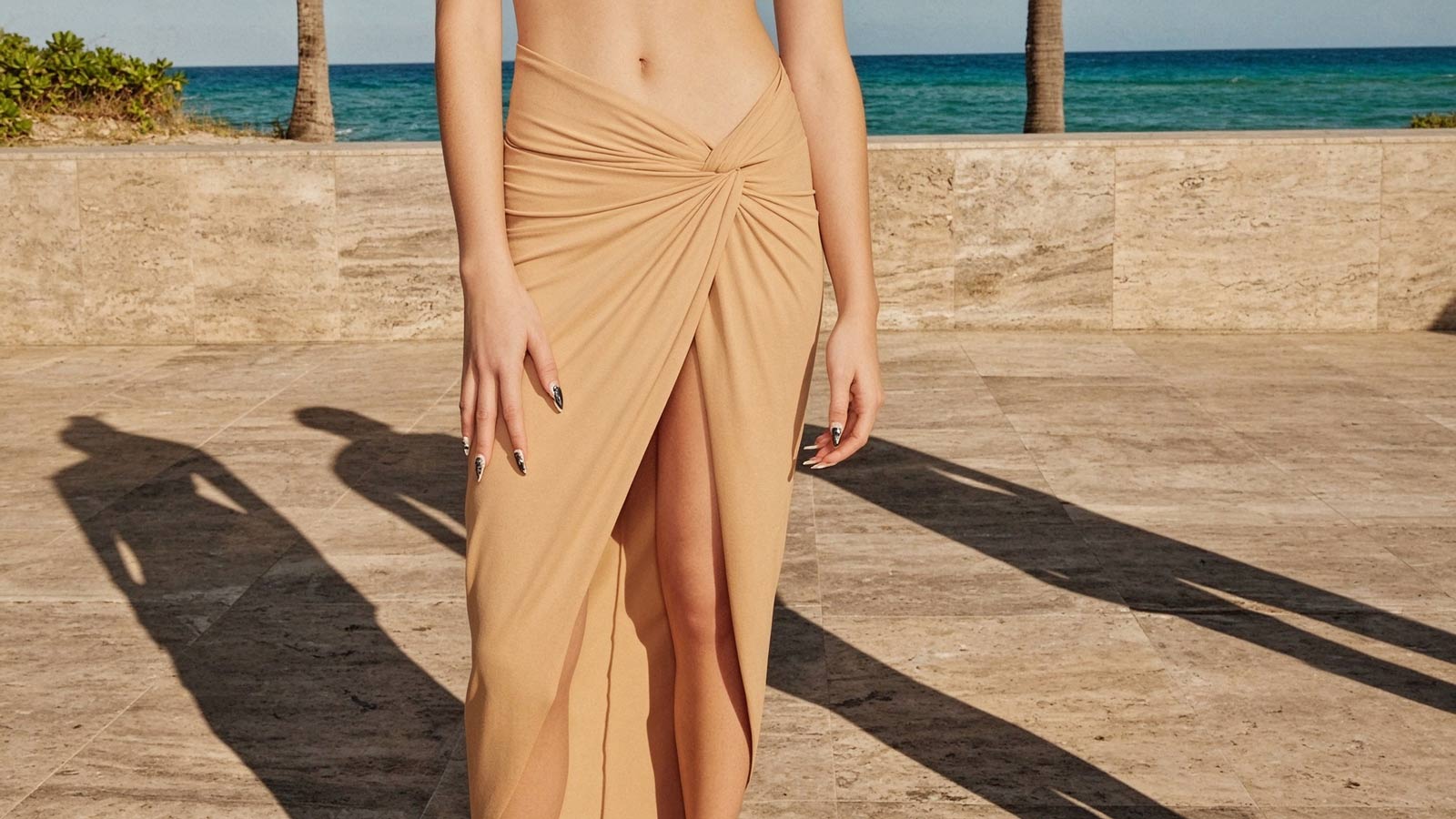
The product spec deserves its own paragraph because it is the business model. The founding range offered nine skin tones where the industry offered beige; sizes ran XXS to 4XL where incumbents stopped at XL; and the hero pieces were engineered answers to specific wardrobe problems — the solution short for slits, bodysuits with bra integration, underwear engineered to disappear. The mission has widened since: an Adaptive Collection for customers with limited mobility, sized up to 4X, addressing an accessibility gap the fashion press had long documented, and a menswear line launched with Neymar Jr. as its face.
Shopify's own enterprise blog uses Skims as a model fashion storefront — cross-selling product pages that complete the look, sizing guidance, installments, and a mobile experience engineered for the social audience that arrives in waves. The product page, in other words, carries as much engineering as the product.
Team USA, the NBA, and Nike
The third-party validation stack is the most aggressive in this category. Skims became the official underwear and loungewear supplier for Team USA at the Tokyo Olympics — outfitting all 626 American women athletes — then the official underwear partner of the NBA, WNBA, and USA Basketball, then Nike's collaborator on NikeSkims, a women's activewear line launched in 2025. Each partnership borrows legitimacy the brand's celebrity could not buy: athletic organizations do not sign decade deals with vanity labels. The comparative arithmetic is instructive — Spanx, which invented the category in 2000 and was valued at $1.2 billion when Blackstone bought its majority, is now worth less than a quarter of Skims' five-billion-dollar mark.
The partnership stack doubles as distribution strategy: every jersey partnership puts the product on bodies the audience already watches, converting fandom into fit-checks at a scale no advertising budget replicates.

From Shopify-native to Fifth Avenue flagship
The growth arithmetic: roughly $145 million in 2020 revenue, $500 million in 2022, $750 million and profitability in 2023, and a trajectory past $1 billion in net sales for 2025. The November 2025 round — $225 million led by Goldman Sachs Alternatives with BDT & MSD participating — repriced the company at $5 billion and earmarked the capital for the stated ambition of becoming a predominantly physical business. The proof-of-concept opened in December 2024: a Fifth Avenue flagship in a former Versace space, designed by Rafael de Cárdenas, following pop-ups and wholesale placements at Nordstrom and Bergdorf Goodman. The leadership talks about store density in Apple and Nike terms — a Skims store anywhere you would find one of theirs — with London and Dubai already on the map and an EMEA president hired in 2025.
The physical pivot is the storefront review's central irony: the company Shopify's blog cites as the model of digital-native fashion now plans to be, in its own words, predominantly physical — and the website that built the brand becomes one channel among twenty stores and counting.
The honest texture of a celebrity-key empire
Three honest cautions belong in the ledger. First, celebrity-key risk: the brand's chief creative asset is a person whose audience, controversies, and attention cycles are not controllable — the same engine that built the company can dent it, and succession is a question the Gredes' operating system will eventually have to answer publicly. Second, sustainability opacity: for a company of this scale, the public materials footprint is thin — recycled-content claims without the certification walls of the supply-chain brands reviewed in this category. Third, sprawl: shapewear to loungewear to swim to menswear to activewear to beauty — the March 2025 acquisition of the founder's beauty brand signals category ambition that can dilute the fit-first focus that made the hero products famous.
None of these are fatal; all three are structural, and a buyer who prices them accurately can buy with clear eyes. The texture of scale is that every strength — distribution, validation, capital — arrives with its matching constraint.
The verdict for the fit-first wardrobe buyer
Skims' storefront is the celebrity-brand case study that business schools now teach and incumbents now study: a fifteen-year bathtub prototype, a six-week rebrand that turned a cultural crisis into a naming masterstroke, a celebrity-founder-plus-operator partnership that behaved like a real company from day one, and a partnership stack — Team USA, the NBA, Nike — that converted fame into institutional legitimacy. The cons are the cons of that very scale: key-person exposure, a thin public sustainability ledger, and a category sprawl that keeps widening.
Buy here if fit is your religion — if nine skin tones and XXS-to-5X sizing and adaptive designs solve problems the incumbents never addressed, if the engineering of the product page matches the engineering of the garment, and if you are comfortable holding a brand whose largest asset is a person rather than a patent. Buy Spanx if two decades of durability data and founder-owned governance are your language of trust, or the bulk basics retailers if price rules. For the buyer who wants the industry's most-engineered second skin — and accepts the celebrity gravity that comes with it — this storefront remains the century's most instructive answer to the question of what fame is worth when it ships product.